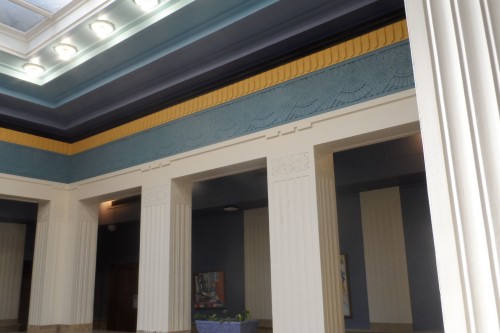
The Chesterfield

The Chesterfield 6


Architect: Muhlenburg Bros. with Noland & Baskervill
Dates: 1903
Address: 900 West Franklin

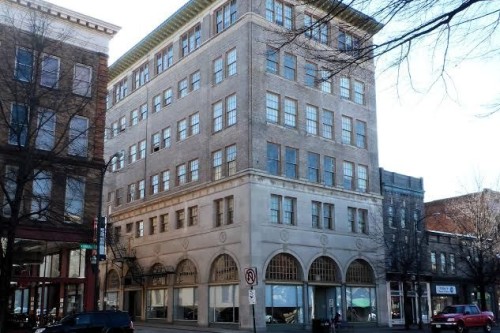
The Chesterfield Apartments opened in November 1903 as Richmond’s first high-rise apartment building. It was also the first building of such a large scale on the prosperous blocks of West Franklin Street near Monroe Park. The building holds a cherished place in Richmond’s collective memory as the home of the Chesterfield Tea Room. At the time of it’s closing in 1988 it was the city’s oldest continuously operating dining establishment.

Seven stories sit atop an english basement that now contains a book store. The former tea room still houses a restaurant. Following the building up from the ground, a traditional classical order is observed. The lightly rusticated stone base transitions into a dark brick and culminates in a novel stuccoed cornice. Bands of wrought iron balconies and bay windows emphasize verticality, a feature that becomes all the more pronounced when compared with the 3 story structures surrounding it.

The Chesterfield is an indispensable element in the West Franklin Street historic district, an area characterized by luxurious town-homes, most of which have now been converted into offices or apartment buildings. The tower’s juxtaposition in scale and introduction of a retail element bring vitality and intrigue to the pedestrian experience. The building is also a contributing structure in what is colloquially known as the “Monroe Park Skyline,” an assemblage of mid and high-rise buildings surrounding Richmond’s Monroe Park.

D.OK.

Morson’s Row

Morson's Row 1


Architect: Albert Lybrock
Date: 1853
Address: 219-223 Governor Street

Morson’s Row is the most handsome assemblage of attached houses in Richmond. These three former dwellings in the Italianate style establish an axial relationship at the eastern end of the pedestrian mall that was once Capitol Street while gently stepping down to reflect the slope of Governor Street. Morson’s Row is grander than other, upscale, mid-19th century dwellings in Richmond– more akin to houses one would find in urban Baltimore or Boston. They were designed as speculative housing by James Marion Morson, a lawyer who practiced in the city and in Goochland County.

Architect Albert Lybrock, born and educated in Germany, came to Richmond in 1852 via New York City, to oversee his design for the United States Customs House which stretched between Main and Bank streets. He would become the most important architect working in Richmond in the prosperous decade prior to the Civil War after landing a number of prestigious commissions here. In addition to his Italianate customs building, his commissions included major interior renovations at the Capitol (1858) and the unique, cast iron Gothic reliquary in Hollywood Cemetery that contains the sarcophagus of James Monroe, the fifth United States president (1859). In the late 1870s Lybrock designed the Miller School in Albemarle County.

While the three townhouses comprising Morson’s Row were built as speculative housing, there was no stinting on detail. Each house is three stories high and rises from an English basement. The most glorious feature of each of the three houses is its curved bow front.  Each of these bays rises to a partial entablature containing crisply defined dentils and a generous cornice supported by handsome brackets. The basement is faced with granite ashlar and the upper exterior surfaces of the façade are brick covered in stucco.

This trio of houses creates an almost musical rhythm as it steps down (or ascends) Governor Street. And the softly-rounded lines of bow fronts are picked up by the curved configuration of the sun porch on the rear of the adjacent Memorial Hospital (now part of the Virginia Department of Highways complex) just up the hill.

Architect Lybrock, himself a slave owner, apparently became an active player in the life of his adopted region including his financial support of a regiment of local Germans in the Confederate army.

Morson’s Row, now owned by the Commonwealth of Virginia and an important part of the Capitol Square district, has long been empty and awaits a new use. Miraculously, its interiors still contain much of their original detailing such as moldings and marble mantels.


E.S.

Architects of Richmond: William Churchill Noland

Davis Monument


Article and photographs by Robert P. Winthrop.

As part of a continuing series we are featuring an essay from a guest writer, Robert Winthrop. Winthrop is partner at Winthrop, Jenkins, and Associates, a Virginia based architecture firm specializing in historic renovation. Historic buildings have also been his focus in numerous writings and lectures. As author of The Architecture of Jackson Ward, Cast and Wrought: The Architectural Metalwork of Downtown Richmond, Virginia, and Architecture in Downtown Richmond, Winthrop has established himself as an authority on the city’s architectural history.

Winthrop has adapted these essays from a lecture series at the Virginia Historical Society. The series, entitled “Sophisticates and Wild Men,” followed the interaction between the exuberant Victorian architects and the sober classicists at the turn of the twentieth century.

*   *   *

William C. Noland (1865-1951), the son of Callender St. George Noland and Mary Edmonds Berkeley, was the last of ten children, five of whom did not survive infancy. Through his mother he was related to the Carters, Spotswoods and Wormleys.  Born on June 4, 1865, two months after the end of the Civil War, his family retained its property, but not its wealth. 

In 1871 the family moved to Ashland so the children could be educated.  His father died in 1878 when William was 13.  William went to a private school in Richmond and then to Episcopal High School of Virginia in Alexandria.  He graduated in 1882 and then went to work in an architect’s office in Philadelphia. He was 17 years old.

Noland was deeply attached to his family and their correspondence survives.  While many persons of his social status went to a University, Noland’s family could not afford it.  His family had relations in Philadelphia, explaining the reason for the move to the prosperous Northern city.

Philadelphia was a thriving industrial city.  There he worked first for Theophilus P. Chandler.  While Chandler was known for Gothic inspired buildings, he was educated at the École des Beaux-Arts in Paris and had been in the Atelier of Vaudremer, one of the leading lights of mid-century French architecture.  Chandler’s wife was a member of the DuPont family.  This connection was helpful.

Chandler was the founder and head of the University of Pennsylvania’s Department of Architecture.   We do not know if Chandler operated his office in the manner of a Parisian atelier, but his interest in educating men for the profession could only have been good for Noland.

In 1886 Noland left Chandler and went to work for the young firm, Cope & Stewardson.  Both Cope and Stewardson had studied at the Cole.  They would become best known as creators of the Collegiate Gothic style. The most important of their buildings, the work at the University of Pennsylvania and Princeton were done after Noland left the firm. Noland could have worked at the firm’s earlier work at Bryn Mawr College, Radnor and Denbigh Halls. Noland seemed to have done well at the firm and may even have traveled in Europe with Cope.

In Philadelphia Noland joined the T-Square Club. It was a social and educational club for young architects.  The Club had competitions for architects modeled on the École, and thus gave young architects without formal architectural education a chance to gain experience.

Noland next looked for work in New York but was unable to get a position with a top of the line firm.  He had the misfortune of looking for a job when a university education and a stint at the École des Beaux-Arts in Paris were desirable.  Noland had moved out of his old boy network. He was a poor son of a FFV.

Noland returned to Virginia in 1891, first to Roanoke and then moving to Richmond in 1893.  In 1897 he formed a partnership with Henry Baskervill.  Henry Baskervill was a native Virginian and Cornell University graduate with a degree in electrical engineering.  When he established his own firm, his first project was the restoration of the White House of the Confederacy.  He became known as an architect rather than as an engineer.

Fortunately for Noland, Baskervill had a knack for finding talented partners.  First with William Noland, and later with Alfred Garey Lambert, Baskervill found two gifted and skilled men who were able to produce high quality designs for his upper class clientele.

The Baskervill firm did little developer or commercial work, unlike the two other early, large Richmond firms, Carneal & Johnston and Marcellus Wright.  Baskervill tended to do one-of-a-kind landmark buildings for socially important clients. Noland’s designs tended to be sophisticated, and well suited for style conscious clients.  It is clear he was up to date in his architectural taste.  The Baskervill firm later developed a specialty in medical buildings due to their long term relationship with the Medical College of Virginia. This became very important in the depression and post war periods.

Noland was also lucky fortunate to be designing in the early twentieth century Richmond.  The city was booming and growing rapidly. Several of his building had particularly visible sites in new neighborhoods.  Stylish Franklin Street provided the sites of Second Baptist Church, Temple Beth Ahabah and St. James Episcopal Church.  Beth Ahabah closes the vista down Ryland Street.  Today Ryland Street is a minor street.  In 1906 it was the entrance to Richmond College.  The handsome home to Rabbi Calish’s prosperous Jewish congregation must have caused some smiles as it framed the entrance to the Baptist School.

St James’ steeple in on axis with the east bound lane of Monument Avenue. His monument to Jefferson Davis is the architectural focus of the central portion of Monument Avenue and Davis Avenue. Noland took full advantage of the scenic opportunity.

Joining these distinguished institutional buildings on Franklin were the impressive homes of Frederic Scott, Eppa Hunton and other local luminaries.  The Scott Mansion was one of the few Richmond houses that could Rival Major Ginter’s home of a decade later.  Scott’s house came complete with a charming carriage house.  A similar Noland designed house appeared at Major Dooley’s Maymont estate.    At Maymont Noland also designed the stunning Italian gardens with their spectacular waterfall.

Noland designed summer houses for both Major Dooley and Frederic Scott on Afton Mountain. Dooley’s house, Swananoah, is a version of the Villa Medici outside of Rome.  The Villa Medici was the model for the Jefferson Hotel. Scott’s house, Royal Orchard, is a medieval styled castle.

Noland & Baskervill was also one of the co-architects for the expansion of Jefferson’s Capitol.  Part of a team consisting of John Kevan Peebles from Norfolk and Fry & Chesterman from Lynchburg, the roles of the individual architects in the design is not clear.  Noland’s Jefferson Davis Monument dates from the same time.

These building were sophisticated essays in stylish early 20th century classicism, and are largely without Victorian leftovers.  It is easy to recognize the influence of Jeffersonian Classicism in many of these buildings.  Jefferson used the ancient Roman temple, the Maison Carrée, as the model for his Virginia State Capitol.  Noland used the same model, but he made it closer in appearance to the Roman Temple. Noland used the Corinthian order as the French temple.  The limited skills of American stone carvers led Jefferson to use the simpler Ionic order, rendered in stucco.

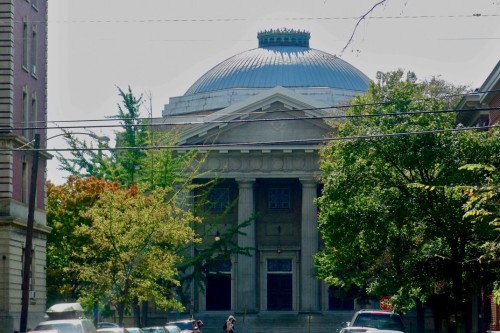
It is easy to see that Beth Ahabah is inspired by Robert Mills’ Monument Church of 1814.  Both are octagonal domed buildings in the Doric order.  Noland’s building is less daring and imaginative than the Mills’ structure, but the temple is sophisticated and beautifully designed. A year later, Noland designed the terminal for the Richmond & Chesapeake Bay Railway at Laurel and Broad Street.  It closed the vista toward Broad on Laurel Street.

The firm was the associate architect of the Chesterfield Apartment house, the oldest high rise apartment in the city. They designed or altered several houses and an apartment on West Franklin in addition to the institutional work. Most of the work was in the new Colonial Revival mode.  Curiously they seemed to have had a minor specialty in converting genuine ante-bellum houses into Colonial Revival mansions. They stripped the Italianate Ritter-Hitchcock house of its Victorian detail and did the same to the Kent-Valentine house.  By 1900 the image of the ante-bellum house was classical rather than Victorian.  The renovations converted the actual pre-war building into the new stereotypical images of a Southern mansion.  Fortunately, Noland’s skilled and sophisticated renovations are quality works in their own right.  They well illustrate the change in attitudes about the South.

The YWCA Fifth Street is a handsome essay in the Italianate mode. The Dooley Hospital that once sat next to the Egyptian building was similar stylistically.  Across  the street from the YMCA, the firm designed the Virginia, a combination office building, apartment  house and the chapel of Second Presbyterian Church.  The Virginia was what we would now call a mixed use building, almost a century head of its time. The chapel is a charming and beautiful space. It is simple, elegant and just Gothic enough.

Baskervill built his own house at the corner of the Boulevard and Byrd Park in the Italian style. This house almost rivals the Scott house in size and imposing character. It is a sophisticated Italian style villa with a beautiful, arcaded entrance. One assumes Baskervill played a role in the design, but the fine detailing is typical of Noland.

The later work of Baskervill & Lambert will be covered in another essay.  Much of the early biographical information was uncovered by Christopher Novelli in his fine Master’s thesis on Noland.

Robert Winthrop

Virginia Museum of Fine Arts

VMFA 2


Architects: Peebles and Ferguson Architects, Norfolk (1936); Theater Wing, Merrill C. Lee Architects, Richmond (1954); South Wing, Baskervill & Son Architects, Richmond (1970); North Wing, Warren Hardwicke Associates, Richmond, and Sculpture Garden, Lawrence Halprin Associates, San Francisco, landscape architect (1976), both demolished; Lewis Mellon Wing, Hardy Holzman Pfeiffer Associates, New York City (1985); Frances G. McGlothlin Wing, Rick Mather Architects, London (2010) with associate SMBW Architects, Richmond.   

Dates: 1936-2010

Address: 200 North Boulevard

The Virginia Museum of Fine Arts was founded and is supported by the Commonwealth of Virginia. Its 14 acre campus, defined by Boulevard, Grove Avenue, Shepherd Street and the grounds of the Virginia Historical Society, is situated on the former Robert E. Lee Camp (for many years it was a retirement community for Confederate veterans and their female relatives). In 1936, during the Great Depression and with construction funding from the Federal Works Administration, the museum opened its doors to a structure elegantly oriented to Boulevard. Peebles & Ferguson Architects took its cues for the building’s design from a Late Renaissance addition to Hampton Court in London by Christopher Wren. The museum’s galleries were located on the upper level with offices and support facilities situated on the ground floor.

Additions were made in 1954 (for additional galleries and a theater) and in 1970 (for galleries). These continued the architectural spirit of the original, center block.

In 1976 another wing, by Warren Hardwicke Associates, and a walled sculpture garden designed by Lawrence Halprin Associates, were added to museum’s north end. These broke with the Wren-inspired classicism. The addition’s curved brick walls recalled the Johnson Wax Company building in Racine, Wis. by Frank Lloyd Wright.

In 1984 the architectural direction of the museum shifted again with construction of the Lewis Mellon Wing, built specifically to house the sizable collections of Sydney and Frances Lewis of Richmond and Paul Mellon of Upperville, Va. Architect Malcolm Holzman, in designing the building, broke with the museum’s exterior red brick, Flemish bond surfaces and introduced Indiana limestone. The wing is a witty tour de force architecturally that combines modernism with such refined classical elements as the Tuscan order (at the entablature) and muscular blocks of rusticated stone at the ground level that recall Henry Hobson Richardson’s Allegheny Courthouse in Pittsburgh.

In 2010 the museum reoriented dramatically how visitors approach the museum by demolishing the former North Wing and sculpture garden and building the Frances G. McGlothlin Wing which is approached by a new motor court. Designed by Rick Mather Architects, the building is unapologetically modernistic in every way: It combines exterior surfaces of Indiana marble with large, deftly handled expanses of sheet glass.

Key to the spirit and success aesthetically of the McGlothlin Wing is how the building seamlessly connects with the museum grounds through large window openings. Happily, a former surface parking lot has been replaced by an expanse of lawn and vehicles are now relegated to a 600 space garage that is largely hidden beneath a dramatically sloping and handsomely-landscaped sculpture garden.

E.S.

Architects of Richmond: Claude K. Howell

November Theater

Article and photographs by Robert P. Winthrop.

As part of a continuing series we are featuring an essay from a guest writer, Robert Winthrop. Winthrop is partner at Winthrop, Jenkins, and Associates, a Virginia based architecture firm specializing in historic renovation. Historic buildings have also been his focus in numerous writings and lectures. As author of The Architecture of Jackson Ward, Cast and Wrought: The Architectural Metalwork of Downtown Richmond, Virginia, and Architecture in Downtown Richmond, Winthrop has established himself as an authority on the city’s architectural history.

Winthrop has adapted these essays from a lecture series at the Virginia Historical Society. The series, entitled “Sophisticates and Wild Men,” followed the interaction between the exuberant Victorian architects and the sober classicists at the turn of the twentieth century.

*   *   *

C. K. Howell (November 27, 1869 – ?) had an active architectural practice in Richmond between 1906 and the early twenties.  He moved regularly and while he had a large practice throughout the South specializing in theaters, his work in Richmond included a number of impressive houses on Monument Avenue as well as the Empire, Lyric and National Theaters.

Born in Donaldsville, Louisiana; his father, Percy Howell, was a hotel proprietor. Howell wrote a biographical sketch in a South Bend Indiana promotional book in 1901.  At age 11 he trained with Toledo architect, L.L Stein for four years (approximately from 1880 to 1884) and then worked in Lexington and Covington Kentucky. He also worked for Samuel Hannaford & Son for two years in Cincinnati. Hannaford was that city’s premiere architect.

Howell then moved to Chicago where he worked for Burnham and Root, one of Chicago most progressive and modern architectural firms. At the time, Burnham and Root had a reputation that rivaled Louis Sullivan. When John Welborn Root’s brother, Walter C. Root (1859-1925), moved to Kansas City in 1886, Howell went with him.  Walter Root soon established a major architectural firm in Kansas City.

Howell returned to Chicago to serve as a construction superintendent at the Columbian Exposition of 1893.  While Burnham and Root were noted progressive architects, the Columbian Exposition, (The Great White City) marked a new interest in classicism in the United States.  In 1893, Howell moved to South Bend, Indiana and established his own firm. He seemed to have been moderately successful there.  In 1904, Howell opened his office in Richmond.

Howell designed a number of homes on Monument Avenue. This is a bit surprising since Howell was new resident of the city.  This may be partially due to one of his earliest clients, O. H. Funston and to Howell’s business partner F.W. Scarborough. Howell designed a Monument Avenue house for O.H. Funston a realtor. Funston was associated with Henry Harwood, one of the most active land traders on Monument, before joining with James B. Elam and founding Elam & Funston. This became one of Richmond’s major real estate firms for the rest of the century.

Howell’s business partner, Francis Winthrop Scarborough, was born in Cincinnati in 1865. He was the bluest of the bluebloods and his family was noted for its connection to Harvard, Yale and other Ivy League schools as well as noted governmental figures. His father was William Woolsey Scarborough, a merchant in Cincinnati. His mother was Sarah Van Buren.

The Scarborough’s were related to the Hoadley family. Francis’ uncle, Cincinnati resident George Hoadly, became the governor of Ohio. His son, Edward Mills Hoadly and Francis attended Renssellaer Polytechnic Institute at the same time.  Both men received degrees in Civil Engineering. Scarborough graduated in 1888; Edward M. Hoadly graduated in 1889. Both men came to Richmond to work for the Chesapeake & Ohio Railroad after graduation. We do not know if Howell became acquainted with the Scarboroughs and Hoadlys in Cincinnati or in Richmond.

We do know C.K. Howell designed a house on Monument Avenue for Edward Mills Hoadly in 1906.  This house cost $18,000.00, so it is clear Hoadly was doing well. F.W. Scarborough left his position at the C & O Railroad and formed a partnership with Howell in 1908. Scarborough had multiple business interest in coal mines, the New River Company and other ventures in addition to the engineering and architectural firm. He was a member of the American Society of Civil Engineers and the American Institute of Mining. The firm name, Scarborough & Howell, Engineers and Architects, suggests that engineering was to be the primary focus of the firm. Scarborough was the managing director.

Edward M. Hoadly’s sister Laura also moved to Richmond. She was born in 1864.  Her first husband was F.W. Scarborough’s cousin, Theodore Woolsey Scarborough. He died at age 33 of typhus. Laura remarried in 1906 to Dr. Philip Edward Johnson and moved to Seattle. Dr. Johnson was attacked by thugs and murdered three months after the wedding. The widow then bought property on Monument Avenue in 1907 and built an impressive house there also designed by Howell. One assumes she moved to Richmond to be nearer to her brother, Edward and her cousin, Francis.

When Howell came to Richmond in the early twentieth century, the Scarborough cousins had been there for over a decade and were associated with the C&O Railroad. One assumes being related to the Governor of Ohio made up for their northern ancestry. They were well established as the house on Monument Avenue indicates.

Howell and Scarborough & Howell designed and built fourteen houses on Monument Avenue, making them one of the most prolific architects on the street.  While the firm thrived, F.W. Scarborough withdrew from it in 1912.  The residential commissions seemed to have vanished at about the same time.  By 1910, Howell’s theater design business was underway and soon was thriving.

Scarborough died in New York City on Christmas Eve, 1914. His death was described as “after a brief illness.” It is possible Scarborough needed to spend more time on his extensive personal investments and ventures. It also is possible he had an earlier diagnosis and he could have withdrawn from the partnership for health reasons. Mrs. Johnson left her house on Monument after Francis’ death and died in 1915 in British Columbia.

Most of Scarborough & Howell houses’ are elaborate examples of the Colonial Revival. While some appear to be quite conventional, when studied in detail they are both eccentric and skillfully designed.

Monument Avenue was a high prestige street. It was created to be the site of impressive houses. The standard Richmond urban lot size was not conducive to designing full size Colonial Revival mansions. The lots were narrow and the development was expected to be filled with twenty-five to thirty foot wide town houses. The ideal Colonial Revival mansion would have been symmetrical with a central entrance with flanking rooms.  This could not be accommodated on the original lots.

In the Funston house Howell designed an impressive central entrance feature with only one flanking wing. This made the house completely asymmetrical. However, since traffic on the street was parallel to the house and your view oblique, it was possible to drive by the house and not note the missing wing. Funston’s house gave the impression of being a full sized mansion, but was missing a wing. This arrangement was a success and two variants were commissioned by other clients. Howell also did a symmetrical mansion and several residences in the form of a traditional town house.

The Binswanger family, who owned Richmond’s largest glass supplier, had three houses on Monument; one was designed by Howell.  This house is original in composition. Like most houses on Monument was designed to express the owner’s prosperity.  The house has very fine art glass, as one would expect, given the family business. Approximately a third of the houses on Monument were built by persons in the real estate, development, building and building supply business.  The Binswanger house is a full scale illustration of Binswanger products. A few years later another Binswanger family member built a house with even finer glass.  D. Wiley Anderson designed this house.

Laura Hoadly Scarborough Johnson’s house did not fit the normal pattern.  It is stylistically Tudor, but the interior is a sophisticated essay in the progressive Arts and Crafts movement. One enters from the side into a spectacular central hall that features a cantilevered stair. Recently restored, the house has a superb interior.

As far as I have been able to determine, the Empire, now the November Theater, was Howell’s first theater. It was designed to be a variety-burlesque theater, but quickly transitioned into a movie theater.  Howell became the architect for the Keith Circuit. The Keith organization was a burlesque, variety theater chain that made the same transition.  Movie theaters were a new building type and Howell was the right man at the right time.

He designed Keith Circuit theaters throughout the south. His most notable works outside of Richmond are the Academy of Music in Lynchburg (1911), the Imperial in Augusta (1917-18), the Jefferson in Charlottesville (1917), the Lucas Theater in Savanna (1921), and the Rylander in Americus, Georgia (1921).  The Lucas Theater is of particular interest since it is similar to the design of the National in Richmond. Howell used Richmond sculptor Ferruccio Legnaioli for the decoration in the Empire and the National.  It appears he may have used him for both the Lucas Theater and the Academy of Music.

Legnaioli was Italian sculptor who came to the United States and arrived in Virginia to do the plaster ceiling of McKim, Meade & White’s Garret Hall at the University of Virginia in 1906. McKim, Meade & White were the best known architectural firm in the nation and could pick and choose their craftsmen.  Legnaioli moved to Richmond and had a successful career here. While he did a number of free standing sculptures, his strong suit appears to have been in architectural decoration. He was good at Renaissance inspired decoration, but had a particular knack for tasteful, semi-nude nymphs and youths that seem to frolic on cornices. The nymphs play a role in the decoration of the November and  National theaters.  In addition to Howell’s theaters, Legnaioli designed the architectural decorations of the Colonial, Byrd and the now demolished Colonial theaters.

While the National exterior is well preserved, the Empire was subject to a particularly brutal modernization in the mid-twentieth century. As part of its reincarnation as the November Theater, the façade has been partially restored and now represents Howell’s intentions.

Howell left Richmond and seems to have moved regularly. He lived in Charlottesville in 1917, Savanna and Charleston. In each city he had a major commission. His last major commission in Richmond was the National Theater of 1923.

Robert Winthrop

White House of the Confederacy and Museum

White House of the Confederacy 6


Architects: Robert Mills, Petticord Associates
Date: 1818, Museum and renovation 1976
Address: 1201 East Clay Street

The Museum of the Confederacy’s main building, completed in 1976, was built to house the institution’s collection of confederate artifacts, the nation’s largest. The institution is the oldest museum in Richmond, founded in 1890, and includes on its grounds the White House of the Confederacy, the home of Jefferson Davis from 1861-1865.

The vast collections were originally kept in the house but in the 1970’s the museum shifted its collection to the new building and restored the White House to its original state. The museum sits on the same block as the historic structure, deep within Richmond’s Court End neighborhood. Together, the buildings and the garden space in between form an intimate and urban museum campus.

The White House of the Confederacy was designed in 1818 as the home of a wealthy Richmond bank executive. Robert Mills, architect of the Washington Monument, designed the building. The newer museum, the work of Petticord Associates, is a sharply modern structure that sits back from the street and takes a “L” shape, forming a square courtyard space between it and the historic center of confederate power.

The Museum of the Confederacy is a worthy piece of architecture in and of itself, but it is the interaction between it and the neighboring White House of the Confederacy, the way in which the modern structure responds to the historic mansion, that makes it one of the most intriguing and thoughtful works of architecture in Richmond. Robert Mills’ design for the home’s exterior is a massive, weighty, and stark piece of neoclassicism in the vein of famous English purist William Kent. The vast, unadorned planes of gray stucco, heavy double-column pairs on the rear porch, and sparse iron detailing give the house a sense of monumentality and simplicity nearing architectural brutalism.

This is picked up and elaborated on by the new museum building. Coffers, cantilevers, and bands of concrete suspended off of the main faces create shadow lines and ceiling details that mirror the massive porch of the historic structure. A nearly symmetrical face with three equally sized bays sits opposite the garden from the White House, foils the building and creates a secluded garden that seems a different world from the bustle of the high rise medical structures of the surrounding neighborhood.

D.OK.

First National Bank Building

First National 2


Alfred Bossom

825-827 East Main St
1913

The First National Bank was founded eight days after Lee’s surrender in Appomattox, when all Richmond banks’ charters had been revoked by the Federal Government. It merged with the National Exchange Bank and, after surviving the financial crisis of the 1890s, needed a new office building, for which Alfred Bossom was hired.

Bossom was an English architect responsible for stately banks and hotels across the nation, and was with the firm on Clinton and Russell when asked to design the building. Bossom’s other commissions in the city include the Monroe Terrace Apartments, the Prestwould Apartments, and the Mutual and Virginia Trust Buildings (in collaboration with Carneal and Johnson), adjacent to the First National Bank Building, forming a prominent early 20th Century financial core on Main Street.

Like the much of the rest of Bossom’s work, the First National Bank Building is proud neoclassicism with crisp detailing. The exterior exhibits clearly the three sections attributable to most neoclassicist works, especially taller ones: base, shaft, and capital; a symbolic continuation of the proportions found on the 50 foot tall fluted Corinthian columns at the foot of the bank. Neoclassicism was a common style of banks and other institutions who wanted to evoke the order and authority of great civilizations in history.

The structure can claim to be the first skyscraper in Richmond, and held the title of tallest building until it was surpassed by the Central National Bank Building 17 years later. Since its birth it has undergone a fair amount of change; the larger original cornice was replaced in the 1970s in an effort to modernize the structure’s appearance, and while the building avoided a transformation into condominiums in the 1980s, it was converted into apartments in late 2012. Under Commonwealth Architects, the building underwent a $30 million renovation. The renovation relied on historic tax credits, with key features of the building, like the marble detailing and ceiling vaults in the first floor former bank space, kept intact.

The new life of the building adds much-needed residences to the area, joining the nearby John Marshall as recently converted, high-profile historic apartments. It is encouraging to see the First National Bank Building, so iconic in Richmond’s past, assume an active and important role in the city’s contemporary downtown.

M.F.A.

Architects of Richmond: Albert F. Huntt

Stern House


Article and photographs by Robert P. Winthrop.

As part of a continuing series we are featuring an essay from a guest writer, Robert Winthrop. Winthrop is partner at Winthrop, Jenkins, and Associates, a Virginia based architecture firm specializing in historic renovation. Historic buildings have also been his focus in numerous writings and lectures. As author of The Architecture of Jackson Ward, Cast and Wrought: The Architectural Metalwork of Downtown Richmond, Virginia, and Architecture in Downtown Richmond, Winthrop has established himself as an authority on the city’s architectural history.

Winthrop has adapted these essays from a lecture series at the Virginia Historical Society. The series, entitled “Sophisticates and Wild Men,” followed the interaction between the exuberant Victorian architects and the sober classicists at the turn of the twentieth century.

 *   *   *

Albert Huntt is a problematic architect in many ways.  While modern Americans admire imagination, many would regard Huntt as being too imaginative. The line separating daring, imaginative and eccentric from downright crazy seems to be blurred in Huntt’s case. When looking at his more exuberant works, it is tempting to see a naïve and untrained wild man who was unaware of the “right” way to do things.

This is a complete misunderstanding of Huntt and his architectural approach. Huntt had the misfortune to be an adventurous and imaginative classicist.  The Twentieth Century has tended to admire the academically correct approach to classicism. Bold and imaginative tendencies have tended to be regarded as incorrect in the world of modern classicism.

Albert Huntt was a Richmond native and the great-grandson of Otis Manson, one of the bolder designers in early Richmond.  A New England native, Manson came to Richmond in the first decades of the nineteenth century and designed a number of sophisticated buildings. He seems to have been in tune with Jeffersonian Classicism in its more imaginative forms.  This was clearly important to Albert Huntt who went so far as to mention on his tombstone in Hollywood Cemetery that he was the descendant of Otis Manson, Richmond’s first architect.  It is tempting to see some of Albert Huntt’s more daring essays in the Colonial Revival as an effort to continue Otis Manson’s bold approach to architecture.

Otis Manson’s son, Dr. Otis Manson, became a distinguished doctor and professor at MCV.  His daughter married Albert Lee Huntt, the father of Albert F. Huntt.  Dr. Manson’s obituary mentions his charitable work for the employees of the Allan & Ginter Tobacco Company.  This may have played a role in his grandson’s architectural career.

The first academic program in architecture in the United States was established in 1865 at M.I.T., three years before Huntt’s birth.  Huntt went to school at the Pennsylvania Military Academy in Chester, then an outer suburb of Philadelphia. The PMA is now Widener University.  Architectural education was not standardized to any degree in the later 19th century.  The PMA architectural program was small. Fortunately Huntt kept a scrapbook of his years at the college that is preserved in the Widener University library. The architectural classes at the PMA were taught by Silas Gildersleve Comfort Jr. (1863-1910).

The Comfort family played an important role in American art and architectural education in the post-Civil War period.  Silas was the youngest son of Silas Gildersleve Comfort (1808-1868) who died five years after Silas Junior’s birth.  The elder Comfort was a noted abolitionist and a prominent Methodist minister.  Silas G. Comfort Jr.’s oldest brother, George Fiske Comfort, and his wife Anna Manning Comfort raised him as their son.  George was an author, educator and artist. He wrote a series of text books on modern languages and studied art abroad. In 1870 he was a founder of the Metropolitan Museum of Art in New York. He remained involved with the Metropolitan until his death in 1910.  In 1872, he was elected Professor of Modern Languages and Aesthetics at Syracuse University.  There he founded the Fine Art College and afterward founded the Syracuse Museum, now the Everson Museum of Art. He was a pioneer in art and architectural education. 

Silas Comfort Jr. took his degrees in engineering and architecture from his brother’s program at Syracuse and then received a Master of Architecture degree, one of the first in the nation.  He then began his 25 year teaching career at PMA.  We know Silas wrote his own textbooks for the architectural course.  He was interested in structural engineering and was much involved in steel design.  Given the intellectual and artistic tastes of the Comfort family, there is a good chance the courses at the P. M. A. were modern and up to date.  

In the later 19th century, the eccentric master Frank Furness dominated Philadelphia’s architectural profession.  Furness’ architecture is now was regarded as being bold and imaginative in excess. The young Louis Sullivan was so impressed by Furness he went to work for him.  While Furness was eccentric, he also attracted prestigious commissions from the Pennsylvania Railroad, the Philadelphia Academy of Art and the University of Pennsylvania. The Philadelphia art scene included gifted eccentrics such as the architect Wilson Eyre, the painter Thomas Eakins and Walt Whitman, America’s greatest 19th Century poet.

Albert Huntt married Georgiana Bartram Hathaway of Chester after graduation.  She was the descendant of John Bartram, America’s greatest early botanist. Bartram was a friend of Jefferson and Benjamin Franklin and was a co-founder of the American Philosophical Society. Her distinguished ancestor must have helped his career.  In 1902, Georgiana was the secretary of the Art Club of Virginia.   Major Dooley was the President of the Art Club. She was much involved in the Daughters of the American Revolution. 

After his graduation and marriage Huntt returned to Richmond and worked for German born architect, Carl Ruehrmund in 1893-94 and went out on his own in 1894.

Huntt had a broad ranging architectural career and produced industrial, commercial, institutional and residential buildings.  One assumes his grandfather’s association with Allan & Ginter led to factory and warehouse designs for the American Tobacco Company, Allan & Ginter’s successor firm. Albert Huntt was the architect for the American Tobacco Company and designed the impressive Climax warehouse of 1900 on Tobacco Row.

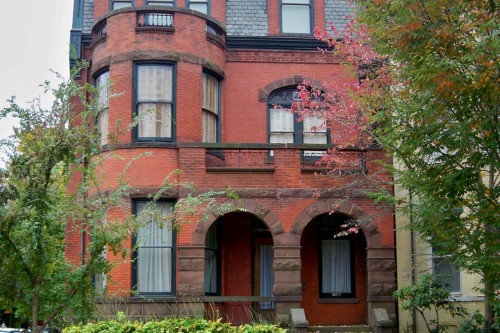
Three large brownstone and brick houses survive from his first years after returning to Richmond.  1501 and 1503 Grove Avenue are fine examples of the Richardson Romanesque. Both built in 1895, they perfectly represent the architectural tastes of the Brown Decades. There is a third house on Franklin Street and a row of townhouses on Grove Avenue form this period.  

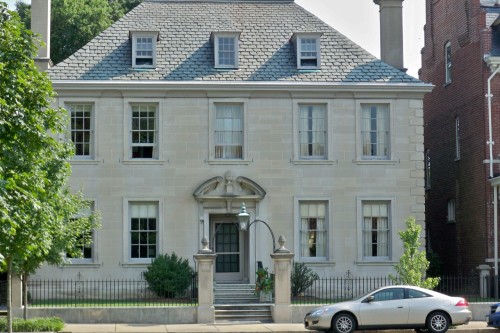
Huntt transitioned from the substantial Romanesque to the newer Colonial Revival styles in the next decade. In 1907, he designed a fine residence for Cary Ellis Stern at 1700 Grove Avenue.  While it clearly inspired by the century old John Marshall house, it is not a copy. With its well-detailed Doric porch, it is both up to date and respectful.

Two years earlier he designed the George house at 1831 Monument Avenue, his first house on the street.  This house has the substantial feel of the Romanesque combined with Georgian details and composition.  While Huntt could be restrained and correct, he rarely chose to be so. He wasn’t interested in antiquarian reconstructions.

By 1913 the Lafferty house on Monument Avenue displays a baroque approach to classicism. The front is divided into two bays; one is larger than the other. The entrance porch uses a mixture of Ionic and Corinthian columns. The entablature features triglyphs from the Doric order.  Thus, he used elements from all three of the classical orders in this remarkable creation.  To say that the porch disobeys classical rules hardly begins to express the composition of the house.

The Sorg House of 1914 on Monument is a classical, theatrical fantasy on Classical themes. Sorg was the vice president of the Millhiser Bag Company, and Huntt had redesigned a house at 1100 Grove Avenue into an apartment house for the Sorg family in 1912. 

The Sorg residence has a bowed front porch with the central stair flanked by triple Ionic columns, two of which step down the stair. The façade behind the porch is asymmetrical with an off center entrance.  This asymmetry is typical of Richmond town house design.

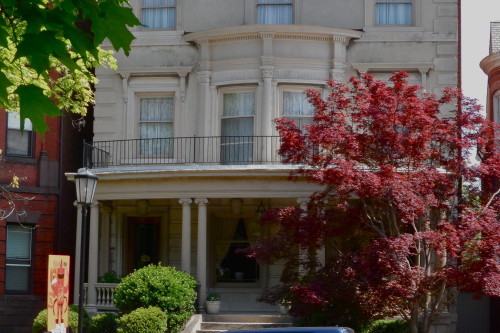
The upper level of the house features two bay windows flanked by Ionic columns and crowned by broken pediments. A grand total of 14 Ionic columns embellish the house. It is a dazzling composition obeying no Classical rules or conventions.

Hunt designed other, tamer houses on the street, but all are of interest. At 2300 Monument Avenue, Huntt redesigned Richmond’s typical step gabled Greek Revival, townhouse of the sort designed by Otis Manson.  Manson was the designer of the Elmira Sheldon house on Church Hill. The Monument Avenue house is bigger and more monumental, but clearly reflects Huntt’s awareness of Richmond’s architectural history.  

At 2500 Monument, Huntt rethought Richmond’s Greek Revival mansion designs such as the Barrett House. The basic composition is Greek Revival with a central porch flanked by triple windows. The massiveness of the house also recalls Richmond’s taste in the 1840s and 1850s as can be seen in the Glasgow or Barrett Houses.  The architectural embellishment is all-new and all Huntt.

One of Huntt’s later commercial designs was for a car dealership on Broad Street. Here his inspiration was the light, elegant 18th Century classicism of the Adam Brothers. Here Hunt was bold, imaginative and almost delicate in his detailing. The building is both modern and classical. His library for the St, Andrews Association is one of the few buildings showing a strong Art Nouveau influence in Richmond.

His final buildings on Monument Avenue, the Kenilworth and Stratford Court apartments feature four triple-tiered porches supported by triple Corinthian columns. Well preserved, these illustrate Hunt’s work well. If Bernini were designing apartment houses on Monument Avenue they might look like this. The entrance design breaks the Bernini fantasy. Again, the doorway breaks every classical rule.

Huntt lists the young Richmond architect, Bascom Rowlett as the associate architect for these apartment houses and several other buildings in the later teens. It is tempting to attribute some of Huntt’s later works to the imaginative Rowlett. However Rowlett’s independent work doesn’t resemble Huntt’s work.  Rowlett was interested in exotic styles and while he produced a number of Classical apartment houses, they never approached the exuberance of Huntt’s work.  Huntt died in 1920.

Huntt’s work does not fit into the stereotype of the conservative southern architect.  His designs were bold, imaginative and a bit eccentric. He was also successful, and had many successful businessmen as his clients. While he worked in a classical style, there is little antiquarian in his works. 

Robert Winthrop