Mixed Use Mid-Rise on Shafer and Grace Streets

Shafer & Grace Mid-Rise

Image courtesy of http://www.loopnet.com


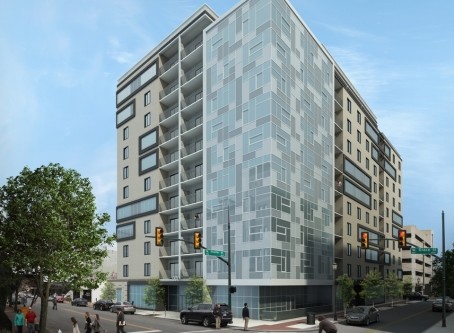
August 2014 is expected to bring yet another mid-rise project to Grace Street in the Lower Fan District. The building currently on the site, a one story brick retail structure, will be demolished beginning as early as this month. 

The 11 story, 170,000 square foot building will contain 152 apartments and a 3,400 square feet retail space situated on the corner of Grace and Shafer Streets. ShaferGrace LLC is developing the 22 million dollar project with Walter Parks serving as architect. Once completed, the structure will be one of three on the corner to be completed within the last 3 years.

Parks is also designing a 7 story mixed-use building for VCU on the same block, set to be completed at around the same time.

D.OK.

Current: A New Building for McGuire Woods

Image courtesy of the Richmond Times-Dispatch

Image courtesy of the Richmond Times-Dispatch

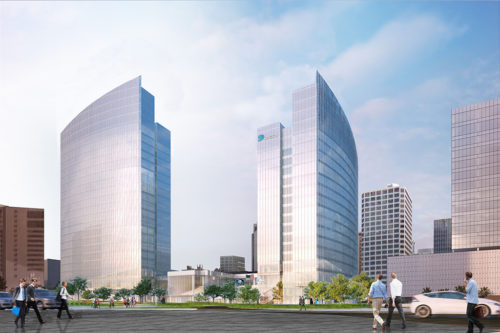
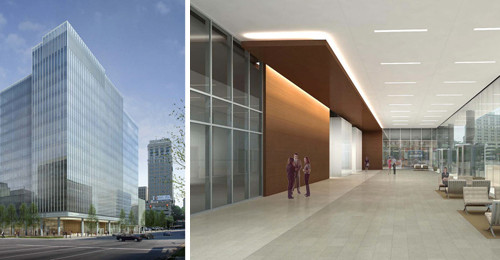
McGuire Woods, a law firm headquartered in downtown Richmond with 19 offices worldwide, has recently announced a new Headquarters building is to be constructed. The building’s site is a full block south of cary between 8th and 9th streets. It will be somewhere from 15 to 20 stories tall.

This block is currently occupied by surface parking and is considered by many to be one of the most significant rifts in the financial districts urban fabric. The construction of the building will close the mid block automobile cut through from 8th street to the Manchester bridge.

In addition to office space, 520 parking spaces and 10,000 square feet of ground level retail space will be included in the building. Pending city approval, it is expected to break ground this spring and open in 2015.

D.OK.

Current: First Freedom Center

Image

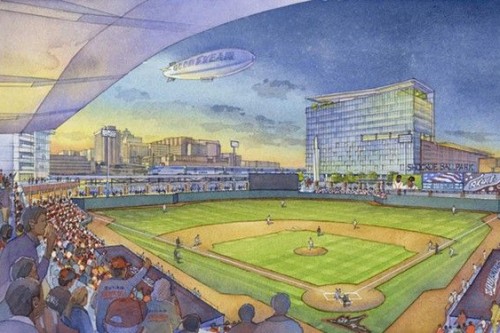
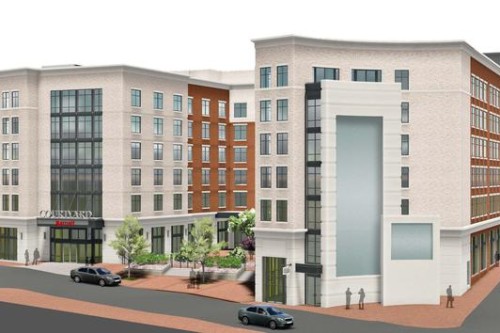
A major new development is headed for Richmond in the form of the First Freedom Center and Hotel. The building, which was approved by city council on Monday (the 23rd), will be built on the corner of 14th and Cary Street in Shockoe Slip. This site is now used as surface parking but it was once home to the State’s Capitol building where the Virginia Statute for Religious Freedom was signed into law.

The building will include a Courtyard Marriott and an extended stay Residence Inn which, together, will total 210 rooms. In addition, the First Freedom Center will occupy some of the building’s first floor. A monument to the important legislation passed on the site will occupy the corner while a the two wing hotel will take up the remaining space, leaving a plaza facing Cary Street. The building will permanently close a block-long section of Virginia Street, a historic cobblestone street that predates Richmond’s gridded city plan. Baskervill is the project’s architect; construction is set to begin in early 2013.

Check back for more coverage as this project develops.

D.OK.

Current: Hargreaves Plan for River Development

In mid 2011, the Cambridge office of the internationally renowned firm Hargreaves Associates was awarded a $490,000 commission from the city for a (re)development of Richmond’s Riverfront. The firm has already undertaken successful riverfront plans for cities including San Francisco, Louisville, Houston and others. This month, the final draft of the Riverfront Plan was unveiled.

The target area includes the portion of the river from the Robert E Lee Bridge to the Henrico County line and Ancarrow’s Landing. Intending to build off the framework of the 2009 Downtown Master Plan, the plan focuses on accessibility and recreational uses. The plan is ambitious, calling for a wide range of improvements, including more public art, bike paths, completion of the capital trail, rowing clubs, revamping of watercraft sports, and cultural venues. Accessibility is also a common point of the proposal, through developing new pedestrian bridges and various completions of old trails to Belle Isle, Browns Island and Mayo Island. Other designated areas of focus are Chapel Island, Manchester, Tobacco Row, Ancarrow’s Landing, and the Tredegar Green. A prevailing technique used in many locations along the river are terraces, easing the level of descent from recreation to the water’s edge. The proposals are comprehensive, covering ecology, land acquisition, possible roadway change and future urban development.

Despite the wide aims of the plan, Hargreaves emphasizes that it will function as “a single, unified, cohesive system,” and that benefits from subsequent riverfront investment will spread to other neighborhoods of the city. To break up the magnitude of Hargreaves’ vision, the plan is divided into three priorities. The first, headlined by improvements to Mayo Island and Brown’s Island, is estimated at 35.4 million dollars.

Mayor Dwight Jones acknowledged that “The Richmond Region exists because of the critical role the James River played in our history” and acknowledged the importance of this plan with a $5 million addition to the Capital budget in 2013 and 2014.

Unlike countless past riverfront development strategies gone unrealized, the energy brought about by Hargreaves’ plan will hopefully lead to implementation. Before releasing the final plan, the firm completed a series of three popularly attended town meetings to discuss and edit their strategies. You can find all of their presentations online here:

http://www.richmondgov.com/PlanningAndDevelopmentReview/PlansAndDocuments.aspx

M.F.A.
Photos courtesy of Hargreaves Associates.

An Interview with Steven Holl

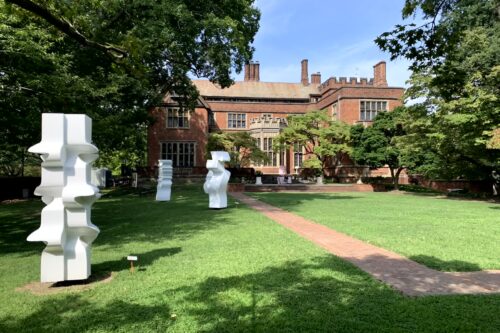
On April 25, the School of the Arts at Virginia Commonwealth University announced plans for an Institute for Contemporary Art. The new 38,000 square foot building to house the interdisciplinary program will be built at Richmond’s  busiest intersection, Belvidere and Broad streets. The structure will contain gallery spaces, a 247-seat performance space, café, classroom, sculpture terrace and administrative offices. Steven Holl Architects, based in New York City, will design the building. BCWH Architects of Richmond is associate architect.
The Steven Holl firm designed such recent projects as the Bloch Building (an addition to the Nelson-Atkins Museum of Art in Kansas City), Simmons Hall at the Massachusetts Institute of Technology in Cambridge, Mass., and the “Horizontal Skyscraper” in Shenzhen, China. On May 17 Holl receives the American Institute of Architect’s Gold Medal, the profession’s highest accolade for an individual architect.
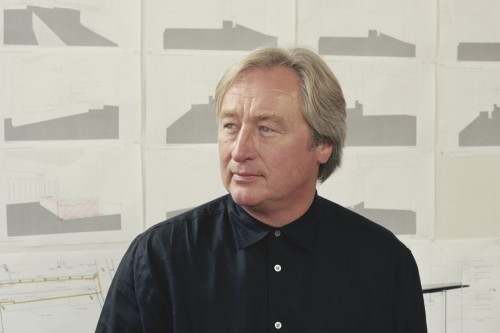
Steven Holl, 64, spoke with ArchitectureRichmond’s Edwin Slipek by telephone from his New York office on the afternoon of April 27. Here are excerpts from that interview.
What were early influences on you becoming an architect?My brother James [now an artist and professor at Marymount Manhattan College] and I were always building things in the backyard when we were boys. We had a large backyard at our house in Bremerton, Washington. We’d jump out of bed and be out there for two hours before breakfast. We built a two-story tree house and a house with one floor underground. We’d imagine, we’d create and we’d make. We were naturals.

What later influenced your development as an architect?

In my sophomore year at the University of Washington I was quite busy working on a design project one day when Professor Hermann Pundt, an enormously enthusiastic man, came over and told me he was starting a Rome studies program. He said, “Steve, go to Rome.” I lived behind the Pantheon and became enthralled by quality of light inside that space. It was always slightly changing at different times of day and in varying weather conditions. After I came back from Europe I had a different framework of what architecture is. It changed my life.

What is your favorite space, place or building?

The one I’m working on now. And Rome, of course. Also, I’ve always loved Louis Kahn’s Kimball Art Museum in Fort Worth and Frank Lloyd Wright’s Johnson Wax Building [in Racine, WI]. And all of the buildings of Le Corbusier. I’ve traveled to see most of his buildings. Once, when I had with no money, I scraped my way through France even spending a night in a monk’s cell in La Tourette Monastery [Le Corbusier’s last major European commission which houses a silent order].

Have you ever been to Richmond before becoming involved with the VCU project?

In 1996 our firm was a finalist for the First Freedom Monument [a competition sponsored by the Richmond-based Council for America’s First Freedom to commemorate the Virginia Statute for Religious Freedom. Michael Graves subsequently won the competition but the project never materialized]. At that time I walked along the James and meditated upon the river. There is a deep sense of history in Richmond.

In designing VCU’s new ICA, how is conceiving a museum or gallery different from how you approach other building types?

In the last 15 to 20 years there have been two types of museums. First, there’s been the neutral white box which defers to the art. But it sucks the life out of the art. And then there are the overly-expressive projects that look like a turkey coming out of the oven with the tin foil coming off. At the ICA we will have galleries that are rectilinear for the basic exhibition spaces but the circulation areas will be energetic and exciting. Spatial energy is important to me.

What was your first impression of the proposed building site at the intersection of West Broad and Belvidere streets, Richmond’s busiest?

[Before visiting the site] I had looked at an overview [of the surrounding neighborhoods and area}. The Fan [District] was on my mind. The site seemed like a wasted opportunity that could become into something greater: It was a sad parking lot, it’s just like Los Angeles or Houston. I’m glad I looked at the overall plan.  It asks for something other than what it is. I felt the building’s design could have a strong relationship with the corner and there would be landscaping toward the campus.

What do you hope to achieve with your design of the ICA?

This is different from any building that we’ve ever done. It responds to the question of ‘What is art today?’ We call it Forking Time. This suggests that the contemporary art world has many parallel activities. There had been a grand narrative to western art until conceptual art took over in the 1970s. But there’s been a rupture. This building aspires to reflect that today, things can coexist. And this is hopeful. The building has arms that stretch out and will give curators four separate areas. Each space is the size of a gallery in Chelsea [New York]. There will be flexibility. There might be a great video show being presented in one while in another gallery there is a great sculpture show. The vertical space will allow for other possibilities. You’ll be able to see the intensity, clarity and direction of an artist’s body of work. But first and foremost the ICA will be a great space.

On what other projects is your firm currently working?

Two weeks ago I was in Chengdu, China working on a water garden. In the near future I’ll be going to Seoul, our first project in Korea. In late January we won an international competition for a new building at the Houston Museum of Fine Arts.  At Princeton we’re building a fine arts complex that will serve as a new south entrance to the university. This involves moving the Dinky [the storied and beloved railroad link to the Amtrak station] 500 feet. We are building a new building for the Glasgow School of the Arts directly across the street from Charles Rennie MacIntosh’s original building. Earlier this afternoon I was on W. 216 St. at Columbia University [Holl is a professor of architecture there] where the Campbell Sports Center is taking shape. There are some wonderful views of the New York skyline from that building.

Whew. What do you do to relax?

I paint. I paint every morning. I paint every day wherever I am. I never go anywhere without my watercolor pad.  My most exciting times are when I am painting. Why would I want to play golf? That’s boring.

E.S.

Current: Mayor Jones’ Green Plan Supports Trolleys

On Sunday, Mayor Dwight Jones introduced RVAgreen, Richmond’s plan for sustainable urban development in the years ahead. Fifty-five suggestions are included in the proposal including everything from bike sharing to a city beautification program. The most captivating and dramatic proposal in the plan is the resurrection of Richmond’s trolley system.

Richmond was the first city in the world to operate a successful electric trolley system. The trolley was wildly successful in its time, spurring on development through new parks and neighborhoods and changing the face of the city forever. Sadly, trolley service, which began in 1887, ended in 1942 and has been legend ever since.

For decades, Richmonders have dreamt and talked about the trolleys and the potential for their reinstatement. Light rail has also been tossed around as a way to revive the glory of Richmond’s mass transit past. These conversations, formerly relegated to the back booths of smoky restaurants, may now be seeing the light of day.

RVAgreen mentions a revived trolley system serving the densest part of Richmond. However, the discussion of trolleys is relegated to a single paragraph. The plan theorizes that these attractive, fixed-line routes would be easy to navigate for tourists and commuters alike and spur economic development and sustainable urban growth.

A full digital copy of the RVAgreen plan is linked to below. The trolley section is on page 33.

RVAGreen_ARoadmapToSustainability.pdf

D.OK.