St. John’s Episcopal Church and churchyard

Builder: Richard Randolph
Dates: 1741 (1772, northern nave addition; 1829 nave extension; 1833, tower; 1877, apse)
Address: 2401 East Broad Street.

Although Richmond embraces its English roots, there are few places that evoke the flavor and memory of our city’s colonial heritage more than the tree-shaded and walled grounds of St. John’s Episcopal Church atop Church Hill. The sanctuary itself, a frame, modest-sized, vernacular structure, is the city’s oldest house of worship (although it has been expanded numerous times). And today, while the church’s profile is more picturesque than colonial in appearance, the churchyard (and city burial grounds it contains), possesses a peaceful dignity amidst the burgeoning downtown activity only blocks away. This was Richmond’s first major public cemetery and is the resting place of such notables as George Wythe, (America’s first law professor who taught Thomas Jefferson and James Madison), and Elizabeth Poe, an actress who was more famously the mother of Edgar Allan Poe. A special treat on the south side of the church grounds– which offers a dramatic, hilltop vantage point from which to enjoy the mostly 19th century skyline and rooftops of Church Hill– is the one-story, diminutive carpenter Gothic-style pastor’s study with rich exterior architectural detailing.

What eclipses even the considerable charms of this architectural assemblage and the verdant burial ground, however, is the church’s place in American history. It was here in June 1775 that patriot Patrick Henry, in addressing the Virginia Convention, made his stirring cry for a break with Britain: “Give me liberty or give me death.”

E.S.

St. John’s Mews

Landscape architect: Ralph Griswold
Dates: 1963
Address: Between East Broad Street and East Grace Street, bounded by 23rd and 24th streets

In the early 1950s Richmond’s downtown was still vibrant with residents, retail, restaurants, and electric street cars and yet Church Hill, our city’s oldest neighborhood and certainly one of the most beautiful, was in a deplorable state of disrepair. In 1956 the Historic Richmond Foundation began its valiant efforts to save and restore the neighborhood and its many treasures. Rather than develop properties haphazardly across the neighborhood, a single “pilot block” was selected and restored to be an example to all of Church Hill’s massive potential.

The block (south of Broad Street between 23rd and 24th streets) had its buildings restored and occupied, its yards landscaped and planted and its street lamps lit by gas, all of which added to its ambience. The final stroke of genius was to establish the cobblestone-paved alley as a mews. Landscape architect Ralph Griswold was selected to design the space.

The cobblestone paving of the original alley remained in place and was supplemented by acquiring the back 30 feet of the private yards of those buildings facing Broad. In this previously overlooked service space, Griswold planted intensely with lush ornamental grasses, seasonal flowers, crape myrtle and magnolia. Woven through the landscaping are paths paved in reclaimed brick which intersect at several points to create intimate spaces. One is a brick patio with antique, Victorian garden benches; another is a small gazebo-like structure made with salvaged wrought iron.

The result of this effort is an unexpected urban garden that feels more curated than manicured. The various period features of the Mews, coupled with the views of the surrounding gardens and historic buildings, amount to a veritable outdoor museum of traditional English garden design. The view eastward through the alley frames the St. John’s churchyard, giving the Mews its name.

Since the restoration of Church Hill began more than 50 years ago, much has changed in the now-treasured neighborhood. Small shops and restaurants once again fill its storefronts and homes and gardens are lovingly cared for by their dedicated inhabitants. Thankfully, walking through the shaded secrecy of St. John’s Mews has remained as wonderful and romantic an experience as it’s always been.

D.OK.

Opinion: ChildSavers Building

Architect: Philip Johnson, renovation by Baskervill
Dates: 1968, renovation in 2007
Address: 200 North 22nd Street

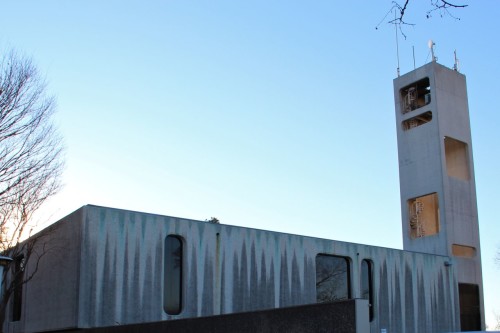
Philip Johnson’s WRVA radio station, now the ChildSavers building, goes beyond padding Richmond’s architectural resume with an illustrious name. The building functions as a beacon of creativity and innovation in one of Richmond’s oldest neighborhoods. The materiality of concrete and glass along with broad and uninterrupted faces have a classically modern identity but the irregularly spaced rounded windows and triangular patio reveal the mind of an architect in a state of flux.

Johnson is a famously eclectic architect. Looking over his oeuvre at random might make him come off at stylistically schizophrenic, however, when understood chronologically, there is a steady and almost methodical progression to his work. In the ChildSaver’s building, one catches Johnson in a key exploratory period between his Mies van der Rohe influenced International style phase and his later forays into postmodernism.

While the building is rarely included in lists of Johnson’s most famous work, I believe it is an invaluable and singular piece in the scope of his architecture. The building does not expose a  structural skeleton or include transparency effects typical of earlier projects like the glass house or Seagram building. Instead, openings punched through solid walls anticipate the developments of his postmodern works without including the often clumsy ornamental forms that came along with them

Despite the vast stylistic gaps between the 1800th century homes in Church Hill and the ChildSavers building, Johnson managed to tie his structure to the urban fabric. The relationship to the site harmonizes with the city in an oddly southern manner. Its broad lawn facing the city sets the building back gracefully. The facade on N. 22nd Street does not meet the side walk but instead retains a small strip of green space as most homes in Church Hill do. Even the blank faces are not as stark as those of early international style buildings. The worn and richly textured concrete accented by the swaying shadows of the trees planted close by recall the reserved southern homes of A. Hays Town more than Corbusier’s Villa Savoye. The building reaffirms its surrounding environment without being overly referential and without compromising the vision of the clients and architect.

From the rooftops of Church Hill both the steeple of St. John’s Church and the broadcast tower of the WRVA building can be seen, inviting comparison. One the beacon of religion and a symbol for the center of a community; the other an expression of modern times and modern interests. I could think of no better pair of buildings to represent the neighborhood.

D.OK.

ChildSavers Building


Architect: Philip Johnson, renovation by Baskervill

Dates: 1968, renovation in 2007

Address: 200 North 22nd Street


Serenely rested on top of Church Hill, tucked into a small row of trees is the work of one of the most renowned architects to ever build in Richmond, Phillip Johnson. Johnson’s work can be found across the globe, with the Lincoln Center and Sony Headquarters in New York City and the famous Glass House in Connecticut are only some of the buildings in a vast resumé. Built in 1968 to house WRVA, one of Virginia’s first broadcast radio stations, the 18,000 square foot structure has a beautiful view of the skyline to the west.

Identified by large apertures in concrete walls, round edged squares or thinner rectangles give the structure a space age feel. This and the stripping of ornament to the bare essentials as well as the geometric abstraction of the structure further emphasizes the modernism and polarity of style that much of historic Richmond architecture doesn’t identify with. It was this exploration that characterized Johnson’s career, one of always trying new forms and identities. The broadcasting tower, free standing on the small plot of flat grass behind the one story main building, appears as a vertical representation of the latter, the same concrete with round rectangular punctures running up its sides.One architectural critic compared the building’s placement and organization to that of a Greek temple front facing the public on top of an acropolis, and deemed the structure “one of the city’s most visible and important mid-20th-century architectural landmarks.”WRVA moved to West End in 2000. After a renovation by local firm Baskervill, the non-profit organization Childsavers assumed occupancy and remains there today.

M.F.A.