The John Marshall

John Marshall 1


Architect: Marcellus Wright

Dates: 1929
Address: 101 N. 5th Street

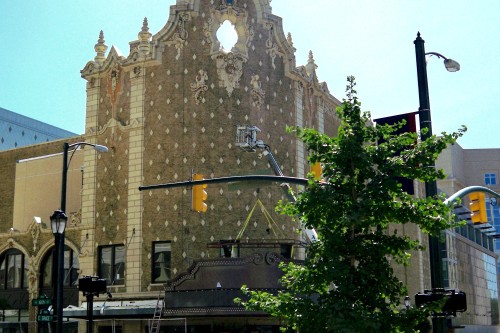
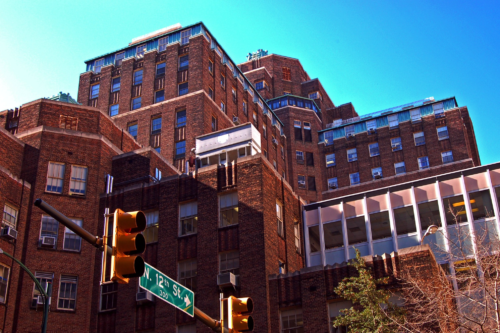
Erected in 1929, the Hotel John Marshall immediately became an establishment in the city. It’s imposing entrances, grand ballrooms, and bombastic skyline signage were icons of Richmond’s then vibrant Grace Street corridor. The area was home to boutiques, restaurants, and department stores that attracted visitors from across the state and beyond. With 443 rooms, multiple retail and restaurant spaces, and massive ballrooms and meeting spaces, it was Richmond’s largest hotel by far.

The building was designed by Marcellus Wright and named for Richmonder and Chief Justice John Marshall (often referred to as the father of our nation’s judicial system). The architect combined elements of neoclassicism, art deco, and Moorish revival detailing into a unique expression. The building follows the standard formula for traditional American skyscrapers; a base and shaft surmounted by an ornate pinnacle. The base is essentially a paired down neo-classic facade in stone as are the ballrooms it contains. The verticality of the shaft section and the minor setback at its end provide the deco element. The Moorish influenced romanticism is applied thickly to the upper story in ornamental form which trickles down to enclose a smaller number of window bays below. The eclectic elements are not totally in harmony, but then neither is the grid of metal and light bulbs set on the roof.

Starting in the 1950‘s, downtown Richmond began to decay and the hotel lost its market. The Hotel John Marshall had once served as home away from home for countless shoppers coming from as far as North Carolina to walk the retail mecca that was East Grace street. As strip malls and shopping plazas depleted Richmond’s retail core the urban fabric itself was being torn by highways. The grand hotel which had once been a center for our city’s society was forced to shut down in 1988 after years of waning financial success.

After years of neglect the building was purchased by Dominion Realty Partners to be repurposed as luxury apartments. A complete interior renovation and stabilization of the facade was done transforming the hotel into a apartment building with 238 units, 2 ballrooms, and 20,000 of retail space. The building opened in late 2011.

D.OK.

Maggie L. Walker Governor’s School

Architect: Carneal, Johnston and Wright, Restoration by BCWH with Saddler and Whitehead
Date: 1938, expansion in 1963, restoration in 2002
Address: 1000 N Lombardy St

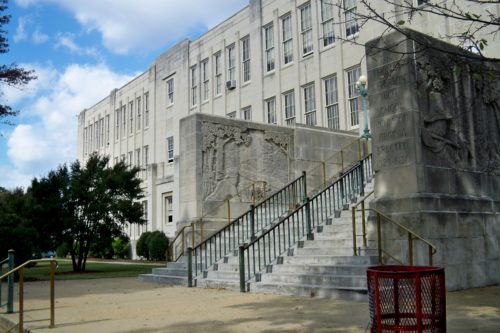
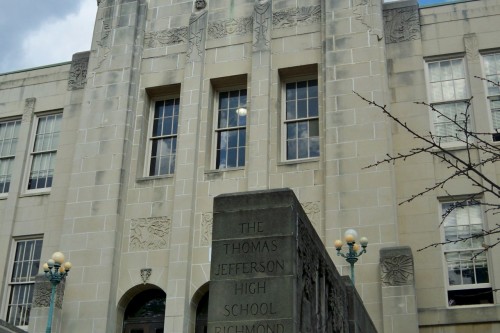
Maggie Walker High School’s creation and image is the result of several incidents occurring at the same time. In 1934, a city icon in Maggie L. Walker passed, and Richmond wished to honor her name in some way. Virginia Union University sold recently vacated land to the city, and a new facility was required for the city’s black youth, segregated under the “Jim Crow” laws. These circumstances, in concurrence with the height of the art deco period, were the causes that brought Carneal, Johnston and Wright’s high school to become one of the most significant educational buildings in the city.

The same architects’ extensive expansion in 1963 added to the original plan of two joined Y shapes and the building today exists largely as a realization of these two efforts. Limestone and concrete are paired handsomely with a dark red brick, while lime green accenting, glass block and subtle art deco ornamentation complete the sophisticated structure’s image.

The school’s interior plan is regular and predictable, a classically symmetrical arrangement that lends a navigable yet repetitive experience. Staircases hinge the building’s wings on the ends that house classrooms, while larger program such as the auditorium, gym, common room and cafeteria are clustered in the center.

While the iconic elevation of Maggie L. Walker High School is its grand entrance on Lombardy Street, the opposite entrance is the most heavily trafficked, and another common vista is from the I-95 overpass, above the athletic fields and parking lot north of the school.

The high school began as exclusively African American, but a historic documentation and restoration from Sadler and Whitehead with BCWH in 2002 opened the doors for the Governor’s School of Government and International Studies. Hopefully this sensitive modern restoration signifies the school as an important Richmond landmark that must be cared for, and one that will last.

M.F.A

Central Fidelity Bank


Architect: John Eberson with Carneal and Johnston
Dates: 1928-1929
Address: 219 E. Broad Street

The Central Fidelity Bank building (known colloquially as the CFB) was the product of the collaboration between architect John Eberson of New York City and Richmond firm Carneal and Johnston. The result was a true expression of art deco and one of the most imposing presences on Broad street. Upon completion, the building was the tallest in Virginia and it retained this title until 1971 when it was surpassed by Richmond City Hall.

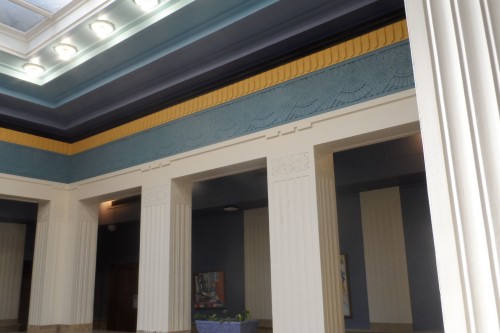
The tower is a stoic monument to the Art Deco style. It’s reserved massing includes setbacks typical of art deco buildings as well as vertical bands of masonry and windows. The building is largely rendered in brick with a more expensive material (in this case limestone) as the base. The street level features a multi-story arched entryway with a symmetrical composition of screened openings. Intricate and geometric metal work typical of art deco feature prominently in the facade and grand lobby.

While Eberson is known for his more exuberant theaters, bank buildings are typically designed to promote a sense of stability and sensibility. It is clear that he conformed to these accepted techniques when one compares this work to Richmond’s Loew’s theatre (Carpenter Center/Center Stage). Eberson designed the theatre in the same year he completed the bank tower.

One of the most interesting features of the CFB development, although not strictly the same building, was the Broad-Grace Arcade; an interior pedestrian street cutting through the 200 block of East Broad Street. So great was the demand on retail space in the Grace street corridor that the entire length of the arcade was retail. The storefronts and the floor space above them are currently empty.

The tower has gone through several owners including the Central Fidelity Bank and Wachovia. A developer from Washington D.C. purchased the property in 2007 with the intent of transforming it into a hotel but the finances fell through. With the exception of the occasional art show in the grand hall, the building sits empty but it is for lease and awaiting reuse.

D.OK.