
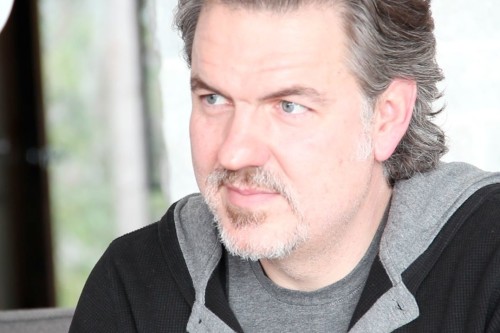
Interview: Chris Fultz


Chris Fultz is head of Fultz Architects, a Richmond-based design firm. Previously, he served as a design principle at SMBW Architects where he lead such projects as Luck Stone’s headquarters, the Belvedere Gardens Mausoleum, and the United Network for Organ Sharing headquarters. He was interviewed by ArchitectureRichmond’s Don O’Keefe earlier this year.

Talk about your time at SMBW. What were some of the most rewarding projects you worked on there?

SMBW is the reason I’m still in Richmond. I met one of the founding partners, Will Scribner, while I was in graduate school. At that time he had a vision to establish a truly modernist-oriented practice in Richmond, which was incredibly intriguing to me. While I was there some of the most rewarding projects that I worked on included the Belvedere Gardens Mausoleum in Salem, Virginia, the UNOS (United Network for Organ Sharing) headquarters [Richmond], and Luck Stone headquarters [Goochland County].

Belvedere Gardens was the first time I was able to work with a truly visionary client. He pushed and encouraged the design team to do more. One of the most remarkable things about that story is that he kept asking us to slow down. He felt the design process was proceeding too rapidly, which you never hear in the business of architecture.

The other rewarding aspect was that it was the first project where I was able to pursue something I am very passionate about which is building in the Virginia landscape. I came from Texas which is very flat. [There are] not a lot of geographic features to work with so one of the things I have always been inspired by in Virginia is the geography of the state. The Belvedere Gardens Mausoleum, for all intents and purposes, really is a landscape project. What I learned through that process was how to create a profound sense of place that allowed you to connect with the site in a really meaningful way. It yielded something that was very genuine and original yet it responded to the immediate site and the surrounding viewshed of the Appalachian Mountains. I think that elevated the human experience of the place.

What was a project that you worked on at SMBW that really affected Richmond?

The UNOS headquarters building was rewarding on many levels. It was one of the first truly modern buildings in the Biotech Park. However, the story there is the Donor Memorial. Our vision was to design a national memorial for organ and tissue donors. It was truly design by committee, the most profound sense of collaboration I’ve ever had. It was the antithesis of what you typically think of as design by committee which is political and counter productive. We ended up designing a humble and unique place in downtown Richmond which I think has lived up to some of the ideals and ambition that we set forth.

How do you think SMBW has prepared you for founding Fultz Architects?

I’m very grateful for the opportunities that I had there. It was a great environment, a very supportive environment to be in as a young designer. Within a matter of a few years I was thrust into a leadership position. The 15 years that I spent there allowed me to grow and mature not only as a designer but as a business owner. That lead me to a point in my career where I had the courage to step out and start my own thing.

What can we expect from Fultz Architects? What excites you most about this next step?

I’ve got some fantastic projects coming down the pipe. UNOS just purchased a building in Jackson Ward. They want to completely recast the interior and promote the kind of vocabulary that’s going on at their headquarters building. They were exploring the idea of a community learning center on the first floor. I think we will be able to realize some of those ideas.

Currently, we are working on Luck Stone’s new scale office [a small building that serves as a customer interface with a quarry]. We’ve been designing a prototype that can be reproduced and executed on a number of sites. We are looking at ways to adapt skin and color palettes so that it’s more site specific, dependent on the nature of the quarry. One of the things we did with this project was to take the green aggregate out of the quarry, mix it with concrete, cast the slab and polish it. It’s beautiful. That project has also lead us to other opportunities like industrial design. We are designing this metal kiosk for the customer interface. That project we are doing with Charles Yeager [a Richmond-based fabricator] who’s a good friend of mine. One of the things I’m most proud of is the relationships I have been able to cultivate with local designers. Their imprint can be seen on most of my work.

There is an empathetic aspect to the way that I work and I think there is a lot of value in that. I’m committed to modernism. I’m committed to practicing that in a traditional city. I think that the city and the community are finally getting comfortable with modern architecture in a traditional context. There is a growing demographic of people out there looking for more than a plain solution. I have confidence that I can find those people and establish those new relationships.

Fultz Architects site:
http://www.fultzarchitects.com/

D.OK.

University of Richmond

Westhampton Lake as seen from the Student Commons

Architect: Cram and Ferguson, architect; Carneal and Johnston, associate architect; Warren Manning Associates, landscape architect.
Date: 1914
Address: 28 Westhampton Way 

Many Richmond commercial and residential areas developed westward after the installation of electric streetcars in 1888. The University of Richmond, which was located near the intersection of today’s Lombardy and Grace streets, established a sprawling, 200-acre suburban campus at the terminus of the Westhampton trolley line. The move allowed for the introduction of a women’s campus as well as expansive new sports facilities. The Boston architecture firm of Cram, Goodhue and Ferguson attempted to establish a cloister-like environment in the Gothic Revival style. This approach had already garnered the firm praise for its designs at the United States Military Academy at West Point and at Princeton University. For the Richmond campus, however, due to budget restrictions, the firm substituted brick and cast concrete where it would have preferred to use stone. Cram completed eight initial buildings including Ryland Hall, the refectory, the stadium, Jeter and Richmond dormitories, North Court (the woman’s Westhampton College), the power plant and Millhiser Gymnasium. With World War I occurring soon after the campus was completed, however, construction was halted for a number of years and the Cram firm never returned.

Over the ensuing decades, planners and architects strayed from Cram’s vision of a cloister-like monastery in the wooded countryside: Instead they created a more picturesque setting with Westhampton Lake as the centerpiece. However, with the exception of a brief flirtation from the 1960s to ‘80s with modernism and post-modernism, in the 1990s the university resumed building, (almost slavishly) in the collegiate Gothic mode. The best of the most recent buildings include Weinstein Hall (which houses the political science department) by SMBW.

E.S.

Richmond City Hall

Architect: Ballou and Justice, renovation by SMBW architects
Date: 1971
Address: 900 East Broad Street

While opinions of City Hall cover a vast range, the particularity of its image is difficult to ignore. Built in 1971, it was the tallest building in Virginia for four years. Deteriorating structural conditions of its facade of marble and granite prompted a re-cladding of the exterior by local firm SMBW. This resulted in an award winning project of an aluminum-based facade, keeping the original intent and personality of City Hall while improving on its structural concerns.

The building sits on a four story plinth of black marble, raised above the street level and contained by planters. A large glass canopy is suspended over the entrances, drawing the pedestrian under and into the center of the building. As a form, it is a fairly straightforward skyscraper of uniform sides, divided into quadrants internally. But the structure manages to stand out distinctly on the Richmond skyline through the recognizable recessed windows and emphasized spandrels, an image enabled by the detached perimeter columns from the exterior curtain wall system. The overhanging roof, service box above and antenna give it the vague appearance of a slowly moving massive ship on the horizon.

In total, City Hall contains more than 800 employees; 18 departments and agencies in addition to offices for the city government, mayor, city council and school administration comprise the 21 story building. Some of the best views of the city can be found from its lookout on the top floor, publicly accessible and free of charge.

M.F.A.

Sources:
Hart, S. (n.d.). Born again: A new skin offers a new start. Architectural Record, Retrieved from http://archrecord.construction.com/features/green/archives/0505edit-1.asp