
Second Presbyterian Church

Second Presbyterian Church 6


Architect: Minard LaFever
Date:1845
Address: Nine North Fifth Street

When Presbyterian minister Moses D. Hoge commissioned a church design for his congregation, which was moving westward from Shockoe Hill toward Gamble’s Hill, he made a bold move. He eschewed classicism, which had been the architectural approach of most Richmond churches up to that time, and built a Gothic Revival edifice. Apparently, Hoge believed that the nooks, crannies and the romanticism of Gothic design allowed for sentiment and memories to find comfortable resting places. He selected the prominent New York architect Minard LaFever (1798-1854) as designer. LaFever never visited Richmond for this project but provided Hoge with plans from one of his pattern books (he wrote five).

Probably, in a nod to budget restrictions, brown-hued brick, rather than stone was used as the primary exterior material. Vermont sandstone was used as trim (in a recent exterior renovation, the stone was replaced with a similar material imported from Germany).

The sanctuary’s central front door hits hard along the North Fifth Street sidewalk, but if one looks up, a 100 foot steeple rises majestically. In the era before skyscrapers, it was one of the most imposing silhouettes on Richmond’s skyline.

Upon entering the sanctuary, plaster walls scored to look like stone rise to support a series of wooden arches and a ceiling of wooden planks stained a dark shade of brown. It is a tour de force of the carpenter gothic. Behind the pulpit at the front of the church, an impressive wooden reredos, apparently designed by Hoge, rises 40 feet to frame the lectern.

Today, the Gothic Revival sanctuary is joined via a glass and steel connector to the Virginia Building (1906) at the corner of Fifth and Main streets. Thought to be Richmond’s first high-rise apartment building, the Virginia Building now serves Second Presbyterian as a church house.

E.S.

St. John’s Episcopal Church and churchyard

Builder: Richard Randolph
Dates: 1741 (1772, northern nave addition; 1829 nave extension; 1833, tower; 1877, apse)
Address: 2401 East Broad Street.

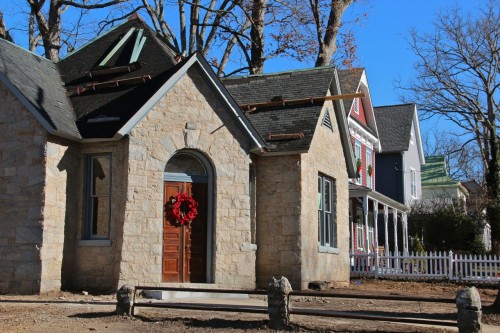
Although Richmond embraces its English roots, there are few places that evoke the flavor and memory of our city’s colonial heritage more than the tree-shaded and walled grounds of St. John’s Episcopal Church atop Church Hill. The sanctuary itself, a frame, modest-sized, vernacular structure, is the city’s oldest house of worship (although it has been expanded numerous times). And today, while the church’s profile is more picturesque than colonial in appearance, the churchyard (and city burial grounds it contains), possesses a peaceful dignity amidst the burgeoning downtown activity only blocks away. This was Richmond’s first major public cemetery and is the resting place of such notables as George Wythe, (America’s first law professor who taught Thomas Jefferson and James Madison), and Elizabeth Poe, an actress who was more famously the mother of Edgar Allan Poe. A special treat on the south side of the church grounds– which offers a dramatic, hilltop vantage point from which to enjoy the mostly 19th century skyline and rooftops of Church Hill– is the one-story, diminutive carpenter Gothic-style pastor’s study with rich exterior architectural detailing.

What eclipses even the considerable charms of this architectural assemblage and the verdant burial ground, however, is the church’s place in American history. It was here in June 1775 that patriot Patrick Henry, in addressing the Virginia Convention, made his stirring cry for a break with Britain: “Give me liberty or give me death.”

E.S.