Current: Steven Holl unveils the design of the VCU Institute of Contemporary Art

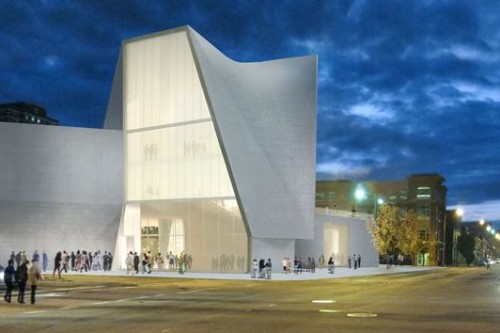
Steven Holl, world famous architect and winner of the 2011 AIA Gold Medal, unveiled his plan for the new VCU Institute of Contemporary Arts today. The 32 million dollar project is a landmark achievement for Virginia Commonwealth University’s highly rated School of the Arts.

The building will sit at the south west corner of Broad and Belvedere streets, Richmond’s busiest intersection. The design responds to the intersection with a curved wall of weathered zinc and a curtain of plate glass. The other side of the building features projecting bars of space that define a sculpture garden with a water feature and cafe. This softer side of the exterior is meant to relate to the irregular, forking grid of the fan district, which the building borders.

The 38,000 square foot ICA will contain numerous spacious galleries, a large atrium, landscaped sculpture terraces, a 240 seat theatre, and more. Needless to say, the building will be well equipped to host the most ambitious shows and installations from internationally acclaimed artists.

Holl will introduce further ICA drawings and renderings, as well as a series of his signature architectural water colors, at the Meulensteen gallery in New York City on Thursday. The exhibition will travel to the Virginia Center for Architecture later in the year.

ArchitectureRichmond’s own Edwin Slipek, who also serves as architecture critic for Style Magazine, recently interviewed Steven Holl about the ICA and his view on architecture in general. The interview will be published in Style in the coming days. Check back for our continuing coverage of this project.

D.OK.

Virginia Center for Architecture

Architect: John Russell Pope
Dates: 1919
Address: 2501 Monument Avenue

One of the most impressive mansions on the already extravagant Monument Avenue, the Branch House was commissioned in 1916 by John Kerr Branch, a wealthy stockbroker and bank president, with enough space to house his extensive collection of Italian Renaissance items, including tapestries, furniture, woodwork, and armor. A popular style for the wealthy in the early 20th Century, the Tudor Jacobean mansion’s brick and sandstone castle-like exterior shields an impeccably preserved interior, from the elaborate furniture and lighting fixtures to the carefully crafted wood detailing. Other examples of thoughtful handiwork are found all over the building: the three uniquely laid brick chimneys, fireproof concrete floors, and exterior sculpted stone motifs to name just a few. A generous amount of light permeates the building through large warped glass bays, from the back gallery space to the cozy library on the third floor, so that the building maintains a warmness even through its imposing size. A brick wall lining the other side of the lot contains a courtyard, stepped down from the back gallery space in a private retreat, overlooking Fan houses through a screen of trees.

The 27,000 square foot mansion was designed by John Russell Pope, most well known for the Jefferson Memorial and the National Gallery of Art in D.C, but whose work is also found two blocks north at the Science Museum of Virginia. Unlike the architect’s other well known classical style buildings, the Branch House employs a Tudor Jacobean style, influenced by the famous Compton Wynyates mansion in Warwickshire, England.

After passing through other owners twice after the Branch family, the house found a well suited occupant in the Virginia Center for Architecture, one of the few architectural museums in the country, whose exhibitions and event hosting allow the architectural prize to be observed and celebrated. Located along the already historic Monument Avenue, it was independently listed on the National Register of Historic places in 1984.

M.F.A.
More information about the Branch House and the Virginia Center for Architecture’s events and galleries can be found at:
http://www.virginiaarchitecture.org/vca_index.html

Sources:
nps.gov. (n.d.). Branch house. Retrieved from http://www.nps.gov/nr/travel/richmond/BranchHouse.html