Virginia Museum of Fine Arts

VMFA 2


Architects: Peebles and Ferguson Architects, Norfolk (1936); Theater Wing, Merrill C. Lee Architects, Richmond (1954); South Wing, Baskervill & Son Architects, Richmond (1970); North Wing, Warren Hardwicke Associates, Richmond, and Sculpture Garden, Lawrence Halprin Associates, San Francisco, landscape architect (1976), both demolished; Lewis Mellon Wing, Hardy Holzman Pfeiffer Associates, New York City (1985); Frances G. McGlothlin Wing, Rick Mather Architects, London (2010) with associate SMBW Architects, Richmond.   

Dates: 1936-2010

Address: 200 North Boulevard

The Virginia Museum of Fine Arts was founded and is supported by the Commonwealth of Virginia. Its 14 acre campus, defined by Boulevard, Grove Avenue, Shepherd Street and the grounds of the Virginia Historical Society, is situated on the former Robert E. Lee Camp (for many years it was a retirement community for Confederate veterans and their female relatives). In 1936, during the Great Depression and with construction funding from the Federal Works Administration, the museum opened its doors to a structure elegantly oriented to Boulevard. Peebles & Ferguson Architects took its cues for the building’s design from a Late Renaissance addition to Hampton Court in London by Christopher Wren. The museum’s galleries were located on the upper level with offices and support facilities situated on the ground floor.

Additions were made in 1954 (for additional galleries and a theater) and in 1970 (for galleries). These continued the architectural spirit of the original, center block.

In 1976 another wing, by Warren Hardwicke Associates, and a walled sculpture garden designed by Lawrence Halprin Associates, were added to museum’s north end. These broke with the Wren-inspired classicism. The addition’s curved brick walls recalled the Johnson Wax Company building in Racine, Wis. by Frank Lloyd Wright.

In 1984 the architectural direction of the museum shifted again with construction of the Lewis Mellon Wing, built specifically to house the sizable collections of Sydney and Frances Lewis of Richmond and Paul Mellon of Upperville, Va. Architect Malcolm Holzman, in designing the building, broke with the museum’s exterior red brick, Flemish bond surfaces and introduced Indiana limestone. The wing is a witty tour de force architecturally that combines modernism with such refined classical elements as the Tuscan order (at the entablature) and muscular blocks of rusticated stone at the ground level that recall Henry Hobson Richardson’s Allegheny Courthouse in Pittsburgh.

In 2010 the museum reoriented dramatically how visitors approach the museum by demolishing the former North Wing and sculpture garden and building the Frances G. McGlothlin Wing which is approached by a new motor court. Designed by Rick Mather Architects, the building is unapologetically modernistic in every way: It combines exterior surfaces of Indiana marble with large, deftly handled expanses of sheet glass.

Key to the spirit and success aesthetically of the McGlothlin Wing is how the building seamlessly connects with the museum grounds through large window openings. Happily, a former surface parking lot has been replaced by an expanse of lawn and vehicles are now relegated to a 600 space garage that is largely hidden beneath a dramatically sloping and handsomely-landscaped sculpture garden.

E.S.

Opinion: Museum of the Confederacy


The Museum of the Confederacy is an exemplary piece of modernism in Richmond, responding to its site and program gracefully. The museum was designed in close proximity to the White House of the Confederacy, one of Richmond’s most significant historic buildings. Given this and its function as a frame for civil war artifacts, context is paramount in the design. The museum succeeds in its efforts to respond to the older structure while expressing the time in which it was built.

The Museum of the Confederacy is built in a style known to some as ‘Brutalism.’ The expression, born of the French term ‘Béton brut’ which describes exposed and unfinished concrete, refers to buildings composed largely of concrete and glass with irregular and asymmetrical massing.  The style was prevalent during the poor planning era of the 1960s and 1970s and is, as such, often associated with buildings that are unresponsive to the site and to human scale. The Museum of the Confederacy is a shining example of a building in the brutalist style working with the site and the context in an intimate and sensitive way.

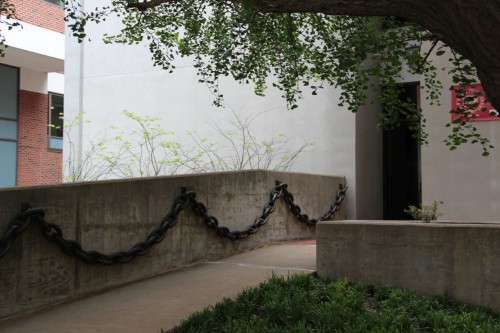
The material is the most obvious connection between the two buildings. The Museum of the Confederacy uses a gray, lightly textured concrete which compliments the stark grey stucco of the White House beautifully. Mid afternoon light displays how rich and textured the concrete can be, appearing warmer and more irregular than the neighboring stucco. The plan of the building creates an intimate garden space that juxtaposes old and new beautifully. The face of the building directly opposite the White House mirrors its composition of symmetrical, regular bays while the massing of the building over all is an asymmetric ‘L’ which better suits the site.

The most invaluable gesture of the modern museum is that its largest cantilever, which covers the museum entrance, extends out towards the corner of the White House, creating a palpable tension. This reach, this search for a connection between present and past, between modern, objective scholarship and the tumultuous emotions of America’s Civil War, is abstracted and frozen in time. The Museum of the Confederacy’s achievement is in its dual nature. It both fosters a drama between it and its historic progenitor and crafts its mass, shadow, and material into harmony.

D.OK.

Wilton House


Date: 1753
Address: 215 S. Wilton Rd.

Constructed in 1753, the Wilton House Museum is among the oldest buildings in Richmond. Originally, it served as the rural plantation home of the influential Randolphs, one of the First Families of Virginia. It was moved to its current location in Richmond’s affluent West End in 1933 as its original surroundings industrialized. The lavish Georgian mansion hosted many notable visitors such as George Washington, Thomas Jefferson, and Marquis de Lafayette.

The building’s exterior is spare and simple despite its grand scale. Its largely unadorned brick faces and sharp planes of slate roofing serve as canvases for the swaying shadows from foliage above. The house is a beautifully crafted study in proportion, mass and texture, metal and wood accents harmonizing with the slate and brick of the large cubic volume. An axial path leads up to the central entrance, continues through the house, and extends down rear terraces to a small brick patio overlooking the James River. Across the river, the entirely undeveloped Williams Island can be seen. The illusion of wilderness helps to ground the antiquated building in a proper context.

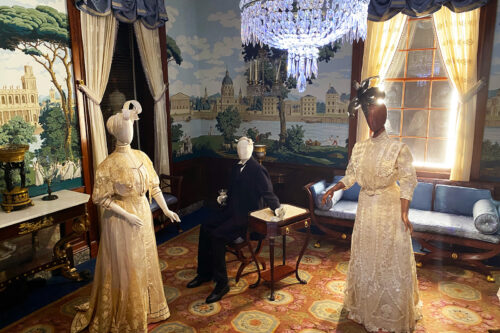
Wilton House is now a museum open for tours which focus largely on its authentic Georgian interiors. The original plantation site featured several symmetrically organized companion buildings only one of which was moved to the current location. Still, with the help of some well placed signage at the museum’s entrance, it is possible for a visitor to extrapolate what it must have been like to visit the grand home so many years ago.

D.OK.

For more information on the museum’s history and accessibility, see link:

http://www.wiltonhousemuseum.org/

Virginia Historical Society

Architect: Bissell and Sinkler, additions by Glave & Holmes
Dates: 1913
Address: 428 North Boulevard

The Virginia Historical Society was founded 1831 as a private intellectuals club and is now a museum dedicated to the preservation and dissemination of Virginia history to the general public. The museum is located on the Boulevard in the same super block as the Virginia Museum of Fine Arts, helping to lend its neighborhood the name of ‘Museum District’. It is a private non-profit organization and has been funded entirely by private sources since it’s founding.

The current museum’s central section, known as Battle Abbey, was built in 1913 by the Philadelphia firm Bissell and Sinkler. It has since been added to four times, first in 1959, and in 1992, 1998, and 2006 by Glave & Holmes. The museum now includes generous event and lecture halls as well as exhibition space for the largest collection of Virginia artifacts on permanent view anywhere.

Visually, the Virginia Historical Society is imposing and austere, bordering on architectural brutalism. Its additions have only intensified this impression. Together, they create uninterrupted planes of stone and concrete so long that they are rivaled only by the Richmond flood wall. There is little intrigue in the eastern, Boulevard oriented facades and they scarcely hint at a function or delegation of space inside. The southern and western most additions are particularly underachieving and seem only to poorly imitate the rigid proportions of the principal facade. The museum’s site is a key part of its identity. The sparse and planar lawn sets the museum back from the street in a generously southern manner and matches the formal qualities of the structure. While there is no interaction between the Virginia Historical Society and the neighboring Virginia Museum of Fine Arts campus, its relationship to the other grand structures on the Boulevard give the museum a sense of place and prominence.D.OK.

Science Museum of Virginia

Architect: John Russell Pope
Dates: 1917-1919
Address: 2500 West Broad St

Now known as a primary educational and cultural feature of the city, the inscribed words  “Union Station of Richmond” upon the Science Museum’s facade underneath a grand clock recall the honored past of the proud neoclassical edifice as a beacon for transportation, a gateway to the city. Prior to its use as a train station however, the site was used for Civil War military encampments, state fairs, and grounds for professional baseball teams. Purchased by Richmond, Fredericksburg and Potomac Rail Lines, the company originally envisioned a leisurely commuter station for the site, but an international competition in 1913 gave way to a design by the famous architect John Russell Pope, his only commission for a commercial building.

Pope emphasized the grandeur of the station by placing it back from the street, creating a promenade up the slight slope. Similar to many neoclassical buildings of the same scale, a monumental doric colonnade of Indiana limestone is symmetrically organized by a 100 foot high dome. This is balanced with steel and cast iron canopies and bracings, forming a grand yet refined composition.

Train services boomed during World War II, with 57 trains passing through the station every day. But ridership declined, and train services eventually migrated to Staples Mill Rd. The building was sold to the state of Virginia in 1976, who planned to demolish it with intentions of building a new office park, before successful preservation efforts intervened and the Science Museum of Virginia found a permanent home.

Major draws of the museum include a massive pendulum suspended from the domed rotunda and an attached IMAX theater to the west of the building. Notable instances of architecture also occur outside the building proper, with the grounds in front boasting the world’s largest Kugel as well as the site for each annual Solar Decathlon House designed by Virginia Tech architecture students. Behind the museum, a small part of the original train yard remains with a small car, used mainly for parties and events, a vestige of the building’s former life.

Sources:
Mebane, L. (2009, December 30). History of broad st station. Retrieved from http://sciencemuseumofvirginia.blogspot.com/2009/12/history-of-broad-street-station_9387.html

nps.gov. (n.d.). Broad st station. Retrieved from http://www.nps.gov/nr/travel/richmond/BroadStreetStation.html