
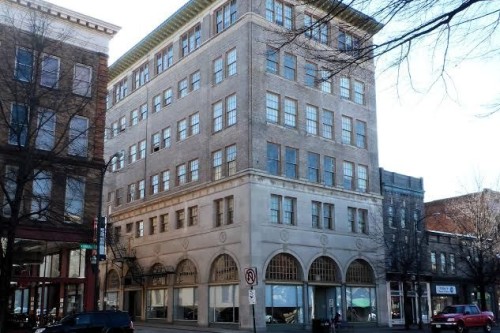
The Commonwealth Club

Architect: Carrére and Hastings
Dates: 1891
Address: 401 W. Franklin St.

The Commonwealth Club is one of Richmond’s most historic and opulent private clubs and its building reflects this. Founded in 1890, The Commonwealth Club was a social gathering place with facilities for dining, fitness, and drinking. Initially the club commissioned a local architect but ultimately chose the top tier New York firm Carrére and Hastings to execute the design.Upon the request of the clientele, the building melds elements of both Richardsonian Romanesque and Colonial Revival styles. The overt asymmetry of the building, particularly its north facade, and use of brownstone to frame arches and rusticate the base clearly display the fashionable Romanesque tendencies of the time. In keeping with Virginia’s colonial roots, Tuscan columns and a Palladian entry were combined into the structure. Carrére and Hastings even added its uniquely overblown high Beaux-Arts cartouches to the facade, rendering them in terra cotta.

The Commonwealth Club stands in Monroe Ward, just blocks from Carrére and Hastings’ other Richmond projects, the Jefferson Hotel and the Mayo-Carter House (the Junior League headquarters at 205 W. Franklin St.). It remains as lovely a building to visit as in 1890 but don’t get too excited about joining the club; membership is by invitation only and is limited to males.

D.OK.

The Jefferson Hotel

Architect: Carrère and Hastings

Dates: 1892-1895


Address: 101 West Franklin Street, Richmond, VA

The Jefferson Hotel is one of the finest examples of Beaux Arts Richmond architecture and certainly one of the grandest. Conceived and funded in 1892 by Gilded Age Richmond business leader Lewis Ginter, the design was carried out by the very best from New York, Carrère and Hastings.John Mervin Carrère and Thomas Hastings were both trained at the Ecole des Beaux-Arts in Paris. Both apprenticed with the firm of McKim, Mead and White, the most influential and sought after firm in America in the Beaux Arts period. Carrère and Hastings founded their own firm and designed projects such as the New York Public Library main branch and the Standard Oil Building. In addition to work in New York, the firm designed across North America and in Europe.

Even given the scope and scale of their works, The Jefferson Hotel was by no means a minor project. Carrère and Hastings drew largely from Italian Villa typology especially on the building’s north facade. This faces Franklin Street which is largely composed of brownstones and townhouses with projecting bays and turret elements. The tuscan towers of the Jefferson’s north facade break up the monotony of the broad Street frontage and relate to the composition of Franklin Street.The building’s south face is perhaps even more grand though certainly less inventive. Columns and entablatures frame massive arched windows to grand interior ballrooms. Ornamental swag and massive, exuberant cartouches (a trademark of the firm) decorate the face.  Above the first few levels the detailing falls sharply which makes the upper facade appear unresolved. Even so, the Jefferson is a more than a valuable asset to Richmond’s urban fabric and history.Unfortunately, the Jefferson is currently fronted on almost three full sides by surface parking lots. Nowhere is this condition more egregious than on the south facade (facing Main Street) where the grand columned facade is met with an entire block of parking. This block is one of the places most needing of thoughtful infill in all of Richmond. While many structures surrounding the hotel have been destroyed the Jefferson itself was saved; demolition was considered in the 1970s.

Today, the Jefferson remains the finest hotel in Richmond, holding both the coveted AAA Five Diamond rating and the Mobil Five Star rating. There is little doubt that it will serve as a key anchor point for the development of the surrounding Monroe Ward and as a Richmond landmark for decades to come.

D.OK.