White House of the Confederacy and Museum

White House of the Confederacy 6


Architects: Robert Mills, Petticord Associates
Date: 1818, Museum and renovation 1976
Address: 1201 East Clay Street

The Museum of the Confederacy’s main building, completed in 1976, was built to house the institution’s collection of confederate artifacts, the nation’s largest. The institution is the oldest museum in Richmond, founded in 1890, and includes on its grounds the White House of the Confederacy, the home of Jefferson Davis from 1861-1865.

The vast collections were originally kept in the house but in the 1970’s the museum shifted its collection to the new building and restored the White House to its original state. The museum sits on the same block as the historic structure, deep within Richmond’s Court End neighborhood. Together, the buildings and the garden space in between form an intimate and urban museum campus.

The White House of the Confederacy was designed in 1818 as the home of a wealthy Richmond bank executive. Robert Mills, architect of the Washington Monument, designed the building. The newer museum, the work of Petticord Associates, is a sharply modern structure that sits back from the street and takes a “L” shape, forming a square courtyard space between it and the historic center of confederate power.

The Museum of the Confederacy is a worthy piece of architecture in and of itself, but it is the interaction between it and the neighboring White House of the Confederacy, the way in which the modern structure responds to the historic mansion, that makes it one of the most intriguing and thoughtful works of architecture in Richmond. Robert Mills’ design for the home’s exterior is a massive, weighty, and stark piece of neoclassicism in the vein of famous English purist William Kent. The vast, unadorned planes of gray stucco, heavy double-column pairs on the rear porch, and sparse iron detailing give the house a sense of monumentality and simplicity nearing architectural brutalism.

This is picked up and elaborated on by the new museum building. Coffers, cantilevers, and bands of concrete suspended off of the main faces create shadow lines and ceiling details that mirror the massive porch of the historic structure. A nearly symmetrical face with three equally sized bays sits opposite the garden from the White House, foils the building and creates a secluded garden that seems a different world from the bustle of the high rise medical structures of the surrounding neighborhood.

D.OK.

Union Presbyterian Seminary

Union Presbyterian 6


Architects: Charles H. Read, Jr.; The Glave Firm; and Glave & Holmes Architects
Date: 1896 and additions and renovations
Address: 3401 Brook Road, Richmond

Travel along Brook Road through the Ginter Park neighborhood and you’ll unsuspectingly come upon Watts Hall. This glorious hulk of a building houses administrative offices, classrooms and a chapel at Union Presbyterian Seminary. It is a visually thrilling symphony in red brick. Since the topography in Northside Richmond is flat, this massive Tudor Revival structure rises mountain-like to lord over the surrounding area.

Hampton Court (the 1513 Thames riverfront palace Henry VIII once occupied in the London suburbs) probably provided Richmond architect Charles H. Read, Jr. with a historical reference point for Watts Hall, but Thomas Jefferson’s plan for the Lawn at the University of Virginia in Charlottesville inspired Read’s overall seminary campus plan. Similar to how the Rotunda sits at the top of the Lawn, at the seminary Read made Watts Hall the axial focus of his grassy quadrangle. And similar to UVA, this greensward is lined with faculty homes and student dormitories. But whereas Jefferson’s buildings face into the campus, Read set his buildings fronting outward. This was to symbolize the increasingly popular trend at the turn-of-the-last century toward a social ministry— spreading the gospel outward into the community.

For most of the 20th century the seminary’s unrelenting assemblage of brick buildings was dour architecturally. But in the 1970s, under the guidance of the Richmond firm of Glave Newman Anderson, Richmond Hall (a dormitory and dining hall) was remodeled with an injection of modernism. And in 1996 the William Smith Morton Library, designed by The Glave Firm, was completed at the opposite end of the quadrangle from Watts Hall. The library, with its spectacular lobby that rises three stories to a glass ceiling, incorporates Schauffler Hall, a former chapel and classroom building that was built in 1922 and designed by Baskervill and Son.

More recently, the interior of the former seminary library has been dramatically retrofitted by Glave & Holmes to create the Early Worship Center with its strikingly minimalistic Lake Chapel which is set into a space that formerly contained library stacks.

E.S.

Virginia Commonwealth University Cary Street Gym


Architect: Wilfred E. Cutshaw
Date: 1891
Address: 101 S. Linden St.

2010 renovation and expansion by Moseley Architects (lead), Smith+McClane Architects (exterior) and Hastings+Chiverta Architects (consulting)

There may be no more popular building on the Virginia Commonwealth University Monroe Park campus than the Cary Street Gym on the southern edge of the sprawling grounds. This late-19th century city market, which was later converted into a municipal auditorium, has recently found new life as a fitness center for one of the state’s largest universities. In the most recent conversion, completed in 2010, the architects respected totally the solid bones of the granite and red brick Italianate structure, but expanded it substantially by wrapping an L-shaped addition around the eastern and southern sides of the building. The addition, which brings the total square footage to 125,000 square feet, is highly sympathetic to the original structure while also respecting the pedestrian scale of its Oregon Hill neighbors.

The elegantly-proportioned and well-detailed former two-story market was designed by  Wilfred E. Cutshaw, a Richmond city engineer. It recalls similar structures in the days before refrigeration in such cities as Washington, D.C., Florence, Italy and Barcelona. Large windows, broad door openings and high ceilings eased comings and goings and allowed for good ventilation in an era before air conditioning.

In converting the barn-like structure into a university fitness center, the team of architects cleaned up the bones of the building and treaded lightly in the design of the their additions. Today, gym rats enter from the western, Linden Street side of the building by passing under a new loggia that announces the entry while not overwhelming the landmark. Upon entering, the reception area is just a few steps to the right. Enticing views of the open weight room and climbing wall are visible beyond a lattice-like metal screen.

On the eastern side of the old building and fronting Cherry Street, four adjacent basketball courts have been added. These are easily convertible for other sports. One flight up and encircling the space is an indoor track. On the south side of the former market an aquatics center and indoor practice field provide additional activities areas. Glorious natural light floods the interior. The exteriors on the eastern and southern sides, while unnecessarily busy, still mesh harmoniously with the modest Oregon Hill dwellings nearby.

The Cary Street Gym provides a textbook case in excellent adaptive reuse and savvy, but sensitive infill design.

E.S.

Wilton House


Date: 1753
Address: 215 S. Wilton Rd.

Constructed in 1753, the Wilton House Museum is among the oldest buildings in Richmond. Originally, it served as the rural plantation home of the influential Randolphs, one of the First Families of Virginia. It was moved to its current location in Richmond’s affluent West End in 1933 as its original surroundings industrialized. The lavish Georgian mansion hosted many notable visitors such as George Washington, Thomas Jefferson, and Marquis de Lafayette.

The building’s exterior is spare and simple despite its grand scale. Its largely unadorned brick faces and sharp planes of slate roofing serve as canvases for the swaying shadows from foliage above. The house is a beautifully crafted study in proportion, mass and texture, metal and wood accents harmonizing with the slate and brick of the large cubic volume. An axial path leads up to the central entrance, continues through the house, and extends down rear terraces to a small brick patio overlooking the James River. Across the river, the entirely undeveloped Williams Island can be seen. The illusion of wilderness helps to ground the antiquated building in a proper context.

Wilton House is now a museum open for tours which focus largely on its authentic Georgian interiors. The original plantation site featured several symmetrically organized companion buildings only one of which was moved to the current location. Still, with the help of some well placed signage at the museum’s entrance, it is possible for a visitor to extrapolate what it must have been like to visit the grand home so many years ago.

D.OK.

For more information on the museum’s history and accessibility, see link:

http://www.wiltonhousemuseum.org/

University of Richmond

Westhampton Lake as seen from the Student Commons

Architect: Cram and Ferguson, architect; Carneal and Johnston, associate architect; Warren Manning Associates, landscape architect.
Date: 1914
Address: 28 Westhampton Way 

Many Richmond commercial and residential areas developed westward after the installation of electric streetcars in 1888. The University of Richmond, which was located near the intersection of today’s Lombardy and Grace streets, established a sprawling, 200-acre suburban campus at the terminus of the Westhampton trolley line. The move allowed for the introduction of a women’s campus as well as expansive new sports facilities. The Boston architecture firm of Cram, Goodhue and Ferguson attempted to establish a cloister-like environment in the Gothic Revival style. This approach had already garnered the firm praise for its designs at the United States Military Academy at West Point and at Princeton University. For the Richmond campus, however, due to budget restrictions, the firm substituted brick and cast concrete where it would have preferred to use stone. Cram completed eight initial buildings including Ryland Hall, the refectory, the stadium, Jeter and Richmond dormitories, North Court (the woman’s Westhampton College), the power plant and Millhiser Gymnasium. With World War I occurring soon after the campus was completed, however, construction was halted for a number of years and the Cram firm never returned.

Over the ensuing decades, planners and architects strayed from Cram’s vision of a cloister-like monastery in the wooded countryside: Instead they created a more picturesque setting with Westhampton Lake as the centerpiece. However, with the exception of a brief flirtation from the 1960s to ‘80s with modernism and post-modernism, in the 1990s the university resumed building, (almost slavishly) in the collegiate Gothic mode. The best of the most recent buildings include Weinstein Hall (which houses the political science department) by SMBW.

E.S.

Current: Steven Holl unveils the design of the VCU Institute of Contemporary Art

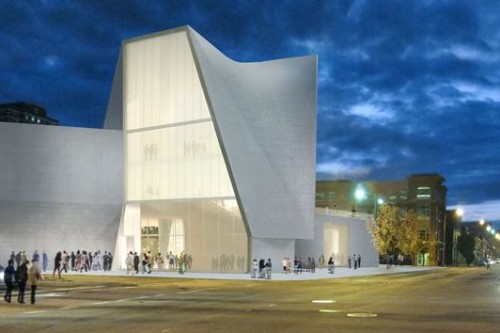
Steven Holl, world famous architect and winner of the 2011 AIA Gold Medal, unveiled his plan for the new VCU Institute of Contemporary Arts today. The 32 million dollar project is a landmark achievement for Virginia Commonwealth University’s highly rated School of the Arts.

The building will sit at the south west corner of Broad and Belvedere streets, Richmond’s busiest intersection. The design responds to the intersection with a curved wall of weathered zinc and a curtain of plate glass. The other side of the building features projecting bars of space that define a sculpture garden with a water feature and cafe. This softer side of the exterior is meant to relate to the irregular, forking grid of the fan district, which the building borders.

The 38,000 square foot ICA will contain numerous spacious galleries, a large atrium, landscaped sculpture terraces, a 240 seat theatre, and more. Needless to say, the building will be well equipped to host the most ambitious shows and installations from internationally acclaimed artists.

Holl will introduce further ICA drawings and renderings, as well as a series of his signature architectural water colors, at the Meulensteen gallery in New York City on Thursday. The exhibition will travel to the Virginia Center for Architecture later in the year.

ArchitectureRichmond’s own Edwin Slipek, who also serves as architecture critic for Style Magazine, recently interviewed Steven Holl about the ICA and his view on architecture in general. The interview will be published in Style in the coming days. Check back for our continuing coverage of this project.

D.OK.

Opinion: Egyptian Buidling

Architect: Thomas S. Stewart
Dates: 1845
Address: 1200 E. Marshall Street Richmond VA
 

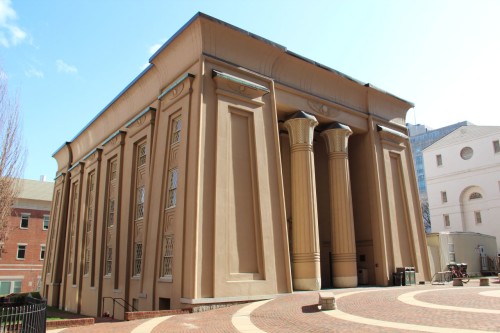
We often look at buildings, if only subconsciously, as what we want them to be. In the case of the Egyptian Building, the preserved, ‘un-ruined’ nature, coloring and stereotyped images could easily be perceptually subverted to tackiness, a tawdry example of American Egyptomania. But it is important to distinguish mere Egyptian flair on a piece of architecture from a building whose design intent was dedicated to authentic principles. This is one such structure. The building sacrifices a large amount of natural light in an effort to emulate the heavy stone construction of Ancient Egypt, and continues Egyptian motifs continuously throughout the interior. (It’s definitely worth it to venture inside if you haven’t yet.)However the building isn’t completely true, as it is made of brick, cast iron and stucco. The southern and northern faces display a line of rhythmic windows, a hint to the contemporary uses and technologies. But this intervention doesn’t diminish the quality of the Egyptian identity. It rather proposes an intriguing duality and informs the viewer that the building, whose image is borrowed from the past, is used for contemporary operations.

It is interesting and possibly rare that the dominant face of an Egyptian style building, a typology known for its monumentality, faces a relatively small courtyard and is opposite another structure much larger in scale. The approach to the entrance also increases its mystique as a heroic yet hidden piece; as tucked away as is possible for a building in a downtown and guarded by a fence, the structure sits with a quiet power.

Perhaps it is this small scale and starkly juxtaposed surroundings that allow the Egyptian Building to achieve an endearing uniqueness as opposed to an overindulgent nostalgia. There’s nothing inherently wrong with employing techniques and aesthetics of another culture or time, if the execution is tactful and the purpose is justifiable. In 1845, the Medical College of Virginia could easily have erected a nondescript, brick building whose legacy would fade into the vast collage of Richmond’s history. Instead, a cultural icon exists, speaking to the spiritual and esoteric power of MCV and the field of medicine in general. A boldly different yet sensitive Richmond landmark is known, not as a surgery theater, but simply as The Egyptian Building.

M.F.A.

Opinion: ChildSavers Building

Architect: Philip Johnson, renovation by Baskervill
Dates: 1968, renovation in 2007
Address: 200 North 22nd Street

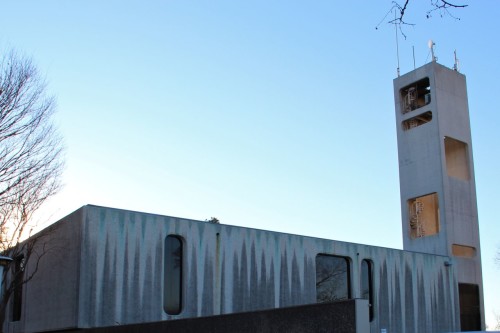
Philip Johnson’s WRVA radio station, now the ChildSavers building, goes beyond padding Richmond’s architectural resume with an illustrious name. The building functions as a beacon of creativity and innovation in one of Richmond’s oldest neighborhoods. The materiality of concrete and glass along with broad and uninterrupted faces have a classically modern identity but the irregularly spaced rounded windows and triangular patio reveal the mind of an architect in a state of flux.

Johnson is a famously eclectic architect. Looking over his oeuvre at random might make him come off at stylistically schizophrenic, however, when understood chronologically, there is a steady and almost methodical progression to his work. In the ChildSaver’s building, one catches Johnson in a key exploratory period between his Mies van der Rohe influenced International style phase and his later forays into postmodernism.

While the building is rarely included in lists of Johnson’s most famous work, I believe it is an invaluable and singular piece in the scope of his architecture. The building does not expose a  structural skeleton or include transparency effects typical of earlier projects like the glass house or Seagram building. Instead, openings punched through solid walls anticipate the developments of his postmodern works without including the often clumsy ornamental forms that came along with them

Despite the vast stylistic gaps between the 1800th century homes in Church Hill and the ChildSavers building, Johnson managed to tie his structure to the urban fabric. The relationship to the site harmonizes with the city in an oddly southern manner. Its broad lawn facing the city sets the building back gracefully. The facade on N. 22nd Street does not meet the side walk but instead retains a small strip of green space as most homes in Church Hill do. Even the blank faces are not as stark as those of early international style buildings. The worn and richly textured concrete accented by the swaying shadows of the trees planted close by recall the reserved southern homes of A. Hays Town more than Corbusier’s Villa Savoye. The building reaffirms its surrounding environment without being overly referential and without compromising the vision of the clients and architect.

From the rooftops of Church Hill both the steeple of St. John’s Church and the broadcast tower of the WRVA building can be seen, inviting comparison. One the beacon of religion and a symbol for the center of a community; the other an expression of modern times and modern interests. I could think of no better pair of buildings to represent the neighborhood.

D.OK.