The Chesterfield

The Chesterfield 6


Architect: Muhlenburg Bros. with Noland & Baskervill
Dates: 1903
Address: 900 West Franklin

The Chesterfield Apartments opened in November 1903 as Richmond’s first high-rise apartment building. It was also the first building of such a large scale on the prosperous blocks of West Franklin Street near Monroe Park. The building holds a cherished place in Richmond’s collective memory as the home of the Chesterfield Tea Room. At the time of it’s closing in 1988 it was the city’s oldest continuously operating dining establishment.

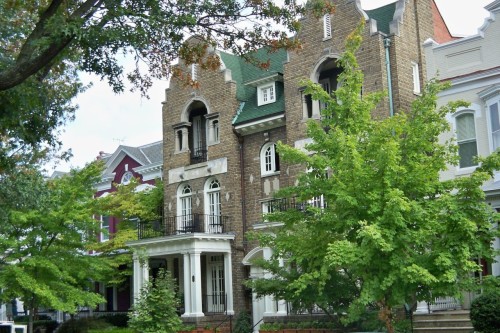
Seven stories sit atop an english basement that now contains a book store. The former tea room still houses a restaurant. Following the building up from the ground, a traditional classical order is observed. The lightly rusticated stone base transitions into a dark brick and culminates in a novel stuccoed cornice. Bands of wrought iron balconies and bay windows emphasize verticality, a feature that becomes all the more pronounced when compared with the 3 story structures surrounding it.

The Chesterfield is an indispensable element in the West Franklin Street historic district, an area characterized by luxurious town-homes, most of which have now been converted into offices or apartment buildings. The tower’s juxtaposition in scale and introduction of a retail element bring vitality and intrigue to the pedestrian experience. The building is also a contributing structure in what is colloquially known as the “Monroe Park Skyline,” an assemblage of mid and high-rise buildings surrounding Richmond’s Monroe Park.

D.OK.

The Pollak Building

Pollak 1


Architect: Ballou and Justice
Dates: 1970
Address: 325 N. Harrison Street

On Harrison Street at the eastern terminus of West Avenue lies the Virginia Commonwealth University’s Pollak Building. The building is occupied by various parts of the VCU School of the Arts including the office of the dean, and the graphic design, fashion, film, and photography programs.

The Pollak Building is, in plan, reminiscent of Louis Kahn’s monumental form of modernism. The large stair towers anchor the building’s four corners while rectangular classroom blocks span the space in between. This creates a large interior courtyard planted with magnolia trees. This space is linked by foot paths to the Anderson Gallery, the Scott House, and the center of campus.

The courtyard is accessible to the public by way of a raised brutalistic arcade that extends to front Harrison Street. The street itself is presented with two main elements. First, spare concrete piers and stairs with a textured pattern left from the form molds used to create it and, second, a low brick wall. The space, though generous and attractive, is underutilized. This is somewhat troubling considering the high premium on space along the retail-heavy Harrison Street.

The principle facade begins at a story above street level and continues up a further 3 stories. Each of the four bars of classrooms and offices that make up the building are sided with blank concrete and fronted with concrete bands containing brick bays, each with two windows. The vertical windows and grid system employed by the facade reference the surrounding Victorian apartment and office buildings.

Recently, the building was outfitted with a green roof. VDMO Architects designed the roof to meet environmental goals such as reduced heat absorption and storm water runoff but the space is also recreational. A small terrace with views of the surrounding Monroe Park skyline and Fan District roof scape is a welcome addition to the Pollak Building.

D.OK.

Mixed Use Mid-Rise on Shafer and Grace Streets

Shafer & Grace Mid-Rise

Image courtesy of http://www.loopnet.com


August 2014 is expected to bring yet another mid-rise project to Grace Street in the Lower Fan District. The building currently on the site, a one story brick retail structure, will be demolished beginning as early as this month. 

The 11 story, 170,000 square foot building will contain 152 apartments and a 3,400 square feet retail space situated on the corner of Grace and Shafer Streets. ShaferGrace LLC is developing the 22 million dollar project with Walter Parks serving as architect. Once completed, the structure will be one of three on the corner to be completed within the last 3 years.

Parks is also designing a 7 story mixed-use building for VCU on the same block, set to be completed at around the same time.

D.OK.

Architects of Richmond: Albert F. Huntt

Stern House


Article and photographs by Robert P. Winthrop.

As part of a continuing series we are featuring an essay from a guest writer, Robert Winthrop. Winthrop is partner at Winthrop, Jenkins, and Associates, a Virginia based architecture firm specializing in historic renovation. Historic buildings have also been his focus in numerous writings and lectures. As author of The Architecture of Jackson Ward, Cast and Wrought: The Architectural Metalwork of Downtown Richmond, Virginia, and Architecture in Downtown Richmond, Winthrop has established himself as an authority on the city’s architectural history.

Winthrop has adapted these essays from a lecture series at the Virginia Historical Society. The series, entitled “Sophisticates and Wild Men,” followed the interaction between the exuberant Victorian architects and the sober classicists at the turn of the twentieth century.

 *   *   *

Albert Huntt is a problematic architect in many ways.  While modern Americans admire imagination, many would regard Huntt as being too imaginative. The line separating daring, imaginative and eccentric from downright crazy seems to be blurred in Huntt’s case. When looking at his more exuberant works, it is tempting to see a naïve and untrained wild man who was unaware of the “right” way to do things.

This is a complete misunderstanding of Huntt and his architectural approach. Huntt had the misfortune to be an adventurous and imaginative classicist.  The Twentieth Century has tended to admire the academically correct approach to classicism. Bold and imaginative tendencies have tended to be regarded as incorrect in the world of modern classicism.

Albert Huntt was a Richmond native and the great-grandson of Otis Manson, one of the bolder designers in early Richmond.  A New England native, Manson came to Richmond in the first decades of the nineteenth century and designed a number of sophisticated buildings. He seems to have been in tune with Jeffersonian Classicism in its more imaginative forms.  This was clearly important to Albert Huntt who went so far as to mention on his tombstone in Hollywood Cemetery that he was the descendant of Otis Manson, Richmond’s first architect.  It is tempting to see some of Albert Huntt’s more daring essays in the Colonial Revival as an effort to continue Otis Manson’s bold approach to architecture.

Otis Manson’s son, Dr. Otis Manson, became a distinguished doctor and professor at MCV.  His daughter married Albert Lee Huntt, the father of Albert F. Huntt.  Dr. Manson’s obituary mentions his charitable work for the employees of the Allan & Ginter Tobacco Company.  This may have played a role in his grandson’s architectural career.

The first academic program in architecture in the United States was established in 1865 at M.I.T., three years before Huntt’s birth.  Huntt went to school at the Pennsylvania Military Academy in Chester, then an outer suburb of Philadelphia. The PMA is now Widener University.  Architectural education was not standardized to any degree in the later 19th century.  The PMA architectural program was small. Fortunately Huntt kept a scrapbook of his years at the college that is preserved in the Widener University library. The architectural classes at the PMA were taught by Silas Gildersleve Comfort Jr. (1863-1910).

The Comfort family played an important role in American art and architectural education in the post-Civil War period.  Silas was the youngest son of Silas Gildersleve Comfort (1808-1868) who died five years after Silas Junior’s birth.  The elder Comfort was a noted abolitionist and a prominent Methodist minister.  Silas G. Comfort Jr.’s oldest brother, George Fiske Comfort, and his wife Anna Manning Comfort raised him as their son.  George was an author, educator and artist. He wrote a series of text books on modern languages and studied art abroad. In 1870 he was a founder of the Metropolitan Museum of Art in New York. He remained involved with the Metropolitan until his death in 1910.  In 1872, he was elected Professor of Modern Languages and Aesthetics at Syracuse University.  There he founded the Fine Art College and afterward founded the Syracuse Museum, now the Everson Museum of Art. He was a pioneer in art and architectural education. 

Silas Comfort Jr. took his degrees in engineering and architecture from his brother’s program at Syracuse and then received a Master of Architecture degree, one of the first in the nation.  He then began his 25 year teaching career at PMA.  We know Silas wrote his own textbooks for the architectural course.  He was interested in structural engineering and was much involved in steel design.  Given the intellectual and artistic tastes of the Comfort family, there is a good chance the courses at the P. M. A. were modern and up to date.  

In the later 19th century, the eccentric master Frank Furness dominated Philadelphia’s architectural profession.  Furness’ architecture is now was regarded as being bold and imaginative in excess. The young Louis Sullivan was so impressed by Furness he went to work for him.  While Furness was eccentric, he also attracted prestigious commissions from the Pennsylvania Railroad, the Philadelphia Academy of Art and the University of Pennsylvania. The Philadelphia art scene included gifted eccentrics such as the architect Wilson Eyre, the painter Thomas Eakins and Walt Whitman, America’s greatest 19th Century poet.

Albert Huntt married Georgiana Bartram Hathaway of Chester after graduation.  She was the descendant of John Bartram, America’s greatest early botanist. Bartram was a friend of Jefferson and Benjamin Franklin and was a co-founder of the American Philosophical Society. Her distinguished ancestor must have helped his career.  In 1902, Georgiana was the secretary of the Art Club of Virginia.   Major Dooley was the President of the Art Club. She was much involved in the Daughters of the American Revolution. 

After his graduation and marriage Huntt returned to Richmond and worked for German born architect, Carl Ruehrmund in 1893-94 and went out on his own in 1894.

Huntt had a broad ranging architectural career and produced industrial, commercial, institutional and residential buildings.  One assumes his grandfather’s association with Allan & Ginter led to factory and warehouse designs for the American Tobacco Company, Allan & Ginter’s successor firm. Albert Huntt was the architect for the American Tobacco Company and designed the impressive Climax warehouse of 1900 on Tobacco Row.

Three large brownstone and brick houses survive from his first years after returning to Richmond.  1501 and 1503 Grove Avenue are fine examples of the Richardson Romanesque. Both built in 1895, they perfectly represent the architectural tastes of the Brown Decades. There is a third house on Franklin Street and a row of townhouses on Grove Avenue form this period.  

Huntt transitioned from the substantial Romanesque to the newer Colonial Revival styles in the next decade. In 1907, he designed a fine residence for Cary Ellis Stern at 1700 Grove Avenue.  While it clearly inspired by the century old John Marshall house, it is not a copy. With its well-detailed Doric porch, it is both up to date and respectful.

Two years earlier he designed the George house at 1831 Monument Avenue, his first house on the street.  This house has the substantial feel of the Romanesque combined with Georgian details and composition.  While Huntt could be restrained and correct, he rarely chose to be so. He wasn’t interested in antiquarian reconstructions.

By 1913 the Lafferty house on Monument Avenue displays a baroque approach to classicism. The front is divided into two bays; one is larger than the other. The entrance porch uses a mixture of Ionic and Corinthian columns. The entablature features triglyphs from the Doric order.  Thus, he used elements from all three of the classical orders in this remarkable creation.  To say that the porch disobeys classical rules hardly begins to express the composition of the house.

The Sorg House of 1914 on Monument is a classical, theatrical fantasy on Classical themes. Sorg was the vice president of the Millhiser Bag Company, and Huntt had redesigned a house at 1100 Grove Avenue into an apartment house for the Sorg family in 1912. 

The Sorg residence has a bowed front porch with the central stair flanked by triple Ionic columns, two of which step down the stair. The façade behind the porch is asymmetrical with an off center entrance.  This asymmetry is typical of Richmond town house design.

The upper level of the house features two bay windows flanked by Ionic columns and crowned by broken pediments. A grand total of 14 Ionic columns embellish the house. It is a dazzling composition obeying no Classical rules or conventions.

Hunt designed other, tamer houses on the street, but all are of interest. At 2300 Monument Avenue, Huntt redesigned Richmond’s typical step gabled Greek Revival, townhouse of the sort designed by Otis Manson.  Manson was the designer of the Elmira Sheldon house on Church Hill. The Monument Avenue house is bigger and more monumental, but clearly reflects Huntt’s awareness of Richmond’s architectural history.  

At 2500 Monument, Huntt rethought Richmond’s Greek Revival mansion designs such as the Barrett House. The basic composition is Greek Revival with a central porch flanked by triple windows. The massiveness of the house also recalls Richmond’s taste in the 1840s and 1850s as can be seen in the Glasgow or Barrett Houses.  The architectural embellishment is all-new and all Huntt.

One of Huntt’s later commercial designs was for a car dealership on Broad Street. Here his inspiration was the light, elegant 18th Century classicism of the Adam Brothers. Here Hunt was bold, imaginative and almost delicate in his detailing. The building is both modern and classical. His library for the St, Andrews Association is one of the few buildings showing a strong Art Nouveau influence in Richmond.

His final buildings on Monument Avenue, the Kenilworth and Stratford Court apartments feature four triple-tiered porches supported by triple Corinthian columns. Well preserved, these illustrate Hunt’s work well. If Bernini were designing apartment houses on Monument Avenue they might look like this. The entrance design breaks the Bernini fantasy. Again, the doorway breaks every classical rule.

Huntt lists the young Richmond architect, Bascom Rowlett as the associate architect for these apartment houses and several other buildings in the later teens. It is tempting to attribute some of Huntt’s later works to the imaginative Rowlett. However Rowlett’s independent work doesn’t resemble Huntt’s work.  Rowlett was interested in exotic styles and while he produced a number of Classical apartment houses, they never approached the exuberance of Huntt’s work.  Huntt died in 1920.

Huntt’s work does not fit into the stereotype of the conservative southern architect.  His designs were bold, imaginative and a bit eccentric. He was also successful, and had many successful businessmen as his clients. While he worked in a classical style, there is little antiquarian in his works. 

Robert Winthrop

Retail Design in Richmond Part I: Need Supply and Black Swan Books

Need Supply Co. 2


Need Supply Co.

Architect: BAM Architects
Dates: 2007-2010
Address: 3100 West Cary Street 23221

Black Swan Books

Architect: BAM Architects
Dates: 2003
Address: 2601 West Main Street

Since 1996, Need Supply Co. has dealt in boutique women’s and menswear from its store in Richmond. Over the years, it has developed a large online presence. Recently, it was named as one of the 25 Best menswear stores in the nation by GQ magazine. This accolade is due largely to the items that Need Supply carries but, as the article made clear, the aesthetic of the store itself was a large factor in the decision.

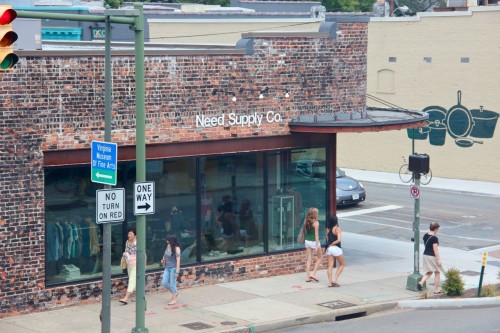
Need Supply Co. is headquartered in Carytown, the city’s most fashionable shopping district. Its corner site consists of a low, brick building with a large, cantilevered overhang. The building was given a thorough renovation by Richmond-based BAM Architects before Need was able to move in.

The result is easily one of the most striking and contemporary commercial spaces in Richmond. Exterior brick was stripped leaving its rough texture exposed; wood and steel structural features were given the same treatment. Handsome clothes racks, lighting fixtures, and casework complements the architecture. The company’s spare graphic design and signage program completes a total aesthetic that is as much about what isn’t there as what is.

Black Swan Books, another BAM Architects project several blocks away in the Fan District, takes a more traditional approach. Serifed fonts adorn the facade and packed bookcases fill the room. Upon closer observation, many similarities between Black Swan and Need Supply can be seen.  Exposed ductwork and raw materials are a constant though in this context they complement worn leather binding and blonde wood moldings rather than spare clothing displays. Black Swan’s extensive collection of rare books is housed in contemporary casework.

D.OK.

Cathedral of the Sacred Heart

Sacred Heart 1


Architect: Joseph Hubert McGuire, architect

Date: 1906 with 1996 renovations by Robert P. Winthrop
Address: 800 Cathedral Place

Virginia-born New York industrialist Thomas Fortune Ryan and his devout wife, Ida Barry Ryan, gave much of their considerable wealth to Catholic causes and institutions along the east coast. But nothing in their benevolence compares with the architecturally spectacular cathedral they donated to the Catholic Diocese of Richmond in the first decade of the 20th century. It is the world’s only cathedral paid for by a single donation. For many years Richmond parishioners had worshipped at the seat of the Roman Catholic Church there, Saint Peter’s, an elegant but much smaller church on East Grace Street. In the years following the installation of electric streetcar systems in 1888 however, the city’s residential population moved ever westward—and churches and synagogues followed. The site chosen for the new cathedral was on a site the diocese already owned directly across Laurel Street from Monroe Park.

The Ryans awarded the commission to Joseph Hubert McGuire (1865-1947), a New York City-based architect who had studied how to adapt the classical architectural idiom to modern uses at the Ecole des Beaux Arts in Paris. For Richmond, McGuire designed a Renaissance revival structure entered by passing under a colossal portico of six Corinthian columns. Fireproof tiles by Rafael Guastavino cover the porch’s ceiling (Guastavino also provided tiles for a number of major New York buildings and the city’s subway stations, the latter developed in part by industrialist/philanthropist Ryan).

With its flanking, twin towers, the church recalls vaguely St. Paul’s Cathedral, Christopher Wren’s London masterwork. Virginia granite and Indiana limestone are used on the exterior. And like St. Paul’s, a high dome rises dramatically at the crossing of the nave and transepts. The interior décor of the church is especially well articulated.

If the sanctuary is one of Richmond’s great single buildings architecturally, McGuire also delivered a highly successful complex of supporting buildings, including a bishop’s residence and church house. These are linked by a number of loggias of varying heights to establish the sense of an ecclesiastical village that has grown over time.

The richly hued stained glass windows were installed in the 1950s.
And in the 1990s some interior spaces were rearranged to reflect changes in the Catholic litany. Most notable was moving the high altar from the apse to the crossing. A crypt directly under the altar, reached by a circular granite steps, is the final resting place of Richmond bishops and members of the Ryan family.

E.S.


Dominion Place

Dominion Place 6


Architect:  Pietro Belluschi Inc. with Jung / Brannen Associates

Date: 1978
Address: 1025 W. Grace Street

A stoic brutalist slab, the 12 story Dominion Place rises out of the leafy Fan District near the corner of Ryland Avenue and Grace Street. It is the closest Richmond has come to Unité d’Habitation, Le Corbusier’s famous housing tower in Marseille, France. Concrete and glass are the materials, though some brick is used at the base and to delineate the central stair tower. The building features a communal roof terrace.  The asymmetrical facade and rhythmically changing horizontal window bands may make the building feel radical comparative to the older surrounding neighborhood. However, its effect on the community is nearly identical to the adjacent Gresham Court apartment tower.

Dominion Place shares many functional similarities with its historic neighbor on West Franklin Street. Both are much higher than the most of the surrounding neighborhood, both house a large number of people, and both are set back from the street. While plantings fill both buildings’ setback space, a little more street interaction would have been welcome. A key difference between the buildings is their inhabitants. Dominion Place was designed specifically for seniors and those with disabilities. The subsidised rent is relative to income rather than market rate.

Overall, the building is a constructive part of the Fan District. It may have some design shortcomings but there are few buildings that do not. Dominion Place adds texture, diversity, and 250 much needed units to the neighborhood.

D.OK.

Architects of Richmond: Otis Asbury


Article and photographs by Robert P. Winthrop.

As part of a continuing series we are featuring an essay from a guest writer, Robert Winthrop. Winthrop is partner at Winthrop, Jenkins, and Associates, a Virginia based architecture firm specializing in historic renovation. Historic buildings have also been his focus in numerous writings and lectures. As author of The Architecture of Jackson Ward, Cast and Wrought: The Architectural Metalwork of Downtown Richmond, Virginia, and Architecture in Downtown Richmond, Winthrop has established himself as an authority on the city’s architectural history.

Winthrop has adapted these essays from a lecture series at the Virginia Historical Society. The series, entitled “Sophisticates and Wild Men,” followed the interaction between the exuberant Victorian architects and the sober classicists at the turn of the twentieth century.

 *   *   *


Otis Kerr Asbury was the son of Josiah Asbury and Marry Farrow.  Josiah (1833-1902) was a well-known and respected building contractor in Charlotte NC.  Otis stated that his father was an architect, and I assume his father designed the buildings he built. There was no organized architectural profession in North Carolina or Virginia before the twentieth Century. It was quite common for contractors to refer to themselves as architects.  Otis’ uncle, S. J. Asbury, was also a contractor. S. J. Asbury’s son was Louis H. Asbury, one of North Carolina’s most important architects in the first half of the last century. He also was one of the earliest registered architects in the state and a founder of the AIA in North Carolina.

Otis lived in Charlotte in 1905, but was a Richmond resident in 1906. He worked with Charles K. Bryant in 1906 and Charles K. Howell in 1908. He established his own firm in 1911 with Herbert Whitehurst, an engineer. The Whitehurst family owned a firm manufacturing sash, blinds and doors. They lived on Monument Avenue in a handsome Colonial Revival house designed by Noland and Baskervill. The Whitehurst connections would have been useful for a young architect from Carolina. We know nothing of Asbury’s professional education, but his cousin Louis went to Duke and then to M.I.T.

In 1906 Richmond was thriving with much of the construction activity taking place in the West End and the Lee District.  Asbury was involved in two aspects of this work.  He designed upper class residences and upscale apartments.  With Monument Avenue experiencing a building boom and apartments becoming the rage, the environment was ideal for Asbury’s skills.

Asbury designed a number of houses on Monument Avenue, but he also designed a series of extravagant suburban houses associated with Byrd Park.  He seems to have been comfortable both within the limitations of the urban environment and the freer suburban setting.  He could be formal, grand or picturesque, depending on the desires of his clients.

His best known building is an apartment house, the ultra-picturesque Ingleside Court of 1916 on Davis Avenue. In 1914, he also designed two fine apartment houses, the Gladstone and the Gloucester on Cutshaw Place, now the Meadow Street triangular park. Along with the Stuart Hall Apartments on West Avenue, these buildings were among the finest of the period.

The most concentrated collection of his houses is in the middle of Byrd Park on Westover Road. In the course of the development of Byrd Park, (originally Reservoir Park) a fifteen acre parcel remained in private ownership. Asbury designed five large houses in the development. These must rank among the finest houses of the 1920s in Richmond. The earliest of these houses is the Lathrop residence of 1918 at 1000 Westover Road.  Asbury had designed a charming cottage for C. B. Lathrop at 1514 Park Avenue in 1915. In 1918 he designed a much larger house for C. W. Lathrop in the new development in Byrd Park.  This is a grand and elegant Italian villa.  While the house is impressive, it is also unexpectedly intimate.

In some ways it contrasts with Henry Baskervill’s residence a few blocks away on the Boulevard. Erected in 1912, the Baskervill house shares the same basic design elements, but seems to have to been designed to impress potential clients, more than to serve as a family home. Beautifully designed and detailed, the Baskervill house is an advertisement for the Baskervill firm. The Lathrop house also is impressive, but in a more residential character.

If the series of commissions that followed is any indicator, the Lathrop House was a great success.  The Watkins House at 704 Westover Road is a grander essay in the Italian manner.  Built in 1921, it is a broad and imposing mass of yellow brick and limestone. The owner’s initials, BW, are carved on the cartouche above the entrance.

A year later, Asbury designed another house a block away at 804 Westover Road. The Kauffman residence is a picturesque essay in the California-Mission style.  There is no trace of formality in its composition. Two houses built the next year are similarly informal, but they are in an English picturesque style. The house at Brandon Road and Westover Road and the second house at Brandon and Spotswood are informal in the extreme. These houses were built by another Watkins, so it is clear the family was happy with Asbury’s work. Asbury was also the architect of the long vanished Blue Shingles house, overlooking the James on the northern side of Byrd Park.

Asbury did little commercial work except for an unusual Classical bank on Church Hill and the Order of the Eagles Club house in Jackson Ward.

The Great Depression all but destroyed Asbury’s career as it did for most architects in the nation at the time. His last building permit in Richmond was for a house in 1939.  The previous residential permit was in 1925.  He was a member of the Virginia AIA from 1921 to 1929. It is possible he returned to Carolina in the later twenties. He continued to do limited work in Virginia.  He is buried with his family in Charlotte.