Virginia Museum of Fine Arts

VMFA 2


Architects: Peebles and Ferguson Architects, Norfolk (1936); Theater Wing, Merrill C. Lee Architects, Richmond (1954); South Wing, Baskervill & Son Architects, Richmond (1970); North Wing, Warren Hardwicke Associates, Richmond, and Sculpture Garden, Lawrence Halprin Associates, San Francisco, landscape architect (1976), both demolished; Lewis Mellon Wing, Hardy Holzman Pfeiffer Associates, New York City (1985); Frances G. McGlothlin Wing, Rick Mather Architects, London (2010) with associate SMBW Architects, Richmond.   

Dates: 1936-2010

Address: 200 North Boulevard

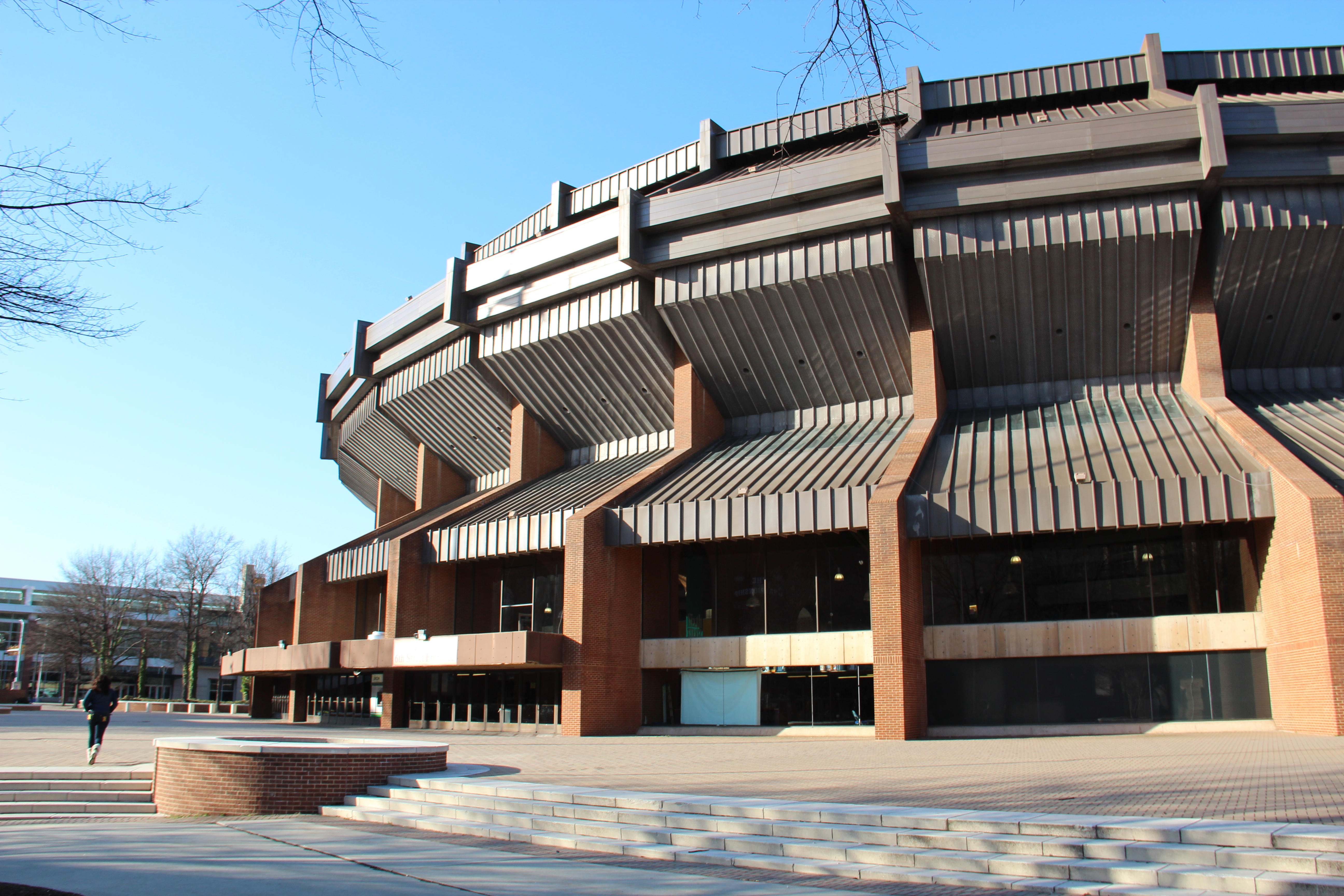
The Virginia Museum of Fine Arts was founded and is supported by the Commonwealth of Virginia. Its 14 acre campus, defined by Boulevard, Grove Avenue, Shepherd Street and the grounds of the Virginia Historical Society, is situated on the former Robert E. Lee Camp (for many years it was a retirement community for Confederate veterans and their female relatives). In 1936, during the Great Depression and with construction funding from the Federal Works Administration, the museum opened its doors to a structure elegantly oriented to Boulevard. Peebles & Ferguson Architects took its cues for the building’s design from a Late Renaissance addition to Hampton Court in London by Christopher Wren. The museum’s galleries were located on the upper level with offices and support facilities situated on the ground floor.

Additions were made in 1954 (for additional galleries and a theater) and in 1970 (for galleries). These continued the architectural spirit of the original, center block.

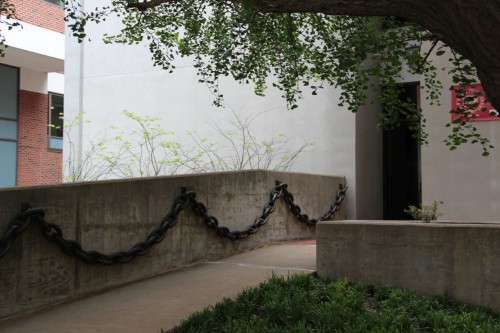
In 1976 another wing, by Warren Hardwicke Associates, and a walled sculpture garden designed by Lawrence Halprin Associates, were added to museum’s north end. These broke with the Wren-inspired classicism. The addition’s curved brick walls recalled the Johnson Wax Company building in Racine, Wis. by Frank Lloyd Wright.

In 1984 the architectural direction of the museum shifted again with construction of the Lewis Mellon Wing, built specifically to house the sizable collections of Sydney and Frances Lewis of Richmond and Paul Mellon of Upperville, Va. Architect Malcolm Holzman, in designing the building, broke with the museum’s exterior red brick, Flemish bond surfaces and introduced Indiana limestone. The wing is a witty tour de force architecturally that combines modernism with such refined classical elements as the Tuscan order (at the entablature) and muscular blocks of rusticated stone at the ground level that recall Henry Hobson Richardson’s Allegheny Courthouse in Pittsburgh.

In 2010 the museum reoriented dramatically how visitors approach the museum by demolishing the former North Wing and sculpture garden and building the Frances G. McGlothlin Wing which is approached by a new motor court. Designed by Rick Mather Architects, the building is unapologetically modernistic in every way: It combines exterior surfaces of Indiana marble with large, deftly handled expanses of sheet glass.

Key to the spirit and success aesthetically of the McGlothlin Wing is how the building seamlessly connects with the museum grounds through large window openings. Happily, a former surface parking lot has been replaced by an expanse of lawn and vehicles are now relegated to a 600 space garage that is largely hidden beneath a dramatically sloping and handsomely-landscaped sculpture garden.

E.S.

White House of the Confederacy and Museum

White House of the Confederacy 6


Architects: Robert Mills, Petticord Associates
Date: 1818, Museum and renovation 1976
Address: 1201 East Clay Street

The Museum of the Confederacy’s main building, completed in 1976, was built to house the institution’s collection of confederate artifacts, the nation’s largest. The institution is the oldest museum in Richmond, founded in 1890, and includes on its grounds the White House of the Confederacy, the home of Jefferson Davis from 1861-1865.

The vast collections were originally kept in the house but in the 1970’s the museum shifted its collection to the new building and restored the White House to its original state. The museum sits on the same block as the historic structure, deep within Richmond’s Court End neighborhood. Together, the buildings and the garden space in between form an intimate and urban museum campus.

The White House of the Confederacy was designed in 1818 as the home of a wealthy Richmond bank executive. Robert Mills, architect of the Washington Monument, designed the building. The newer museum, the work of Petticord Associates, is a sharply modern structure that sits back from the street and takes a “L” shape, forming a square courtyard space between it and the historic center of confederate power.

The Museum of the Confederacy is a worthy piece of architecture in and of itself, but it is the interaction between it and the neighboring White House of the Confederacy, the way in which the modern structure responds to the historic mansion, that makes it one of the most intriguing and thoughtful works of architecture in Richmond. Robert Mills’ design for the home’s exterior is a massive, weighty, and stark piece of neoclassicism in the vein of famous English purist William Kent. The vast, unadorned planes of gray stucco, heavy double-column pairs on the rear porch, and sparse iron detailing give the house a sense of monumentality and simplicity nearing architectural brutalism.

This is picked up and elaborated on by the new museum building. Coffers, cantilevers, and bands of concrete suspended off of the main faces create shadow lines and ceiling details that mirror the massive porch of the historic structure. A nearly symmetrical face with three equally sized bays sits opposite the garden from the White House, foils the building and creates a secluded garden that seems a different world from the bustle of the high rise medical structures of the surrounding neighborhood.

D.OK.

Opinion: Museum of the Confederacy


The Museum of the Confederacy is an exemplary piece of modernism in Richmond, responding to its site and program gracefully. The museum was designed in close proximity to the White House of the Confederacy, one of Richmond’s most significant historic buildings. Given this and its function as a frame for civil war artifacts, context is paramount in the design. The museum succeeds in its efforts to respond to the older structure while expressing the time in which it was built.

The Museum of the Confederacy is built in a style known to some as ‘Brutalism.’ The expression, born of the French term ‘Béton brut’ which describes exposed and unfinished concrete, refers to buildings composed largely of concrete and glass with irregular and asymmetrical massing.  The style was prevalent during the poor planning era of the 1960s and 1970s and is, as such, often associated with buildings that are unresponsive to the site and to human scale. The Museum of the Confederacy is a shining example of a building in the brutalist style working with the site and the context in an intimate and sensitive way.

The material is the most obvious connection between the two buildings. The Museum of the Confederacy uses a gray, lightly textured concrete which compliments the stark grey stucco of the White House beautifully. Mid afternoon light displays how rich and textured the concrete can be, appearing warmer and more irregular than the neighboring stucco. The plan of the building creates an intimate garden space that juxtaposes old and new beautifully. The face of the building directly opposite the White House mirrors its composition of symmetrical, regular bays while the massing of the building over all is an asymmetric ‘L’ which better suits the site.

The most invaluable gesture of the modern museum is that its largest cantilever, which covers the museum entrance, extends out towards the corner of the White House, creating a palpable tension. This reach, this search for a connection between present and past, between modern, objective scholarship and the tumultuous emotions of America’s Civil War, is abstracted and frozen in time. The Museum of the Confederacy’s achievement is in its dual nature. It both fosters a drama between it and its historic progenitor and crafts its mass, shadow, and material into harmony.

D.OK.

Current: Steven Holl Architects: Forking Time


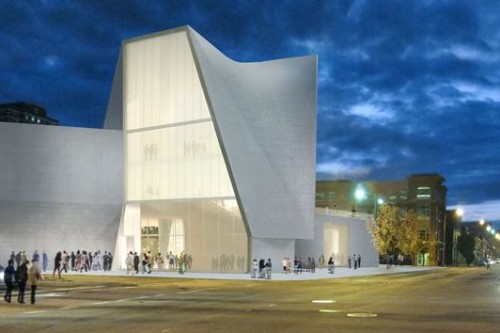
The Virginia Center for Architecture is currently hosting ‘Forking Time,’ an exhibition by Steven Holl Architects focusing on the design for the new Virginia Commonwealth University Institute for Contemporary Arts (ICA). Holl, last year’s American Institute for Architects Gold Medal winner, is considered by some to be the nation’s leading architect. Projects such as Kansas City’s Nelson Atkins Museum, the “Horizontal Skyscraper” in Shenzhen, China, and Simmons Hall at M.I.T. are among his most famous works.

Based in New York and Beijing, the firm tackles projects all around the world. Steven Holl and senior partner Chris McVoy have designed the new ICA  which is slated for completion in 2015. The exhibition, originally displayed at the Meulensteen Gallery in New York City, opened in Richmond on September 13th and will be on view until October 18th.

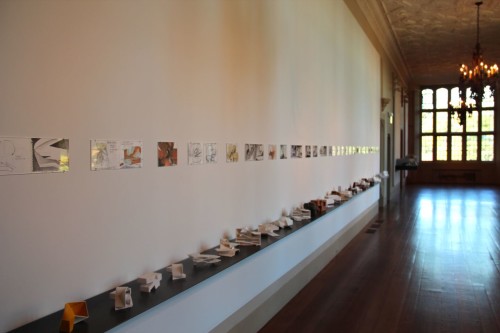
The heart of the exhibition is 30 some small study models culminating in a large model of the completed, or nearly completed, design of the ICA. Earlier iterations are formal exercises; various sculptural pieces with varying degrees of abstraction. It is the early models that are perhaps the show’s highlight. The intimate scale of the work and the generally high level of craft in the models make them visually appealing; Indian miniature painting comes to mind.

Each model is accompanied by one of Holl’s signature water colors. The progression of the models and paintings is easy to follow, later pieces being just shades off of the final design. A few exceptions include a pair of models a third of the way through this progression. One features a group of dark, stone-like fused elements, the other looks like a cube eroded from the inside. Holl is thought, by some, to be an architect who works in distinct modes. In these models we can see a design approach more reminiscent of his M.I.T. dorm or Chengdu’s “Sliced Porosity Block” as opposed to the final design which is more closely related to his Nelson Atkins addition or the Surf Museum in Biarritz, France.

Aside from these objects, the exhibition includes a bit of wall text and a screen displaying some computer renderings. Some wall mounted plans or sections could have been useful, but it is difficult to criticize the handsome minimalism of the exhibit.

If you have not yet seen the exhibit, it is well worth the visit. After all, it is not often that world renowned architects show work in our city, much less work on a major local project.

D.OK.

ArchitectureRichmond writer Edwin Slipek’s recent review of the show in Style Magazine:
The Architect’s Mind: How did Steven Holl create Richmond’s new Institute of Contemporary Art?

Virginia Center for Architecture:
http://www.virginiaarchitecture.org/vca_index.html

Steven Holl Architects:
http://www.stevenholl.com/index.php

Current: First Freedom Center

Image

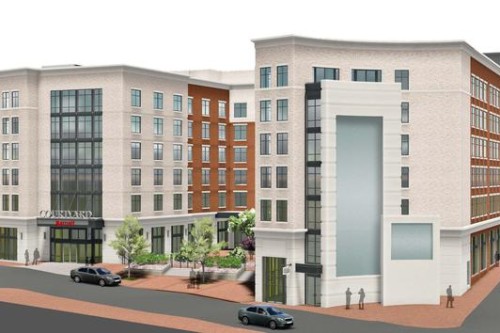
A major new development is headed for Richmond in the form of the First Freedom Center and Hotel. The building, which was approved by city council on Monday (the 23rd), will be built on the corner of 14th and Cary Street in Shockoe Slip. This site is now used as surface parking but it was once home to the State’s Capitol building where the Virginia Statute for Religious Freedom was signed into law.

The building will include a Courtyard Marriott and an extended stay Residence Inn which, together, will total 210 rooms. In addition, the First Freedom Center will occupy some of the building’s first floor. A monument to the important legislation passed on the site will occupy the corner while a the two wing hotel will take up the remaining space, leaving a plaza facing Cary Street. The building will permanently close a block-long section of Virginia Street, a historic cobblestone street that predates Richmond’s gridded city plan. Baskervill is the project’s architect; construction is set to begin in early 2013.

Check back for more coverage as this project develops.

D.OK.

First Unitarian Universalist Church

Architect: Ulrich Franzen
Dates: 1972
Address: 1000 Blanton Avenue

The First Unitarian Universalist Church of Richmond traces its roots back to 1830 when the Unitarian Universalist society was founded. It was the first congregation to use the term Unitarian Universalist despite several name changes in its long history. In 1906 the Unitarians built their first dedicated meeting house at the corner of Harrison and Floyd in the Fan District. Virginia Commonwealth University owns the building which still stands despite demolition threats.

In 1972 the congregation moved to its new building at the corner of Blanton Ave. and Garret St., adjacent to Byrd Park’s Carillon. The famously progressive institution selected famous and progressive architect, Ulrich Franzen. Franzen, a German born graduate of the Harvard School of Design, designed the building with strong influence from the much admired American architect Louis Kahn.

The Church is composed of large concrete block piers which protrude around the exterior. Inside of these are ‘service spaces’ such as restrooms, storage, and maintenance rooms. The negative spaces in between are the ‘served spaces’ such as large, open meeting rooms, art galleries, and a children’s center. Spanning between the heavy exterior masses are simple planes of glass and wood. Openings are either floor to ceiling view windows or angled clerestory strips designed to let in light only.

The strong, solid massing, formal repetition, and simple materiality of the building gives it a sense of place and permanence on its prominent site. The Unitarian Universalist Church is a invaluable addition to Richmond’s architectural portfolio.

D.OK.

The Commonwealth Club

Architect: Carrére and Hastings
Dates: 1891
Address: 401 W. Franklin St.

The Commonwealth Club is one of Richmond’s most historic and opulent private clubs and its building reflects this. Founded in 1890, The Commonwealth Club was a social gathering place with facilities for dining, fitness, and drinking. Initially the club commissioned a local architect but ultimately chose the top tier New York firm Carrére and Hastings to execute the design.Upon the request of the clientele, the building melds elements of both Richardsonian Romanesque and Colonial Revival styles. The overt asymmetry of the building, particularly its north facade, and use of brownstone to frame arches and rusticate the base clearly display the fashionable Romanesque tendencies of the time. In keeping with Virginia’s colonial roots, Tuscan columns and a Palladian entry were combined into the structure. Carrére and Hastings even added its uniquely overblown high Beaux-Arts cartouches to the facade, rendering them in terra cotta.

The Commonwealth Club stands in Monroe Ward, just blocks from Carrére and Hastings’ other Richmond projects, the Jefferson Hotel and the Mayo-Carter House (the Junior League headquarters at 205 W. Franklin St.). It remains as lovely a building to visit as in 1890 but don’t get too excited about joining the club; membership is by invitation only and is limited to males.

D.OK.

An Interview with Steven Holl

On April 25, the School of the Arts at Virginia Commonwealth University announced plans for an Institute for Contemporary Art. The new 38,000 square foot building to house the interdisciplinary program will be built at Richmond’s  busiest intersection, Belvidere and Broad streets. The structure will contain gallery spaces, a 247-seat performance space, café, classroom, sculpture terrace and administrative offices. Steven Holl Architects, based in New York City, will design the building. BCWH Architects of Richmond is associate architect.
The Steven Holl firm designed such recent projects as the Bloch Building (an addition to the Nelson-Atkins Museum of Art in Kansas City), Simmons Hall at the Massachusetts Institute of Technology in Cambridge, Mass., and the “Horizontal Skyscraper” in Shenzhen, China. On May 17 Holl receives the American Institute of Architect’s Gold Medal, the profession’s highest accolade for an individual architect.
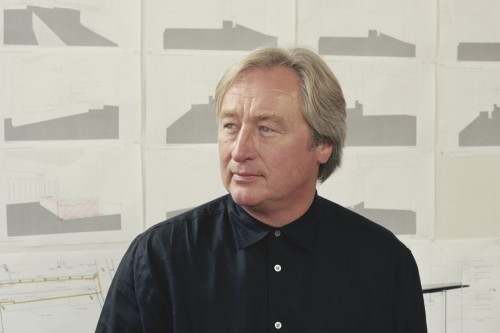
Steven Holl, 64, spoke with ArchitectureRichmond’s Edwin Slipek by telephone from his New York office on the afternoon of April 27. Here are excerpts from that interview.
What were early influences on you becoming an architect?My brother James [now an artist and professor at Marymount Manhattan College] and I were always building things in the backyard when we were boys. We had a large backyard at our house in Bremerton, Washington. We’d jump out of bed and be out there for two hours before breakfast. We built a two-story tree house and a house with one floor underground. We’d imagine, we’d create and we’d make. We were naturals.

What later influenced your development as an architect?

In my sophomore year at the University of Washington I was quite busy working on a design project one day when Professor Hermann Pundt, an enormously enthusiastic man, came over and told me he was starting a Rome studies program. He said, “Steve, go to Rome.” I lived behind the Pantheon and became enthralled by quality of light inside that space. It was always slightly changing at different times of day and in varying weather conditions. After I came back from Europe I had a different framework of what architecture is. It changed my life.

What is your favorite space, place or building?

The one I’m working on now. And Rome, of course. Also, I’ve always loved Louis Kahn’s Kimball Art Museum in Fort Worth and Frank Lloyd Wright’s Johnson Wax Building [in Racine, WI]. And all of the buildings of Le Corbusier. I’ve traveled to see most of his buildings. Once, when I had with no money, I scraped my way through France even spending a night in a monk’s cell in La Tourette Monastery [Le Corbusier’s last major European commission which houses a silent order].

Have you ever been to Richmond before becoming involved with the VCU project?

In 1996 our firm was a finalist for the First Freedom Monument [a competition sponsored by the Richmond-based Council for America’s First Freedom to commemorate the Virginia Statute for Religious Freedom. Michael Graves subsequently won the competition but the project never materialized]. At that time I walked along the James and meditated upon the river. There is a deep sense of history in Richmond.

In designing VCU’s new ICA, how is conceiving a museum or gallery different from how you approach other building types?

In the last 15 to 20 years there have been two types of museums. First, there’s been the neutral white box which defers to the art. But it sucks the life out of the art. And then there are the overly-expressive projects that look like a turkey coming out of the oven with the tin foil coming off. At the ICA we will have galleries that are rectilinear for the basic exhibition spaces but the circulation areas will be energetic and exciting. Spatial energy is important to me.

What was your first impression of the proposed building site at the intersection of West Broad and Belvidere streets, Richmond’s busiest?

[Before visiting the site] I had looked at an overview [of the surrounding neighborhoods and area}. The Fan [District] was on my mind. The site seemed like a wasted opportunity that could become into something greater: It was a sad parking lot, it’s just like Los Angeles or Houston. I’m glad I looked at the overall plan.  It asks for something other than what it is. I felt the building’s design could have a strong relationship with the corner and there would be landscaping toward the campus.

What do you hope to achieve with your design of the ICA?

This is different from any building that we’ve ever done. It responds to the question of ‘What is art today?’ We call it Forking Time. This suggests that the contemporary art world has many parallel activities. There had been a grand narrative to western art until conceptual art took over in the 1970s. But there’s been a rupture. This building aspires to reflect that today, things can coexist. And this is hopeful. The building has arms that stretch out and will give curators four separate areas. Each space is the size of a gallery in Chelsea [New York]. There will be flexibility. There might be a great video show being presented in one while in another gallery there is a great sculpture show. The vertical space will allow for other possibilities. You’ll be able to see the intensity, clarity and direction of an artist’s body of work. But first and foremost the ICA will be a great space.

On what other projects is your firm currently working?

Two weeks ago I was in Chengdu, China working on a water garden. In the near future I’ll be going to Seoul, our first project in Korea. In late January we won an international competition for a new building at the Houston Museum of Fine Arts.  At Princeton we’re building a fine arts complex that will serve as a new south entrance to the university. This involves moving the Dinky [the storied and beloved railroad link to the Amtrak station] 500 feet. We are building a new building for the Glasgow School of the Arts directly across the street from Charles Rennie MacIntosh’s original building. Earlier this afternoon I was on W. 216 St. at Columbia University [Holl is a professor of architecture there] where the Campbell Sports Center is taking shape. There are some wonderful views of the New York skyline from that building.

Whew. What do you do to relax?

I paint. I paint every morning. I paint every day wherever I am. I never go anywhere without my watercolor pad.  My most exciting times are when I am painting. Why would I want to play golf? That’s boring.

E.S.