The Chesterfield

The Chesterfield 6


Architect: Muhlenburg Bros. with Noland & Baskervill
Dates: 1903
Address: 900 West Franklin

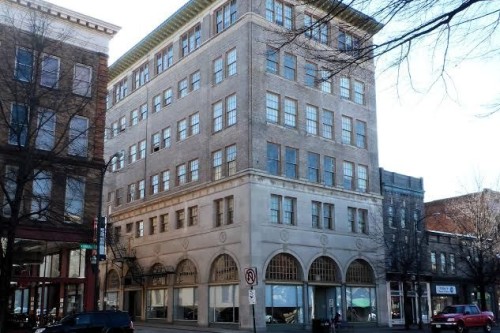
The Chesterfield Apartments opened in November 1903 as Richmond’s first high-rise apartment building. It was also the first building of such a large scale on the prosperous blocks of West Franklin Street near Monroe Park. The building holds a cherished place in Richmond’s collective memory as the home of the Chesterfield Tea Room. At the time of it’s closing in 1988 it was the city’s oldest continuously operating dining establishment.

Seven stories sit atop an english basement that now contains a book store. The former tea room still houses a restaurant. Following the building up from the ground, a traditional classical order is observed. The lightly rusticated stone base transitions into a dark brick and culminates in a novel stuccoed cornice. Bands of wrought iron balconies and bay windows emphasize verticality, a feature that becomes all the more pronounced when compared with the 3 story structures surrounding it.

The Chesterfield is an indispensable element in the West Franklin Street historic district, an area characterized by luxurious town-homes, most of which have now been converted into offices or apartment buildings. The tower’s juxtaposition in scale and introduction of a retail element bring vitality and intrigue to the pedestrian experience. The building is also a contributing structure in what is colloquially known as the “Monroe Park Skyline,” an assemblage of mid and high-rise buildings surrounding Richmond’s Monroe Park.

D.OK.

The Pollak Building

Pollak 1


Architect: Ballou and Justice
Dates: 1970
Address: 325 N. Harrison Street

On Harrison Street at the eastern terminus of West Avenue lies the Virginia Commonwealth University’s Pollak Building. The building is occupied by various parts of the VCU School of the Arts including the office of the dean, and the graphic design, fashion, film, and photography programs.

The Pollak Building is, in plan, reminiscent of Louis Kahn’s monumental form of modernism. The large stair towers anchor the building’s four corners while rectangular classroom blocks span the space in between. This creates a large interior courtyard planted with magnolia trees. This space is linked by foot paths to the Anderson Gallery, the Scott House, and the center of campus.

The courtyard is accessible to the public by way of a raised brutalistic arcade that extends to front Harrison Street. The street itself is presented with two main elements. First, spare concrete piers and stairs with a textured pattern left from the form molds used to create it and, second, a low brick wall. The space, though generous and attractive, is underutilized. This is somewhat troubling considering the high premium on space along the retail-heavy Harrison Street.

The principle facade begins at a story above street level and continues up a further 3 stories. Each of the four bars of classrooms and offices that make up the building are sided with blank concrete and fronted with concrete bands containing brick bays, each with two windows. The vertical windows and grid system employed by the facade reference the surrounding Victorian apartment and office buildings.

Recently, the building was outfitted with a green roof. VDMO Architects designed the roof to meet environmental goals such as reduced heat absorption and storm water runoff but the space is also recreational. A small terrace with views of the surrounding Monroe Park skyline and Fan District roof scape is a welcome addition to the Pollak Building.

D.OK.

Virginia Museum of Fine Arts

VMFA 2


Architects: Peebles and Ferguson Architects, Norfolk (1936); Theater Wing, Merrill C. Lee Architects, Richmond (1954); South Wing, Baskervill & Son Architects, Richmond (1970); North Wing, Warren Hardwicke Associates, Richmond, and Sculpture Garden, Lawrence Halprin Associates, San Francisco, landscape architect (1976), both demolished; Lewis Mellon Wing, Hardy Holzman Pfeiffer Associates, New York City (1985); Frances G. McGlothlin Wing, Rick Mather Architects, London (2010) with associate SMBW Architects, Richmond.   

Dates: 1936-2010

Address: 200 North Boulevard

The Virginia Museum of Fine Arts was founded and is supported by the Commonwealth of Virginia. Its 14 acre campus, defined by Boulevard, Grove Avenue, Shepherd Street and the grounds of the Virginia Historical Society, is situated on the former Robert E. Lee Camp (for many years it was a retirement community for Confederate veterans and their female relatives). In 1936, during the Great Depression and with construction funding from the Federal Works Administration, the museum opened its doors to a structure elegantly oriented to Boulevard. Peebles & Ferguson Architects took its cues for the building’s design from a Late Renaissance addition to Hampton Court in London by Christopher Wren. The museum’s galleries were located on the upper level with offices and support facilities situated on the ground floor.

Additions were made in 1954 (for additional galleries and a theater) and in 1970 (for galleries). These continued the architectural spirit of the original, center block.

In 1976 another wing, by Warren Hardwicke Associates, and a walled sculpture garden designed by Lawrence Halprin Associates, were added to museum’s north end. These broke with the Wren-inspired classicism. The addition’s curved brick walls recalled the Johnson Wax Company building in Racine, Wis. by Frank Lloyd Wright.

In 1984 the architectural direction of the museum shifted again with construction of the Lewis Mellon Wing, built specifically to house the sizable collections of Sydney and Frances Lewis of Richmond and Paul Mellon of Upperville, Va. Architect Malcolm Holzman, in designing the building, broke with the museum’s exterior red brick, Flemish bond surfaces and introduced Indiana limestone. The wing is a witty tour de force architecturally that combines modernism with such refined classical elements as the Tuscan order (at the entablature) and muscular blocks of rusticated stone at the ground level that recall Henry Hobson Richardson’s Allegheny Courthouse in Pittsburgh.

In 2010 the museum reoriented dramatically how visitors approach the museum by demolishing the former North Wing and sculpture garden and building the Frances G. McGlothlin Wing which is approached by a new motor court. Designed by Rick Mather Architects, the building is unapologetically modernistic in every way: It combines exterior surfaces of Indiana marble with large, deftly handled expanses of sheet glass.

Key to the spirit and success aesthetically of the McGlothlin Wing is how the building seamlessly connects with the museum grounds through large window openings. Happily, a former surface parking lot has been replaced by an expanse of lawn and vehicles are now relegated to a 600 space garage that is largely hidden beneath a dramatically sloping and handsomely-landscaped sculpture garden.

E.S.

Second Presbyterian Church

Second Presbyterian Church 6


Architect: Minard LaFever
Date:1845
Address: Nine North Fifth Street

When Presbyterian minister Moses D. Hoge commissioned a church design for his congregation, which was moving westward from Shockoe Hill toward Gamble’s Hill, he made a bold move. He eschewed classicism, which had been the architectural approach of most Richmond churches up to that time, and built a Gothic Revival edifice. Apparently, Hoge believed that the nooks, crannies and the romanticism of Gothic design allowed for sentiment and memories to find comfortable resting places. He selected the prominent New York architect Minard LaFever (1798-1854) as designer. LaFever never visited Richmond for this project but provided Hoge with plans from one of his pattern books (he wrote five).

Probably, in a nod to budget restrictions, brown-hued brick, rather than stone was used as the primary exterior material. Vermont sandstone was used as trim (in a recent exterior renovation, the stone was replaced with a similar material imported from Germany).

The sanctuary’s central front door hits hard along the North Fifth Street sidewalk, but if one looks up, a 100 foot steeple rises majestically. In the era before skyscrapers, it was one of the most imposing silhouettes on Richmond’s skyline.

Upon entering the sanctuary, plaster walls scored to look like stone rise to support a series of wooden arches and a ceiling of wooden planks stained a dark shade of brown. It is a tour de force of the carpenter gothic. Behind the pulpit at the front of the church, an impressive wooden reredos, apparently designed by Hoge, rises 40 feet to frame the lectern.

Today, the Gothic Revival sanctuary is joined via a glass and steel connector to the Virginia Building (1906) at the corner of Fifth and Main streets. Thought to be Richmond’s first high-rise apartment building, the Virginia Building now serves Second Presbyterian as a church house.

E.S.

Retail Design in Richmond Part I: Need Supply and Black Swan Books

Need Supply Co. 2


Need Supply Co.

Architect: BAM Architects
Dates: 2007-2010
Address: 3100 West Cary Street 23221

Black Swan Books

Architect: BAM Architects
Dates: 2003
Address: 2601 West Main Street

Since 1996, Need Supply Co. has dealt in boutique women’s and menswear from its store in Richmond. Over the years, it has developed a large online presence. Recently, it was named as one of the 25 Best menswear stores in the nation by GQ magazine. This accolade is due largely to the items that Need Supply carries but, as the article made clear, the aesthetic of the store itself was a large factor in the decision.

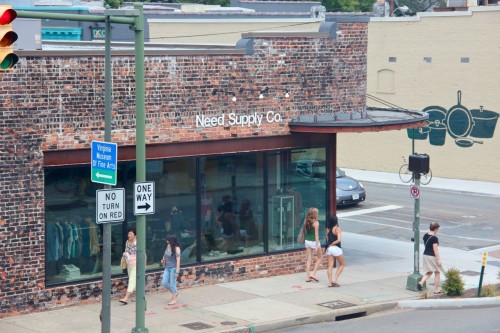
Need Supply Co. is headquartered in Carytown, the city’s most fashionable shopping district. Its corner site consists of a low, brick building with a large, cantilevered overhang. The building was given a thorough renovation by Richmond-based BAM Architects before Need was able to move in.

The result is easily one of the most striking and contemporary commercial spaces in Richmond. Exterior brick was stripped leaving its rough texture exposed; wood and steel structural features were given the same treatment. Handsome clothes racks, lighting fixtures, and casework complements the architecture. The company’s spare graphic design and signage program completes a total aesthetic that is as much about what isn’t there as what is.

Black Swan Books, another BAM Architects project several blocks away in the Fan District, takes a more traditional approach. Serifed fonts adorn the facade and packed bookcases fill the room. Upon closer observation, many similarities between Black Swan and Need Supply can be seen.  Exposed ductwork and raw materials are a constant though in this context they complement worn leather binding and blonde wood moldings rather than spare clothing displays. Black Swan’s extensive collection of rare books is housed in contemporary casework.

D.OK.

Stewart-Lee House

Lee House 1


Norman Stewart
707 East Franklin Street
1844

In the mid 19th Century, Norman Stewart, a rich Scottish tobacco merchant, constructed five free-standing residences, which came to be known as “Stewart’s Row,” one of the finest blocks in Richmond. Featuring side-hall plans and a structure that consumed most of the narrow plots, the rational three story homes that were said to be shaped like shoeboxes added to the impressive resume of Greek Revival in the city. Only one remains today, the Stewart-Lee House.

Norman Stewart’s nephew, who inherited the house, rented it to Robert E. Lee’s son and a group of young Confederate officers. They turned it into a bachelor’s pad of sorts until Robert E Lee’s wife and daughters arrived in 1864 and cleaned the place up. Following his surrender at Appomattox a year later, General Lee joined the rest of his family at the home for a brief two-month period.

Its surroundings are now drastically different. Dwarfed by a fifteen story office building to the west, a shoebox in its own right, the house is contrastingly exposed on the western side by a parking lot. Yet with a Greek-fret patterned cast-iron fence enclosing the front yard and bookends of a small portico and triple decker porch, the Stewart-Lee house serves as an isolated yet complete  transportation to an era past.

The building now serves as offices for the Home Builders Association of Virginia, who led extensive renovations to the house in 2001, a large part of the building’s tremendous preservation. While the context, occupants, and use of the house may have changed, the dignity of the building, with its red brick and dark green shutters, remains just as clear today as it was when General Lee walked up the granite steps.

M.F.A.

Union Presbyterian Seminary

Union Presbyterian 6


Architects: Charles H. Read, Jr.; The Glave Firm; and Glave & Holmes Architects
Date: 1896 and additions and renovations
Address: 3401 Brook Road, Richmond

Travel along Brook Road through the Ginter Park neighborhood and you’ll unsuspectingly come upon Watts Hall. This glorious hulk of a building houses administrative offices, classrooms and a chapel at Union Presbyterian Seminary. It is a visually thrilling symphony in red brick. Since the topography in Northside Richmond is flat, this massive Tudor Revival structure rises mountain-like to lord over the surrounding area.

Hampton Court (the 1513 Thames riverfront palace Henry VIII once occupied in the London suburbs) probably provided Richmond architect Charles H. Read, Jr. with a historical reference point for Watts Hall, but Thomas Jefferson’s plan for the Lawn at the University of Virginia in Charlottesville inspired Read’s overall seminary campus plan. Similar to how the Rotunda sits at the top of the Lawn, at the seminary Read made Watts Hall the axial focus of his grassy quadrangle. And similar to UVA, this greensward is lined with faculty homes and student dormitories. But whereas Jefferson’s buildings face into the campus, Read set his buildings fronting outward. This was to symbolize the increasingly popular trend at the turn-of-the-last century toward a social ministry— spreading the gospel outward into the community.

For most of the 20th century the seminary’s unrelenting assemblage of brick buildings was dour architecturally. But in the 1970s, under the guidance of the Richmond firm of Glave Newman Anderson, Richmond Hall (a dormitory and dining hall) was remodeled with an injection of modernism. And in 1996 the William Smith Morton Library, designed by The Glave Firm, was completed at the opposite end of the quadrangle from Watts Hall. The library, with its spectacular lobby that rises three stories to a glass ceiling, incorporates Schauffler Hall, a former chapel and classroom building that was built in 1922 and designed by Baskervill and Son.

More recently, the interior of the former seminary library has been dramatically retrofitted by Glave & Holmes to create the Early Worship Center with its strikingly minimalistic Lake Chapel which is set into a space that formerly contained library stacks.

E.S.

Virginia Commonwealth University Cary Street Gym


Architect: Wilfred E. Cutshaw
Date: 1891
Address: 101 S. Linden St.

2010 renovation and expansion by Moseley Architects (lead), Smith+McClane Architects (exterior) and Hastings+Chiverta Architects (consulting)

There may be no more popular building on the Virginia Commonwealth University Monroe Park campus than the Cary Street Gym on the southern edge of the sprawling grounds. This late-19th century city market, which was later converted into a municipal auditorium, has recently found new life as a fitness center for one of the state’s largest universities. In the most recent conversion, completed in 2010, the architects respected totally the solid bones of the granite and red brick Italianate structure, but expanded it substantially by wrapping an L-shaped addition around the eastern and southern sides of the building. The addition, which brings the total square footage to 125,000 square feet, is highly sympathetic to the original structure while also respecting the pedestrian scale of its Oregon Hill neighbors.

The elegantly-proportioned and well-detailed former two-story market was designed by  Wilfred E. Cutshaw, a Richmond city engineer. It recalls similar structures in the days before refrigeration in such cities as Washington, D.C., Florence, Italy and Barcelona. Large windows, broad door openings and high ceilings eased comings and goings and allowed for good ventilation in an era before air conditioning.

In converting the barn-like structure into a university fitness center, the team of architects cleaned up the bones of the building and treaded lightly in the design of the their additions. Today, gym rats enter from the western, Linden Street side of the building by passing under a new loggia that announces the entry while not overwhelming the landmark. Upon entering, the reception area is just a few steps to the right. Enticing views of the open weight room and climbing wall are visible beyond a lattice-like metal screen.

On the eastern side of the old building and fronting Cherry Street, four adjacent basketball courts have been added. These are easily convertible for other sports. One flight up and encircling the space is an indoor track. On the south side of the former market an aquatics center and indoor practice field provide additional activities areas. Glorious natural light floods the interior. The exteriors on the eastern and southern sides, while unnecessarily busy, still mesh harmoniously with the modest Oregon Hill dwellings nearby.

The Cary Street Gym provides a textbook case in excellent adaptive reuse and savvy, but sensitive infill design.

E.S.