Morson’s Row

Morson's Row 1


Architect: Albert Lybrock
Date: 1853
Address: 219-223 Governor Street

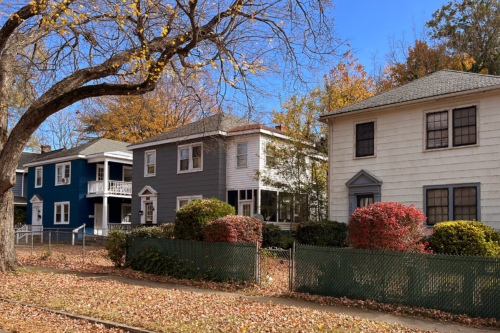
Morson’s Row is the most handsome assemblage of attached houses in Richmond. These three former dwellings in the Italianate style establish an axial relationship at the eastern end of the pedestrian mall that was once Capitol Street while gently stepping down to reflect the slope of Governor Street. Morson’s Row is grander than other, upscale, mid-19th century dwellings in Richmond– more akin to houses one would find in urban Baltimore or Boston. They were designed as speculative housing by James Marion Morson, a lawyer who practiced in the city and in Goochland County.

Architect Albert Lybrock, born and educated in Germany, came to Richmond in 1852 via New York City, to oversee his design for the United States Customs House which stretched between Main and Bank streets. He would become the most important architect working in Richmond in the prosperous decade prior to the Civil War after landing a number of prestigious commissions here. In addition to his Italianate customs building, his commissions included major interior renovations at the Capitol (1858) and the unique, cast iron Gothic reliquary in Hollywood Cemetery that contains the sarcophagus of James Monroe, the fifth United States president (1859). In the late 1870s Lybrock designed the Miller School in Albemarle County.

While the three townhouses comprising Morson’s Row were built as speculative housing, there was no stinting on detail. Each house is three stories high and rises from an English basement. The most glorious feature of each of the three houses is its curved bow front.  Each of these bays rises to a partial entablature containing crisply defined dentils and a generous cornice supported by handsome brackets. The basement is faced with granite ashlar and the upper exterior surfaces of the façade are brick covered in stucco.

This trio of houses creates an almost musical rhythm as it steps down (or ascends) Governor Street. And the softly-rounded lines of bow fronts are picked up by the curved configuration of the sun porch on the rear of the adjacent Memorial Hospital (now part of the Virginia Department of Highways complex) just up the hill.

Architect Lybrock, himself a slave owner, apparently became an active player in the life of his adopted region including his financial support of a regiment of local Germans in the Confederate army.

Morson’s Row, now owned by the Commonwealth of Virginia and an important part of the Capitol Square district, has long been empty and awaits a new use. Miraculously, its interiors still contain much of their original detailing such as moldings and marble mantels.


E.S.

The Pollak Building

Pollak 1


Architect: Ballou and Justice
Dates: 1970
Address: 325 N. Harrison Street

On Harrison Street at the eastern terminus of West Avenue lies the Virginia Commonwealth University’s Pollak Building. The building is occupied by various parts of the VCU School of the Arts including the office of the dean, and the graphic design, fashion, film, and photography programs.

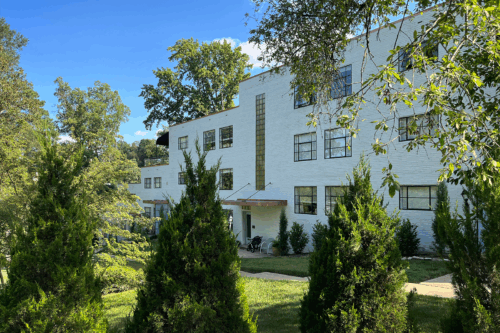
The Pollak Building is, in plan, reminiscent of Louis Kahn’s monumental form of modernism. The large stair towers anchor the building’s four corners while rectangular classroom blocks span the space in between. This creates a large interior courtyard planted with magnolia trees. This space is linked by foot paths to the Anderson Gallery, the Scott House, and the center of campus.

The courtyard is accessible to the public by way of a raised brutalistic arcade that extends to front Harrison Street. The street itself is presented with two main elements. First, spare concrete piers and stairs with a textured pattern left from the form molds used to create it and, second, a low brick wall. The space, though generous and attractive, is underutilized. This is somewhat troubling considering the high premium on space along the retail-heavy Harrison Street.

The principle facade begins at a story above street level and continues up a further 3 stories. Each of the four bars of classrooms and offices that make up the building are sided with blank concrete and fronted with concrete bands containing brick bays, each with two windows. The vertical windows and grid system employed by the facade reference the surrounding Victorian apartment and office buildings.

Recently, the building was outfitted with a green roof. VDMO Architects designed the roof to meet environmental goals such as reduced heat absorption and storm water runoff but the space is also recreational. A small terrace with views of the surrounding Monroe Park skyline and Fan District roof scape is a welcome addition to the Pollak Building.

D.OK.

Architects of Richmond: William Churchill Noland

Davis Monument


Article and photographs by Robert P. Winthrop.

As part of a continuing series we are featuring an essay from a guest writer, Robert Winthrop. Winthrop is partner at Winthrop, Jenkins, and Associates, a Virginia based architecture firm specializing in historic renovation. Historic buildings have also been his focus in numerous writings and lectures. As author of The Architecture of Jackson Ward, Cast and Wrought: The Architectural Metalwork of Downtown Richmond, Virginia, and Architecture in Downtown Richmond, Winthrop has established himself as an authority on the city’s architectural history.

Winthrop has adapted these essays from a lecture series at the Virginia Historical Society. The series, entitled “Sophisticates and Wild Men,” followed the interaction between the exuberant Victorian architects and the sober classicists at the turn of the twentieth century.

*   *   *

William C. Noland (1865-1951), the son of Callender St. George Noland and Mary Edmonds Berkeley, was the last of ten children, five of whom did not survive infancy. Through his mother he was related to the Carters, Spotswoods and Wormleys.  Born on June 4, 1865, two months after the end of the Civil War, his family retained its property, but not its wealth. 

In 1871 the family moved to Ashland so the children could be educated.  His father died in 1878 when William was 13.  William went to a private school in Richmond and then to Episcopal High School of Virginia in Alexandria.  He graduated in 1882 and then went to work in an architect’s office in Philadelphia. He was 17 years old.

Noland was deeply attached to his family and their correspondence survives.  While many persons of his social status went to a University, Noland’s family could not afford it.  His family had relations in Philadelphia, explaining the reason for the move to the prosperous Northern city.

Philadelphia was a thriving industrial city.  There he worked first for Theophilus P. Chandler.  While Chandler was known for Gothic inspired buildings, he was educated at the École des Beaux-Arts in Paris and had been in the Atelier of Vaudremer, one of the leading lights of mid-century French architecture.  Chandler’s wife was a member of the DuPont family.  This connection was helpful.

Chandler was the founder and head of the University of Pennsylvania’s Department of Architecture.   We do not know if Chandler operated his office in the manner of a Parisian atelier, but his interest in educating men for the profession could only have been good for Noland.

In 1886 Noland left Chandler and went to work for the young firm, Cope & Stewardson.  Both Cope and Stewardson had studied at the Cole.  They would become best known as creators of the Collegiate Gothic style. The most important of their buildings, the work at the University of Pennsylvania and Princeton were done after Noland left the firm. Noland could have worked at the firm’s earlier work at Bryn Mawr College, Radnor and Denbigh Halls. Noland seemed to have done well at the firm and may even have traveled in Europe with Cope.

In Philadelphia Noland joined the T-Square Club. It was a social and educational club for young architects.  The Club had competitions for architects modeled on the École, and thus gave young architects without formal architectural education a chance to gain experience.

Noland next looked for work in New York but was unable to get a position with a top of the line firm.  He had the misfortune of looking for a job when a university education and a stint at the École des Beaux-Arts in Paris were desirable.  Noland had moved out of his old boy network. He was a poor son of a FFV.

Noland returned to Virginia in 1891, first to Roanoke and then moving to Richmond in 1893.  In 1897 he formed a partnership with Henry Baskervill.  Henry Baskervill was a native Virginian and Cornell University graduate with a degree in electrical engineering.  When he established his own firm, his first project was the restoration of the White House of the Confederacy.  He became known as an architect rather than as an engineer.

Fortunately for Noland, Baskervill had a knack for finding talented partners.  First with William Noland, and later with Alfred Garey Lambert, Baskervill found two gifted and skilled men who were able to produce high quality designs for his upper class clientele.

The Baskervill firm did little developer or commercial work, unlike the two other early, large Richmond firms, Carneal & Johnston and Marcellus Wright.  Baskervill tended to do one-of-a-kind landmark buildings for socially important clients. Noland’s designs tended to be sophisticated, and well suited for style conscious clients.  It is clear he was up to date in his architectural taste.  The Baskervill firm later developed a specialty in medical buildings due to their long term relationship with the Medical College of Virginia. This became very important in the depression and post war periods.

Noland was also lucky fortunate to be designing in the early twentieth century Richmond.  The city was booming and growing rapidly. Several of his building had particularly visible sites in new neighborhoods.  Stylish Franklin Street provided the sites of Second Baptist Church, Temple Beth Ahabah and St. James Episcopal Church.  Beth Ahabah closes the vista down Ryland Street.  Today Ryland Street is a minor street.  In 1906 it was the entrance to Richmond College.  The handsome home to Rabbi Calish’s prosperous Jewish congregation must have caused some smiles as it framed the entrance to the Baptist School.

St James’ steeple in on axis with the east bound lane of Monument Avenue. His monument to Jefferson Davis is the architectural focus of the central portion of Monument Avenue and Davis Avenue. Noland took full advantage of the scenic opportunity.

Joining these distinguished institutional buildings on Franklin were the impressive homes of Frederic Scott, Eppa Hunton and other local luminaries.  The Scott Mansion was one of the few Richmond houses that could Rival Major Ginter’s home of a decade later.  Scott’s house came complete with a charming carriage house.  A similar Noland designed house appeared at Major Dooley’s Maymont estate.    At Maymont Noland also designed the stunning Italian gardens with their spectacular waterfall.

Noland designed summer houses for both Major Dooley and Frederic Scott on Afton Mountain. Dooley’s house, Swananoah, is a version of the Villa Medici outside of Rome.  The Villa Medici was the model for the Jefferson Hotel. Scott’s house, Royal Orchard, is a medieval styled castle.

Noland & Baskervill was also one of the co-architects for the expansion of Jefferson’s Capitol.  Part of a team consisting of John Kevan Peebles from Norfolk and Fry & Chesterman from Lynchburg, the roles of the individual architects in the design is not clear.  Noland’s Jefferson Davis Monument dates from the same time.

These building were sophisticated essays in stylish early 20th century classicism, and are largely without Victorian leftovers.  It is easy to recognize the influence of Jeffersonian Classicism in many of these buildings.  Jefferson used the ancient Roman temple, the Maison Carrée, as the model for his Virginia State Capitol.  Noland used the same model, but he made it closer in appearance to the Roman Temple. Noland used the Corinthian order as the French temple.  The limited skills of American stone carvers led Jefferson to use the simpler Ionic order, rendered in stucco.

It is easy to see that Beth Ahabah is inspired by Robert Mills’ Monument Church of 1814.  Both are octagonal domed buildings in the Doric order.  Noland’s building is less daring and imaginative than the Mills’ structure, but the temple is sophisticated and beautifully designed. A year later, Noland designed the terminal for the Richmond & Chesapeake Bay Railway at Laurel and Broad Street.  It closed the vista toward Broad on Laurel Street.

The firm was the associate architect of the Chesterfield Apartment house, the oldest high rise apartment in the city. They designed or altered several houses and an apartment on West Franklin in addition to the institutional work. Most of the work was in the new Colonial Revival mode.  Curiously they seemed to have had a minor specialty in converting genuine ante-bellum houses into Colonial Revival mansions. They stripped the Italianate Ritter-Hitchcock house of its Victorian detail and did the same to the Kent-Valentine house.  By 1900 the image of the ante-bellum house was classical rather than Victorian.  The renovations converted the actual pre-war building into the new stereotypical images of a Southern mansion.  Fortunately, Noland’s skilled and sophisticated renovations are quality works in their own right.  They well illustrate the change in attitudes about the South.

The YWCA Fifth Street is a handsome essay in the Italianate mode. The Dooley Hospital that once sat next to the Egyptian building was similar stylistically.  Across  the street from the YMCA, the firm designed the Virginia, a combination office building, apartment  house and the chapel of Second Presbyterian Church.  The Virginia was what we would now call a mixed use building, almost a century head of its time. The chapel is a charming and beautiful space. It is simple, elegant and just Gothic enough.

Baskervill built his own house at the corner of the Boulevard and Byrd Park in the Italian style. This house almost rivals the Scott house in size and imposing character. It is a sophisticated Italian style villa with a beautiful, arcaded entrance. One assumes Baskervill played a role in the design, but the fine detailing is typical of Noland.

The later work of Baskervill & Lambert will be covered in another essay.  Much of the early biographical information was uncovered by Christopher Novelli in his fine Master’s thesis on Noland.

Robert Winthrop

Virginia Museum of Fine Arts

VMFA 2


Architects: Peebles and Ferguson Architects, Norfolk (1936); Theater Wing, Merrill C. Lee Architects, Richmond (1954); South Wing, Baskervill & Son Architects, Richmond (1970); North Wing, Warren Hardwicke Associates, Richmond, and Sculpture Garden, Lawrence Halprin Associates, San Francisco, landscape architect (1976), both demolished; Lewis Mellon Wing, Hardy Holzman Pfeiffer Associates, New York City (1985); Frances G. McGlothlin Wing, Rick Mather Architects, London (2010) with associate SMBW Architects, Richmond.   

Dates: 1936-2010

Address: 200 North Boulevard

The Virginia Museum of Fine Arts was founded and is supported by the Commonwealth of Virginia. Its 14 acre campus, defined by Boulevard, Grove Avenue, Shepherd Street and the grounds of the Virginia Historical Society, is situated on the former Robert E. Lee Camp (for many years it was a retirement community for Confederate veterans and their female relatives). In 1936, during the Great Depression and with construction funding from the Federal Works Administration, the museum opened its doors to a structure elegantly oriented to Boulevard. Peebles & Ferguson Architects took its cues for the building’s design from a Late Renaissance addition to Hampton Court in London by Christopher Wren. The museum’s galleries were located on the upper level with offices and support facilities situated on the ground floor.

Additions were made in 1954 (for additional galleries and a theater) and in 1970 (for galleries). These continued the architectural spirit of the original, center block.

In 1976 another wing, by Warren Hardwicke Associates, and a walled sculpture garden designed by Lawrence Halprin Associates, were added to museum’s north end. These broke with the Wren-inspired classicism. The addition’s curved brick walls recalled the Johnson Wax Company building in Racine, Wis. by Frank Lloyd Wright.

In 1984 the architectural direction of the museum shifted again with construction of the Lewis Mellon Wing, built specifically to house the sizable collections of Sydney and Frances Lewis of Richmond and Paul Mellon of Upperville, Va. Architect Malcolm Holzman, in designing the building, broke with the museum’s exterior red brick, Flemish bond surfaces and introduced Indiana limestone. The wing is a witty tour de force architecturally that combines modernism with such refined classical elements as the Tuscan order (at the entablature) and muscular blocks of rusticated stone at the ground level that recall Henry Hobson Richardson’s Allegheny Courthouse in Pittsburgh.

In 2010 the museum reoriented dramatically how visitors approach the museum by demolishing the former North Wing and sculpture garden and building the Frances G. McGlothlin Wing which is approached by a new motor court. Designed by Rick Mather Architects, the building is unapologetically modernistic in every way: It combines exterior surfaces of Indiana marble with large, deftly handled expanses of sheet glass.

Key to the spirit and success aesthetically of the McGlothlin Wing is how the building seamlessly connects with the museum grounds through large window openings. Happily, a former surface parking lot has been replaced by an expanse of lawn and vehicles are now relegated to a 600 space garage that is largely hidden beneath a dramatically sloping and handsomely-landscaped sculpture garden.

E.S.

Interview: Dave Johannas

Dave Johannas


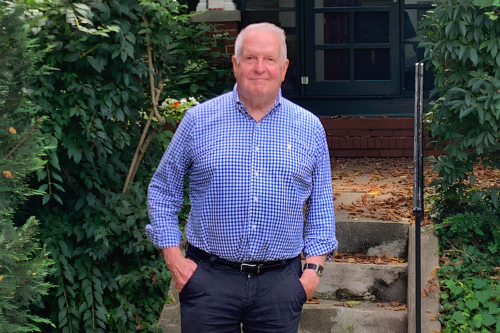
Dave Johannas is the principal at Johannas Design Group (JDG), as well as a member of the planning commission for the city and the Commission of Architectural Review. We have previously featured the Mews at Cary Mill from JDG.

What is the underlying philosophy or mission of the work done at Johannas Design Group, and which projects do you think best exemplify these values?

We are overall community oriented, which is important in terms of working for the city and the future of how our city develops. Everything we do has somewhat of a planning oriented bent to it, as opposed to specifically architecture, and our goal in small-scale work is typically to beef up density in the city. Most of our work is incorporated into the central part of the city, working with or adjacent to historic architecture.

To me, the Mews on West Cary St is a really nice example of integrating modern architecture with historic architecture, infill that attempts to create density in the city, with stuff a little taller than the area was before. The integration of outdoor space, with every dwelling unit connected to the outdoors almost forming a pocket park, is a really important philosophy to the project and something that urban spaces need just as much as any other space.

What is your opinion of the architectural culture in Richmond? What would you say is our city’s chief strengths or shortcomings in this regard?

I’m going to go shortcomings. Because we’re not a city that tries to experiment or takes chances with our architecture, or promote modern or current architecture in itself. We do have a great architectural heritage with a lot quality historic buildings, but in terms of everyone projecting that into the future and thinking about where we’re going, we’re not trying to promote that ethic as a city. There are other cities that are trying to continue to have an architectural heritage, and we fall short of that. We do have talented people here, every city does, but as a culture, our city is not supporting high quality architecture.

You’re also a member of the Commission of Architectural Review (CAR). Can you speak to the importance of this organization and the success of its mission?

The CAR has been around for at least 50 years, and currently oversees about 6,000 properties in the city. The mission has grown and the level of professionalism has gotten more and more focused. It is a relatively sophisticated commission. Without the CAR, without the doctrine of old and historic districts, we would have lost a lot of our heritage and our urban fabric. It takes that type of organization to keep that essential fabric, which is what gives our city its character and culture.

And you don’t see modern architecture as at odds with an historic architectural culture?

Yes I do, no I don’t. You always have to deal with that conflict. At what point is it damaging? How far do you extend into modernity? At what point are you being too historicist? Our commission supports a lot of historicist detailing; good or bad, it will be supported politically. Very seldom do people have the energy, time or client to create modern architecture. The balancing point in neighborhoods can be so delicate, how far do you go or not go?

As a member of the planning commission for the city, what do you believe are the largest issues regarding the city’s urban realm that we face in the present and future?

I’m excited about the planning commission because I’m probably the first dedicated urbanist on it and really philosophically believe in the need for our central city to become more urbane. That’s the message, and I’m going to have the opportunity to keep on delivering it. It’ll be interesting to see where the commission goes.

We need to promote the central city and the level of density here, looking towards affording public transportation and a multi-modal society. Looking at the last thirty years, it’s no question that the cities that thrive financially are the ones that embrace urbanism and have dealt with them in an aggressive fashion.

Johannas Design Group:

http://johannasdesign.com/index.htm

Commission of Architectural Review:

http://www.richmondgov.com/CommissionArchitecturalReview/index.aspx

Planning Commission:

http://www.richmondgov.com/CommissionCityPlanning/index.aspx

M.F.A.

John Tyler Building

John Tyler 1


Architect: Odell and Associates
Dates: 1991
Address: 1300 East Main Street

On the corner of 13th and Main Streets rises the John Tyler Building. The building houses office space for the State of Virginia and lies only a block from the state capitol.
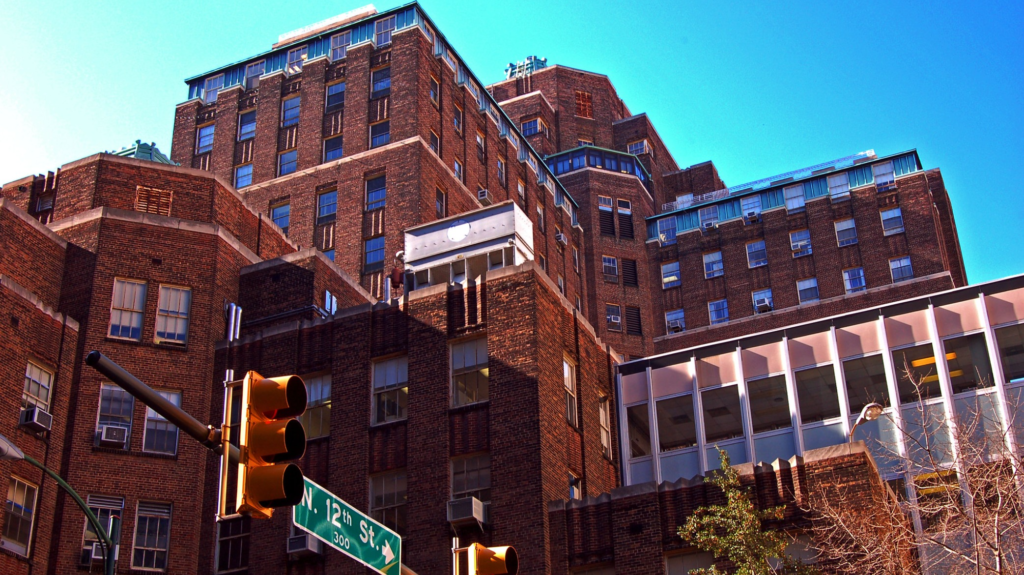
Facades are composed mainly of granite and glass with metal accenting. The John Tyler appears, at first glance, to be more corporate than governmental. No grand entrances, token statues, or unused set back plaza’s are found here. Instead it follows the cues of the neighborhood more literally than most recent high and mid-rise buildings in the city.

The most novel aspect of the John Tyler building’s site is its irregular shape. 13th Street, one of the major fronts of the building, predates Richmond’s grid plan and winds up capitol hill following the path of least resistance. 14th also defies the grid by bowing out to the west. The result of this is a site without a single right angle. The John Tyler hugs this sidewalk line for its entire footprint creating a more dramatic corner condition than one might have expected for state offices.

Still, the relationship with the neighborhood is not as kind as it could have been. The building cafeteria is on the 3rd floor despite being open to the public. One wonders if locating this on the ground floor might have made for a more inviting street presence. Parking entrances and high windows create a deadened sidewalk experience which is particularly troubling on Main Street.

In all, the John Tyler building does serve as a sensitive transition between capitol hill and the financial district. Perhaps its greatest gift to the neighborhood is the way in which its tower and spire accent the view up the winding 13th Street from Shockoe Slip.

D.OK.

Mixed Use Mid-Rise on Shafer and Grace Streets

Shafer & Grace Mid-Rise

Image courtesy of http://www.loopnet.com


August 2014 is expected to bring yet another mid-rise project to Grace Street in the Lower Fan District. The building currently on the site, a one story brick retail structure, will be demolished beginning as early as this month. 

The 11 story, 170,000 square foot building will contain 152 apartments and a 3,400 square feet retail space situated on the corner of Grace and Shafer Streets. ShaferGrace LLC is developing the 22 million dollar project with Walter Parks serving as architect. Once completed, the structure will be one of three on the corner to be completed within the last 3 years.

Parks is also designing a 7 story mixed-use building for VCU on the same block, set to be completed at around the same time.

D.OK.