Architects of Richmond: D. Wiley Anderson

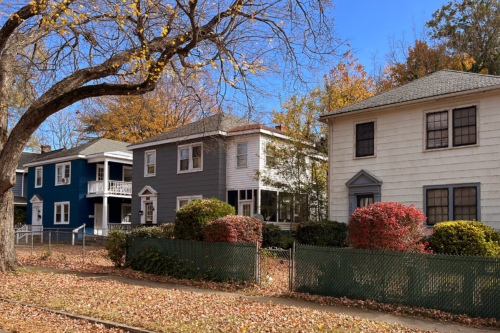
Ellwood Avenue

Article and photographs by Robert P. Winthrop.

As part of a continuing series we are featuring an essay from a guest writer, Robert Winthrop. Winthrop is partner at Winthrop, Jenkins, and Associates, a Virginia based architecture firm specializing in historic renovation. Historic buildings have also been his focus in numerous writings and lectures. As author of The Architecture of Jackson Ward, Cast and Wrought: The Architectural Metalwork of Downtown Richmond, Virginia, and Architecture in Downtown Richmond, Winthrop has established himself as an authority on the city’s architectural history.

Winthrop has adapted these essays from a lecture series at the Virginia Historical Society. The series, entitled “Sophisticates and Wild Men,” followed the interaction between the exuberant Victorian architects and the sober classicists at the turn of the twentieth century.

*   *   *

Born as the Civil War was reaching its conclusion, D. Wiley Anderson (1864-1940) was brought up in Louisa County.  While this area suffered  general decline in the middle of the 19th century,  it did not suffer as directly from the war as did many other parts of Virginia, such as the Tidewater area, the Shenandoah Valley and Richmond.   The great houses of the Jeffersonian period remained as did the former president’s greatest work, the University of Virginia.  

D. Wiley’s father, John B. Anderson, was a successful contractor and we can assume he designed many of his projects as was typical at the time. D. Wiley went to school, excelling in mathematics and drawing, and then worked with his father. He was listed as working with his father on the new work on Rivanna Farm in 1880.  D. Wiley was 16 at the time. Anderson’s own work was always well-built and substantial. He clearly admired and demanded fine construction.  This may well be a legacy from his father.

In 1887 he moved to Richmond and worked for local contractor George W. Parsons for six years. George Parsons was an upscale builder of upper class houses.  We can assume he may well have designed some of these, but he also built architect designed houses, most notably Harvey Page’s palatial residence for Lewis Ginter. This project was under construction from 1888 to 1891. Page was best known for Phoebe Hurst’s impressive house in Washington D.C. Page’s partner, William Winthrop Kent, was a Harvard graduate and he worked for H. H. Richardson and supervised the construction of Richardson’s Hay-Adams house in Washington. Kent also had published a book on wrought iron in 1888.  The architectural detailing and iron work of the Ginter House is clearly related to Richardson’s work.

Parson’s work for Ginter would have introduced Anderson to the full range of modern architectural design and ornamentation.  This was a new style of design he had not found in Louisa or even in Jefferson’s architecture.

Anderson’s work with Parson must have introduced him to many potential clients. D. Wiley Anderson designed a series of houses in Ginter’s new Hermitage Road development in the north side of Richmond. He designed two houses, one in Richmond and one in Brooklyn for John Pope, Ginter’s life partner, and another house for Ginter’s secretary. Anderson was also working for the West End Land Company, partially owned by Major James Dooley.  Dooley was developing the area south of the Confederate Home, now the Virginia Museum of the Fine Arts.

These were big commissions for a young architect. D. Wiley Anderson’s work on Hermitage represents some of the most “Victorian” houses in Richmond. Since they were suburban houses on large properties, they could be more boldly composed since they were freed from the demands of narrow urban lots.

At the turn of the twentieth century, Anderson designed in two styles.  He produced some buildings in the stylish Romanesque mode he encountered in the Ginter house.  He also designed in a classical style, derived from Jefferson and the classical houses of Louisa and central Virginia.  This duality is beautifully illustrated by a pair of houses on Seminary Avenue. The Seminary houses share a common footprint but are in different styles.  The Lee Paschall house is a massy Romanesque mansion and the Thomas Gresham house  is Classical with impressive  monolithic columns.  Paschall and Gresham were the owners of the Wise Granite and Construction Company.   The houses are both personal residences and advertisements for the firm’s work.

Anderson designed a pair of mirror image houses on Elwood Avenue. These buildings created a “Gate house” effect as the entrance to the West End development.  They are in the Queen Anne Style, embellished by an unexpected Italianate type tower.  They are charming and whimsical.  By contrast, the Seminary Avenue houses are massive and imposing. Anderson had a considerable architectural range.

Anderson was a bold and imaginative architect. He did not copy.  It’s clear that historic architecture was just the starting point for his architectural explorations. His buildings are bold, exciting and overblown. Anderson had no interest in reticence, restraint or modesty.

Many of his buildings have a Baroque and almost Mannerist flair. While most of his houses are big, he often uses architectural elements that are even bigger. Everything is large, grand and imposing. He had no interest in classical correctness.

On Hermitage Road early in his career, he designed the impressive Romanesque home, Montrose, for Edward Strudwick, and a proto-Colonial Revival house, Rosedale, for John Pope. There is a second version of Melrose on Floyd Avenue without the verandas.

Bleniquhain, another house built in 1901 on Hermitage is an elaborate essay in the Queen Anne Style. It might well be said to suffer from an acute overdose of architecture.  Now called Holly Lawn, it is charming and idiosyncratic.

Anderson designed a number of houses on Monument Avenue as well as smaller houses in the Fan District. The Monument Avenue houses are consistently classical; all are brick with stone trim.  In 1908 he designed the house for contractor T.T. Adams in red brick with granite trim.  Many of his later houses are in a buff brick with limestone trim. These houses all have an attractive jade green ceramic tile roof.

He designed two houses for the Binswanger family as well as office building and warehouses.  The 1907-08 Harry S. Binswanger’s house is comparatively modest.  The Moses I. Binswanger’s House of 1913 is a showplace of art glass as befits the owner of the Binswanger Glass Company.  Very similar in design is the Arthur Straus house at 2708 Monument, built in the same year. It was followed a year later by the Schwarzschild house at 2710 Monument. The restrained color scheme of these houses make them less showy than the red brick and white trim typical of his earlier houses. They all illustrate Andersons’ taste for oversized dormers.

Richmond experienced a building boom at the turn of the twentieth century. Literally, hundreds of houses were being built in new neighborhoods. If you wanted to stand out, a house by D. Wiley Anderson would do the trick.

Anderson also designed churches, including the former Hanover Avenue Christian Church at the intersection Hanover and Allan Avenues, and the Central Methodist Church in Bainbridge. He designed several churches on Church Hill. He liked cross shaped sanctuaries embellished with towers at the corners.  His Louisa County Courthouse is a tribute to Jefferson’s Rotunda.

His career peaked between 1900 and 1916.  In 1916, William Lawrence Bottomley designed his first house in Richmond.  It would be difficult to find a wider stylistic gap than between Bottomley and Anderson.   In 1922 D. Wiley Anderson returned to Louisa County and was engaged in other pursuits until his death in 1940.

His grand and fanciful houses were no longer stylish.  Richmonders admired more academically correct houses. While there was a taste for the exotic, it was the Hollywood movie star Mission style that the caught the attention of the style conscious.

By the 1970s D. Wiley Anderson’s houses were deeply out of style and many were converted to institutional or boarding house use. They were white elephants. Fortunately, the originality and eccentricity of his personal approach to architecture is increasingly admired.

Robert Winthrop

English Village


DSC_0082


Architects: Bascom Rowlett, Davis Brothers
Date: 1926
Address: 3418 – 3450 Grove Avenue

On an unassuming block of Grove Avenue stands English Village, a development almost 90 years old and deeply embedded in Richmond’s architectural heritage. Yet at its conception in the early 20th century it was a break from the typical financial and spatial model of the city’s multi-family homes.

While mostly removed from one street edge, the departure from common row house typology here is a relief, and the form neatly occupies less than a quarter of the block, exhibiting a grandeur far greater than its physical size. The wings of the connected 17 units are symmetrical, but the overall impression isn’t one of rigidity or monotony. Instead a subdued color palette and careful control of scale help provide a harmonious composition to the complex.

English Village stands as perhaps the masterpiece of both the designer Bascom J. Rowlett and the contractors, the Davis Brothers. While the Arts and Crafts, Tudor complex was a stylistic addition to Rowlett’s eclectic portfolio, it was in keeping with numerous other residential buildings completed by the Davis Brothers west of the Boulevard. The great amount of care and attention to detail familiar to the Davis Brothers’ work can be seen in numerous instances, including the ornamental chimneys and cast concrete, slate roofs, and board-and-batten doors.

While undeniably charming, the development was notable when built mostly for its innovative housing cooperative. Seventeen homeowners bought stock in the English Village Corporation, and while they each contributed to the development’s upkeep, the corporation made no profit and each owner was able to retain individual property titles. This reduced housing costs and gave residents an opportunity to manage their development, both in design and conservation. One of the first cooperatives in the nation, the trend would grow considerably worldwide and find a more modern parallel in condominiums. In addition to this unique cooperative, modern amenities like a boiler room, a concealed attic stairway and sophisticated refrigeration led a newspaper of the time to call English Village “Richmond’s most modern building achievement.”

Interestingly enough, one of the most handsome developments in the city was designed with economy, efficiency and durability as the primary concerns and used the modest cottages of rural England as an aesthetic model. English Village has been immaculately maintained, and despite changes to the landscaping (brick paving replaced by asphalt, the central fountain and rear playground removed), the exteriors remain largely intact, due in part to original by-laws of the cooperative.

M.F.A.

Lewis Ginter Botanical Gardens

IMG_6727

Architect: Ian Robertson, Various Others
Dates: 1981 – Land acquired by Richmond City
Address: 1800 Lakeside Avenue

Known as “Oughnum” to the Powhatans who used the land centuries ago for hunting, the area now known as Lewis Ginter Botanical Gardens has passed through many hands, including those of Patrick Henry. Major Lewis Ginter purchased 10 acres in 1884 for the Lakeside Wheel Club, Bloemendaal Farm and Lewis Ginter Botanical Garden and subsequently built a cottage for the club, a popular destination for Richmond cyclists. His niece Grace Arents inherited the land when Ginter died and retrofitted the cottage in Dutch Colonial style, known now as the Bloemendaal House. Arents travelled the world to see species and other botanical gardens, making notes and bringing back specimens. Upon her death, she donated the land to City of Richmond in honor of her uncle.

The land sat vacant for thirteen years before a committee was formed in 1981 and Arents’ plan for the estate to be turned into a botanical garden came to fruition. Ian Robertson Architects designed the initial plan for the garden’s layout as well as the Martha Reed West Island Garden, but various consultants were hired for the addition of evolving gardens.

Like many botanical gardens, Lewis Ginter’s collection of over 50 acres is divided into different sectors, including the Healing, North Terrace, Tea House, Perennial, and Children’s Gardens. The Rose Garden is a main attraction, boasting 1,800 roses. Different areas allude to various styles or time periods, such as the Four Seasons Garden having a quaint, Arts and Crafts designed area, and the Sunken Garden exhibiting an ancient Roman theme with an emphasis on the flow of water. The architectural beacon of the Gardens is the conservatory, with 63 foot tall glass and steel dome which can be seen lit up well beyond the garden’s limits. Lewis Ginter Botanical Gardens continues to expand, the new Lotus Bridge is one such example.

Current uses include more than visitor viewing of the gardens – concerts, weddings and events fill the Gardens’ calendar, perhaps the most notable of which being the GardenFest of Lights, a common winter holiday event for Richmonders. In 2011, the Institute for Museums and Libraries awarded Lewis Ginter the top honor of National Medal, one of the only three botanical gardens (along with Chicago and New York) to ever receive the award.

M.F.A.


http://www.lewisginter.org/gardens/facilities.php


Winthrop Manor (formerly John B. Cary Elementary School)

IMG_6517

Architect: Charles M Robinson
Date: 1912
Address: 2100 Idlewood Ave

While not the most celebrated grade school designed by Robinson in the city, the former John B. Cary Elementary School in Byrd Park nonetheless shares several similarities with Thomas Jefferson High School, Albert Hill School and Highland Park Public School, despite the differing aesthetic styles. It boasts a common rectangular shape, removed from the street edge and raised monumentally over flat land which allows clear views from every side. This emphasizes the strength and rationality of his buildings, allusions to the power of education taught within.

While his other Richmond public schools exhibit styles ranging from Art Deco to Mediterranean and Colonial Revival, the former Cary Elementary is an undeniable example of Gothic Revival. A weighty, locally quarried granite stone defends the building’s perimeter as a centrally located entrance splits apart the symmetrical wings. Two towers with crenelated parapets frame a Tudor arched opening, as expanses of glass and Gothic ornamentation accentuate the building’s key moment. The fortress-like appearance of the building is reinforced by a completely enclosed courtyard and slightly raised basement, a protective plan by any definition.

Robinson fully capitalized on the educational construction in Richmond from 1909 until the Great Depression, with this building being born in the middle of that time. Named after Colonel John B. Cary, who served as Superintendent to Richmond Public Schools for three years in the late 19th Century, the school was listed on the National Register of Historic Places in 1992.

A major renovation started in 2001 brought the structure back from a desolate condition of water damage, broken windows, caved-in roofs and squatters, and sold in 2010 for $2.1 million. Robinson’s rational plan certainly helped in the building’s potential for this adaptive reuse. In January 2012 it was reopened as an assisted living facility with 66 units, under the name Winthrop Manor. The site, while unfortunately bound by the Downtown Expressway, is well maintained and contains the Byrd Park Community Garden as well.

M.F.A.

Pump House Park

Image

Architect: Wilfred E. Cutshaw
Date: 1882
Address: 1708 Pump House Dr

Tucked away along the Three-Mile Locks of the Kanawha Canal, a weighty Neo-Gothic structure rises over the water, a symbol of utility, conviviality and mystery. Massive gabled slate roofs look out across the river from their overgrown land, neglected but not forgotten.

The great city engineer Wilfred Emory Cutshaw, whose hand is seen in so many Richmond works, employs the same granite in the Pump House as he used for the original City Hall, in part to handle the pressure of the moving water inside the structure. Thin, tall windows with pointed arches allow light to penetrate the heavy building’s mass, into grand spaces within. It was Cutshaw’s unique vision that intended for the public utilities building to be a desired and popular social hall as well was something truly unique, a convergence of function and location.

A boat that started at Seventh Street carried the city’s high society up the river’s gentle rapids to the pump house, where they would dance and fraternize on the upper level open-air dance hall, located above the equipment room, and a catwalk that looks over the machinery below. The open-air hall is more than a beautiful spatial moment of architecture, a blurring of outside/inside; the entirety of the experience, set in the wilderness-environment beyond, must have been one of the most original and exciting ones in Richmond’s history.

The glory of the building didn’t last, however, with population migration beyond the city’s limits at the turn of the century causing the abandonment of the Pump House in 1924, with the machinery sold as scrap metal. The building nearly dodged demolition in the 1950s, became a popular spot for vandals in the 1980s, and fell into disrepair. The isolation and grandeur of an abandoned building as such given the Pump House a reputation as one of Richmond’s spookier spots, with locals ‘ghost hunting’ across the grounds. However, the importance of this historic and impressive structure has made its way back into the public’s conscience in recent decades. Preservation efforts look to possibly reuse the building as offices for the James River Park System, where other rehabilitation plans include installing a coffee shop and bookstore.

The Pump House Park separated from Byrd Park in the mid 1980s, and contains a trail to Washington’s Arch, constructed in 1791 to signify the start of the Kanawha Canal, the first canal in the country.

M.F.A

Architects of Richmond: The Davis Brothers

the Greenwood and the Seminole 1918


Article and photographs by Robert P. Winthrop.

As part of a continuing series we are featuring an essay from a guest writer, Robert Winthrop. Winthrop is partner at Winthrop, Jenkins, and Associates, a Virginia based architecture firm specializing in historic renovation. Historic buildings have also been his focus in numerous writings and lectures. As author of The Architecture of Jackson Ward, Cast and Wrought: The Architectural Metalwork of Downtown Richmond, Virginia, and Architecture in Downtown Richmond, Winthrop has established himself as an authority on the city’s architectural history.

The Davis Brothers (Charles Waddy Davis, Oswald J. Davis, and J. Lee Davis) were building contractors, building material suppliers and developers. They were also involved in banking and thus had a potential to profit from all aspects of a construction project.  They were not architects, but they had in house or freelance talent to design their multiplicity of projects. They produced a huge number of houses and apartments in the old West End in the first decades of the twentieth century. Most of their work is in the Fan, West of the Boulevard and Randolph areas.

Davis Brother’s buildings show a range of different styles and it is tempting to see the hands of several designers for the firm’s production. From building permits, it appears L. Otis Spiers was one of their designers from the 1920 onward, but from the variety, it seems several designers were involved.

A major portion of the firm’s work appears to be in the Craftsman-Arts & Crafts styles. These styles were modern and modest, two characteristics not normally associated with Richmond. These styles were well suited for smaller houses and cottages, but the Davis brothers used the style for larger apartment houses too.

The typical Craftsman house is ideally a bungalow. It is small, modest and sensible. It was created by combining aspects of the English Arts & Crafts movement and some aspects of American design, such as the informal Adirondack Camps or the California mission style as well as incorporating some features of Japanese wooden architecture.  The Craftsman Style’s European origins were intellectually artistic and often socialist and were directly in opposition to the excesses of Victorian capitalism and the industrial revolution. The style rejected pretention and exuberant display in favor of simple and handsome houses well suited for persons of modest means.

The Davis Brothers created a style that integrated the taste for simplicity of the Craftsman ideal with large, multi-story apartments. They created a style that was dignified, simple and handsome.

They also experimented with other more exuberant styles.  Some have a hint of Spanish or Mediterranean design overtones.  They also created buildings with slight Tudor overtones. Typically, the stylistic elements in Davis Brothers buildings are modest.  The Davis Brothers were not interested in revival styles or academic correctness. They were little interested in artiness.

They marketed to the rising middle class. They only rarely did mansions. The major exception to his was J. Lee Davis’ mansion on Hermitage Road. Their choice of clientele was fortunate for the Davis Brothers.

In the 19th century Richmond had an almost Marxian social order with a well-established upper class and a large industrial proletariat. In the early 20th century, the middle class of office workers, government employees, teachers and professional workers expanded greatly. The middle class was made up of bookkeepers, government bureaucrats, telephone operators, teachers, clerks, typists and nurses. They filled the new high-rise office buildings of downtown Richmond.  The Davis Brother’s addressed this new market.

The new middle class grew at the expense of two traditional labor groups, the servant class declined as did agricultural laborers. While the romanticized images of olden days made working on the farm an ideal, it was backbreaking work often done for little pay on isolated farms. Unmarried women had few options before the industrial revolution.

By contrast, living in a big city like Richmond and working in a clean environment as a telephone operator or typist was a great opportunity. At night one could go to one of the new movie places such as the Empire, the Colonial or the National, or you could shop at one of the stylish department stores.

An apartment on Monument Avenue, the Boulevard or in the new West End was a vast improvement on the attic rooms or a bunk house, as was the lot for housemaids or laborers. While Richmond still needed heavy manual labor, there were new skills needed for the modern age. Electricians, plumbers, streetcar operators and store clerks were all in demand. The Davis Brothers marketed to this new middle class. They produced housing that was respectable and modestly stylish.

The Davis Brothers were indeed brothers.  They were carpenters and set up C. W. Davis and Bro. in or before 1905. Charles Waddy Davis and his brother Oswald J. Davis were the original partners. J. Lee Davis joined in and became the president in 1915.  The firm had then become the Davis Brothers. J. Lee Davis seems to have been the driving force in the firm. He was also the President of the West End Bank, the Davis Land Company founded in 1908, and the Wellington Brick Company.

It is not clear how many Davis Brothers there were, not to mention Davis uncles or cousins. Records also mention George K. Davis, L. Thornton Davis and E. Leslie Davis. The family relationships played an important role in the firms operations.

Incidentally, a second family group was their only large rival in development. The Ruehrmund, Lindner and Phillips families were inter related and became the major West End developers in the twenties almost equaling the Davis organization. Max Ruehrmund, Carl Max Lindner and Charles Phillips were cousins. Given the financial uncertainties of real estate development, family ties were preferable to partnerships in the building trades.

The Davis Brothers claimed to build a hundred houses a year in the earlier years of the firm. They mass produced housing. As much of their work is now a century old, and given the pace of construction, the firms work is well built and has unexpectedly held up well. Their stylistic tastes have also been reevaluated. The simple and massive detailing of the Craftsman style had seemed ordinary at twenty or thirty years ago, but now the Davis Brothers’ work seems impressive.

Two buildings show the range of their stylistic tastes. The Wilmarth of 1916 is a bold and aggressive composition, with a dramatic color contrast between the white stucco and brick decorative details.  It seems the Davis’ designers took every chance to articulate the façade.  Two-story Ionic colonnades support an upper level balcony.  Large windows and French doors flood the front apartments with light.  While the building has a slightly Spanish or Mediterranean air, it scrupulously avoids academic purity.

The Dorchester, a few houses away from the Wilmarth, was built in 1918. It is larger, more sober and dignified that the Wilmarth. It is similar to Monument Avenue’s Greenwood and Seminole Apartments built in 1917. The Darlington and Rosaleigh on the Boulevard share similar detailing. These buildings have triple tiered front porches. The porches make use of brick piers and stumpy classical column in varied compositions. French doors connect all the apartments to the porches.

Sulgrave Manor at 2902 Monument is a courtyard apartment house was simplified Tudor half timbering. Built in 1921, it clearly owes more to the Craftsman Style than to anything seen during the reigns of Henry VIII or Elizabeth I. They produced some more elaborate designs such as the Abbyview Apartments behind Battle Abby built in 1922. Linden Terrace on the Boulevard is a similar design.

While some cities repeated the identical designs many times, Richmond had a taste for variety and often meaningless variety. Meaningless variations may be functionally insignificant, but it can be very interesting visually. Complex combinations of piers, columns, porches and decks create intriguing streetscape.

Richmond Building Permits list 63 apartment houses designed by the firm. With this quantity, the Davis’ had an ample opportunity for design experimentation. The Davis Brothers’ were masters of this sort of design.

Even given the Davis Brothers’ taste for the comparatively simple and economical, the end results can be impressive.

A later essay will discuss L. Otis Spiers, the most talented of the designers associated with the Davis Brothers.

Robert P. Winthrop

The Chesterfield

The Chesterfield 6


Architect: Muhlenburg Bros. with Noland & Baskervill
Dates: 1903
Address: 900 West Franklin

The Chesterfield Apartments opened in November 1903 as Richmond’s first high-rise apartment building. It was also the first building of such a large scale on the prosperous blocks of West Franklin Street near Monroe Park. The building holds a cherished place in Richmond’s collective memory as the home of the Chesterfield Tea Room. At the time of it’s closing in 1988 it was the city’s oldest continuously operating dining establishment.

Seven stories sit atop an english basement that now contains a book store. The former tea room still houses a restaurant. Following the building up from the ground, a traditional classical order is observed. The lightly rusticated stone base transitions into a dark brick and culminates in a novel stuccoed cornice. Bands of wrought iron balconies and bay windows emphasize verticality, a feature that becomes all the more pronounced when compared with the 3 story structures surrounding it.

The Chesterfield is an indispensable element in the West Franklin Street historic district, an area characterized by luxurious town-homes, most of which have now been converted into offices or apartment buildings. The tower’s juxtaposition in scale and introduction of a retail element bring vitality and intrigue to the pedestrian experience. The building is also a contributing structure in what is colloquially known as the “Monroe Park Skyline,” an assemblage of mid and high-rise buildings surrounding Richmond’s Monroe Park.

D.OK.

Morson’s Row

Morson's Row 1


Architect: Albert Lybrock
Date: 1853
Address: 219-223 Governor Street

Morson’s Row is the most handsome assemblage of attached houses in Richmond. These three former dwellings in the Italianate style establish an axial relationship at the eastern end of the pedestrian mall that was once Capitol Street while gently stepping down to reflect the slope of Governor Street. Morson’s Row is grander than other, upscale, mid-19th century dwellings in Richmond– more akin to houses one would find in urban Baltimore or Boston. They were designed as speculative housing by James Marion Morson, a lawyer who practiced in the city and in Goochland County.

Architect Albert Lybrock, born and educated in Germany, came to Richmond in 1852 via New York City, to oversee his design for the United States Customs House which stretched between Main and Bank streets. He would become the most important architect working in Richmond in the prosperous decade prior to the Civil War after landing a number of prestigious commissions here. In addition to his Italianate customs building, his commissions included major interior renovations at the Capitol (1858) and the unique, cast iron Gothic reliquary in Hollywood Cemetery that contains the sarcophagus of James Monroe, the fifth United States president (1859). In the late 1870s Lybrock designed the Miller School in Albemarle County.

While the three townhouses comprising Morson’s Row were built as speculative housing, there was no stinting on detail. Each house is three stories high and rises from an English basement. The most glorious feature of each of the three houses is its curved bow front.  Each of these bays rises to a partial entablature containing crisply defined dentils and a generous cornice supported by handsome brackets. The basement is faced with granite ashlar and the upper exterior surfaces of the façade are brick covered in stucco.

This trio of houses creates an almost musical rhythm as it steps down (or ascends) Governor Street. And the softly-rounded lines of bow fronts are picked up by the curved configuration of the sun porch on the rear of the adjacent Memorial Hospital (now part of the Virginia Department of Highways complex) just up the hill.

Architect Lybrock, himself a slave owner, apparently became an active player in the life of his adopted region including his financial support of a regiment of local Germans in the Confederate army.

Morson’s Row, now owned by the Commonwealth of Virginia and an important part of the Capitol Square district, has long been empty and awaits a new use. Miraculously, its interiors still contain much of their original detailing such as moldings and marble mantels.


E.S.