
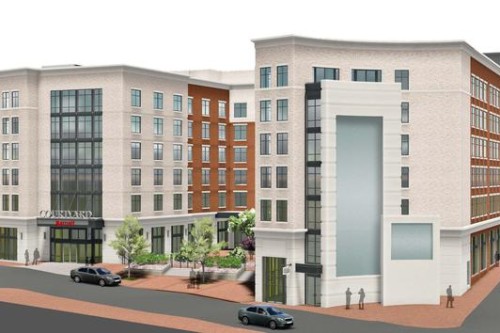
Current: First Freedom Center

Image

A major new development is headed for Richmond in the form of the First Freedom Center and Hotel. The building, which was approved by city council on Monday (the 23rd), will be built on the corner of 14th and Cary Street in Shockoe Slip. This site is now used as surface parking but it was once home to the State’s Capitol building where the Virginia Statute for Religious Freedom was signed into law.

The building will include a Courtyard Marriott and an extended stay Residence Inn which, together, will total 210 rooms. In addition, the First Freedom Center will occupy some of the building’s first floor. A monument to the important legislation passed on the site will occupy the corner while a the two wing hotel will take up the remaining space, leaving a plaza facing Cary Street. The building will permanently close a block-long section of Virginia Street, a historic cobblestone street that predates Richmond’s gridded city plan. Baskervill is the project’s architect; construction is set to begin in early 2013.

Check back for more coverage as this project develops.

D.OK.

Scott House


Architect: Noland and Baskervill
Date: 1911
Address: 909 West Franklin St

The Scott House (formerly the Scott-Bocock House) is a truly Richmond structure, its decades of history almost as impressive as the grand neoclassical façade. Elizabeth and Frederic Scott bought the property from Lewis Ginter in 1903, and soon thereafter commissioned the popular firm of Noland and Baskervill to design the magnificent estate. The couple is buried at Hollywood Cemetery and their daughter, Elisabeth Scott Bocock, moved into the house in the mid 20th century. While there, she founded the Historic Richmond Foundation, the 2300 Club, and the Hand Workshop (now known as the Visual Arts Center of Richmond). In the 1960s, the house was subdivided and used as dorms for VCU students, which continued into the 90s. A renovation in 2004 led to the Scott House opening its doors to the public, and the designation of the building as a Virginia Historic Landmark.

The historic Marble House in Newport, Rhode Island was chosen as inspiration for the Richmond structure, which was itself modeled after the Petit Trianon in Versailles. It stands proudly removed from West Franklin, an exception to the block’s density. The stately house, a handsome combination of limestone and terra cotta, is grounded by green-tiled wrapping terraces and a porte-cochére, shaded by trees in the house’s garden. Oxidized copper and careful cast iron work beautifully balance the gravity of the building’s exterior. Oversized fluted columns with Corinthian capitals give the mansion a sense of monumentality.

The interior is a classic example of the American Renaissance style, originating in the 18th century. The occupant moves through the public, symmetrically divided rooms with no hallways on the first floor, structured around a main entrance stair which lies under a magnificent stained glass dome. Servants’ quarters are to the rear of the building, and a large English style carriage house is hidden behind the mansion. The Anderson Gallery, constructed in 1888 from the former Ginter House stables, also stands behind the Scott-Bocock House. The splendor of the structure is a reminder of Richmond’s insurance-and-banking glory days in the early 20th century, when it was an indulgent capital of the South.

M.F.A

Bank of America Center


Architect: Welton Becket Associates

Dates: 1971-1974
Address: 1111 E. Main St.

Still playing a role in Richmond’s skyline, the Bank of America Center was the tallest building in the city upon its completion in 1974. In addition to its height, the project is a symbol of its time in other ways. The building is an example of what Richmond considered to be progress in the mid to late 20th century. In order to create the tower, a half block of historic iron front buildings were demolished in spite of a long, bitter fight put up by preservationists.

Fortunately, the First Merchant’s Bank (the original tenants) had the sense to commission a competent architectural firm to fill the gap. Los Angeles based Welton Becket Associates managed to design a structure that was at once forward thinking and sensitive to the site’s past and surroundings. First and foremost, it maintained a significant frontage on Main Street. In fact, the low Main Street wing of the tower’s base may be the complex’s most successful element. The precast concrete bands and gentle massing blur the line between neighboring historic iron fronts and the blatantly modern high rise complex. The concrete elegance of the base continues up the tower maintaining an acute attention to detail; the building looks good from up close or far away.

The tower itself sits back from the corner to create a public space. Most large developments in downtown Richmond in the later half of the 20th century were forced to include a certain amount of public space by the city government. This planning misconception is responsible for some areas of Richmond’s downtown appearing more like an inflated suburban office park than a city. While there are far too many plazas and courtyards in our downtown and far too little street interaction, the Bank of America Center is an example of one of the better site plans. The courtyard is rarely inhabited but at least it is set off from the street. The space fronting Main Street is somewhat populated and pleasant, mostly because of surrounding dining establishments and food carts.

The building’s chief failure, in terms of urban interaction at least, is its presence on Cary and 12th Streets. The poetry of a blank wall is part of the modern movement but the broad swaths of concrete on these streets, interrupted only by security cameras and parking entrances, feel more unconsidered than intentionally unadorned. The corner at 12th and Cary Streets is particularly egregious. An intersection that now contains retail on three corners is left unresolved by the austere insensitivity of the tower’s base. What’s more, the intersection serves as a critical link between the vibrant Shockoe Slip and its struggling neighbor, the financial district. One wonders if it would be possible to redevelop this corner in a manner more befitting its site.

D.OK.

University of Richmond

Westhampton Lake as seen from the Student Commons

Architect: Cram and Ferguson, architect; Carneal and Johnston, associate architect; Warren Manning Associates, landscape architect.
Date: 1914
Address: 28 Westhampton Way 

Many Richmond commercial and residential areas developed westward after the installation of electric streetcars in 1888. The University of Richmond, which was located near the intersection of today’s Lombardy and Grace streets, established a sprawling, 200-acre suburban campus at the terminus of the Westhampton trolley line. The move allowed for the introduction of a women’s campus as well as expansive new sports facilities. The Boston architecture firm of Cram, Goodhue and Ferguson attempted to establish a cloister-like environment in the Gothic Revival style. This approach had already garnered the firm praise for its designs at the United States Military Academy at West Point and at Princeton University. For the Richmond campus, however, due to budget restrictions, the firm substituted brick and cast concrete where it would have preferred to use stone. Cram completed eight initial buildings including Ryland Hall, the refectory, the stadium, Jeter and Richmond dormitories, North Court (the woman’s Westhampton College), the power plant and Millhiser Gymnasium. With World War I occurring soon after the campus was completed, however, construction was halted for a number of years and the Cram firm never returned.

Over the ensuing decades, planners and architects strayed from Cram’s vision of a cloister-like monastery in the wooded countryside: Instead they created a more picturesque setting with Westhampton Lake as the centerpiece. However, with the exception of a brief flirtation from the 1960s to ‘80s with modernism and post-modernism, in the 1990s the university resumed building, (almost slavishly) in the collegiate Gothic mode. The best of the most recent buildings include Weinstein Hall (which houses the political science department) by SMBW.

E.S.

Model Tobacco Building

Architect: Schmidt, Garden and Erikson
Date: 1940
Address: 1100 Jefferson Davis Highway (U.S. Route 1)

Nowhere in Richmond do building location, architecture and unifying graphics come together more powerfully and memorably than at the Model Tobacco building, a former factory that is one of six buildings in an industrial neighborhood of South Richmond.
This six story, red brick and glass building was designed by the Chicago architecture firm of Schmidt, Garden and Erikson (a firm that designed some 300 hospitals in other parts of the nation).

The sleek building is obviously meant to be “read” from vehicles at modest highway speeds. The elongated ribbon windows on the street side lend an enhanced sense of horizontality to the building’s street façade. The corporate name, “Model Tobacco,” rendered in nine foot high, aluminum, and sans serif Futura characters (that project slightly above the roofline) can be seen from some distance away.

If the visionary architects of the German Bauhaus sought to establish unity of function, architectural design and graphic identity, this modernistic building would be their poster child.

The landmark, alas, awaits a new use.

E. S.

Maggie L. Walker Governor’s School

Architect: Carneal, Johnston and Wright, Restoration by BCWH with Saddler and Whitehead
Date: 1938, expansion in 1963, restoration in 2002
Address: 1000 N Lombardy St

Maggie Walker High School’s creation and image is the result of several incidents occurring at the same time. In 1934, a city icon in Maggie L. Walker passed, and Richmond wished to honor her name in some way. Virginia Union University sold recently vacated land to the city, and a new facility was required for the city’s black youth, segregated under the “Jim Crow” laws. These circumstances, in concurrence with the height of the art deco period, were the causes that brought Carneal, Johnston and Wright’s high school to become one of the most significant educational buildings in the city.

The same architects’ extensive expansion in 1963 added to the original plan of two joined Y shapes and the building today exists largely as a realization of these two efforts. Limestone and concrete are paired handsomely with a dark red brick, while lime green accenting, glass block and subtle art deco ornamentation complete the sophisticated structure’s image.

The school’s interior plan is regular and predictable, a classically symmetrical arrangement that lends a navigable yet repetitive experience. Staircases hinge the building’s wings on the ends that house classrooms, while larger program such as the auditorium, gym, common room and cafeteria are clustered in the center.

While the iconic elevation of Maggie L. Walker High School is its grand entrance on Lombardy Street, the opposite entrance is the most heavily trafficked, and another common vista is from the I-95 overpass, above the athletic fields and parking lot north of the school.

The high school began as exclusively African American, but a historic documentation and restoration from Sadler and Whitehead with BCWH in 2002 opened the doors for the Governor’s School of Government and International Studies. Hopefully this sensitive modern restoration signifies the school as an important Richmond landmark that must be cared for, and one that will last.

M.F.A