Opinion: Egyptian Buidling

Architect: Thomas S. Stewart
Dates: 1845
Address: 1200 E. Marshall Street Richmond VA
 

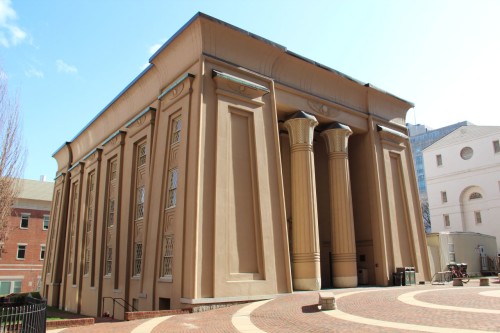
We often look at buildings, if only subconsciously, as what we want them to be. In the case of the Egyptian Building, the preserved, ‘un-ruined’ nature, coloring and stereotyped images could easily be perceptually subverted to tackiness, a tawdry example of American Egyptomania. But it is important to distinguish mere Egyptian flair on a piece of architecture from a building whose design intent was dedicated to authentic principles. This is one such structure. The building sacrifices a large amount of natural light in an effort to emulate the heavy stone construction of Ancient Egypt, and continues Egyptian motifs continuously throughout the interior. (It’s definitely worth it to venture inside if you haven’t yet.)However the building isn’t completely true, as it is made of brick, cast iron and stucco. The southern and northern faces display a line of rhythmic windows, a hint to the contemporary uses and technologies. But this intervention doesn’t diminish the quality of the Egyptian identity. It rather proposes an intriguing duality and informs the viewer that the building, whose image is borrowed from the past, is used for contemporary operations.

It is interesting and possibly rare that the dominant face of an Egyptian style building, a typology known for its monumentality, faces a relatively small courtyard and is opposite another structure much larger in scale. The approach to the entrance also increases its mystique as a heroic yet hidden piece; as tucked away as is possible for a building in a downtown and guarded by a fence, the structure sits with a quiet power.

Perhaps it is this small scale and starkly juxtaposed surroundings that allow the Egyptian Building to achieve an endearing uniqueness as opposed to an overindulgent nostalgia. There’s nothing inherently wrong with employing techniques and aesthetics of another culture or time, if the execution is tactful and the purpose is justifiable. In 1845, the Medical College of Virginia could easily have erected a nondescript, brick building whose legacy would fade into the vast collage of Richmond’s history. Instead, a cultural icon exists, speaking to the spiritual and esoteric power of MCV and the field of medicine in general. A boldly different yet sensitive Richmond landmark is known, not as a surgery theater, but simply as The Egyptian Building.

M.F.A.

MeadWestvaco Corporate Headquarters

Architect: MSTSD Architects, Atlanta
Dates: 2010
Address: 501 South 5th Street

In 2010, MeadWestVaco, a Fortune 500 paper and packaging company, moved its corporate headquarters to Virginia and with it came the construction of a new office building in downtown Richmond. A riverfront site was selected to give the company an iconic presence in the skyline as well as views and scenic beauty.The mid-rise project incorporates a modern reflective blue curtain wall facing the river. Floor to ceiling glass graces open work-spaces and conference rooms. The faces of the building directed to the north and east receive a different treatment. Here, horizontal bands of windows and concrete alternate and the solidity of this mass attempts to relate to the existing cityscape. The building features green technology landing it a coveted LEED silver certification.

Most streets are confronted with the somewhat neglected lower reaches of the facade or its parking facilities, the exception being the building’s frontage along Tredegar street. The glass prism at the corner with 7th Street forms a welcoming entrance to the building as does the terraced landscaping (courtesy of Higgins & Gerstenmaier) further down the block. Unfortunately, both of these spaces are for employees only.

The building occupies approximately 40% of the large, irregular block on which it is located and includes both above-ground and underground parking. It does not incorporate mixed public uses such as retail. As such, it makes few strides in activating the urban space on the south side of the downtown expressway. Further development is anticipated in the area surrounding MWV in the form of Foundry Park, a mixed use development along the river.

D.OK.

Main Street Station

Architect: Wilson, Harris and Richards
Dates: 1901
Address: 1500 East Main St

Known simply as The Clock Tower to many passing its ornate tower on Interstate 95, the Renaissance Revival train station in Shockoe Bottom stands as an historic and current icon of Richmond. Built in 1901 as the city’s premiere railroad destination servicing Seaboard Air Line and Chesapeake and Ohio Railroad, the station was designed by the Philadelphia firm of Wilson, Harris and Richards, who were experienced in train station designs. The station stood as Richmond’s gateway for 50 years, before train lines switched to the former Broad Street Station in the 1950s.

During the years that train service was absent from Main St Station, the building passed through many hands and potential uses, including a mall, nightclub, and offices for Virginia Department of Health. Flooding in 1972 and fires in 1976 and 1983 only helped deter a developer’s long term commitment to the site. However the architectural value of the building didn’t waver, and it was designated a National Historic Landmark in 1976. Extensive renovations starting in 2001 modernized and secured some structural systems (such as lack of a steel skeleton supporting the second story and some of the headhouse floors being made of coal ash) with the vision that the station would be utilized in the near future.

For those pedestrians walking under Interstate 95 or drivers passing the building on Main Street in Shockoe Bottom, it is not the clock tower but a grand staircase that welcomes them to the station, lifting the heavy stone base. A Pompeian brick body rests above, seven bays wide with terra cotta accentuations. The loggia, complete with Corinthian capital columns and carved roses on the lower face of the arches, is capped by a steeply pitched red clay tile roof with two rows of dormers. The bright orange and red colors of the building’s skin announce its presence vibrantly in Richmond’s downtown collage. The train shed behind the station is also of significant engineering merit for being one of the last gable-roof train sheds in America as well as one of the first to employ the widespread steel truss system and boasts the largest intact train trestle system in the country, upon which the platform rests.

In 2003, Amtrak resumed train services to Main St Station, and there are currently plans to develop the stop along the high speed Northeast Corridor. There are also tentative plans for a retail intervention in the train shed with an exterior plaza.

M.F.A.

Sources:
Revitalizing America’s Train Stations. (n.d.). Richmond – main st station history. Retrieved from http://www.greatamericanstations.com/Stations/RVM

Science Museum of Virginia

Architect: John Russell Pope
Dates: 1917-1919
Address: 2500 West Broad St

Now known as a primary educational and cultural feature of the city, the inscribed words  “Union Station of Richmond” upon the Science Museum’s facade underneath a grand clock recall the honored past of the proud neoclassical edifice as a beacon for transportation, a gateway to the city. Prior to its use as a train station however, the site was used for Civil War military encampments, state fairs, and grounds for professional baseball teams. Purchased by Richmond, Fredericksburg and Potomac Rail Lines, the company originally envisioned a leisurely commuter station for the site, but an international competition in 1913 gave way to a design by the famous architect John Russell Pope, his only commission for a commercial building.

Pope emphasized the grandeur of the station by placing it back from the street, creating a promenade up the slight slope. Similar to many neoclassical buildings of the same scale, a monumental doric colonnade of Indiana limestone is symmetrically organized by a 100 foot high dome. This is balanced with steel and cast iron canopies and bracings, forming a grand yet refined composition.

Train services boomed during World War II, with 57 trains passing through the station every day. But ridership declined, and train services eventually migrated to Staples Mill Rd. The building was sold to the state of Virginia in 1976, who planned to demolish it with intentions of building a new office park, before successful preservation efforts intervened and the Science Museum of Virginia found a permanent home.

Major draws of the museum include a massive pendulum suspended from the domed rotunda and an attached IMAX theater to the west of the building. Notable instances of architecture also occur outside the building proper, with the grounds in front boasting the world’s largest Kugel as well as the site for each annual Solar Decathlon House designed by Virginia Tech architecture students. Behind the museum, a small part of the original train yard remains with a small car, used mainly for parties and events, a vestige of the building’s former life.

Sources:
Mebane, L. (2009, December 30). History of broad st station. Retrieved from http://sciencemuseumofvirginia.blogspot.com/2009/12/history-of-broad-street-station_9387.html

nps.gov. (n.d.). Broad st station. Retrieved from http://www.nps.gov/nr/travel/richmond/BroadStreetStation.html

Opinion: Does Richmond Need a New Coliseum?

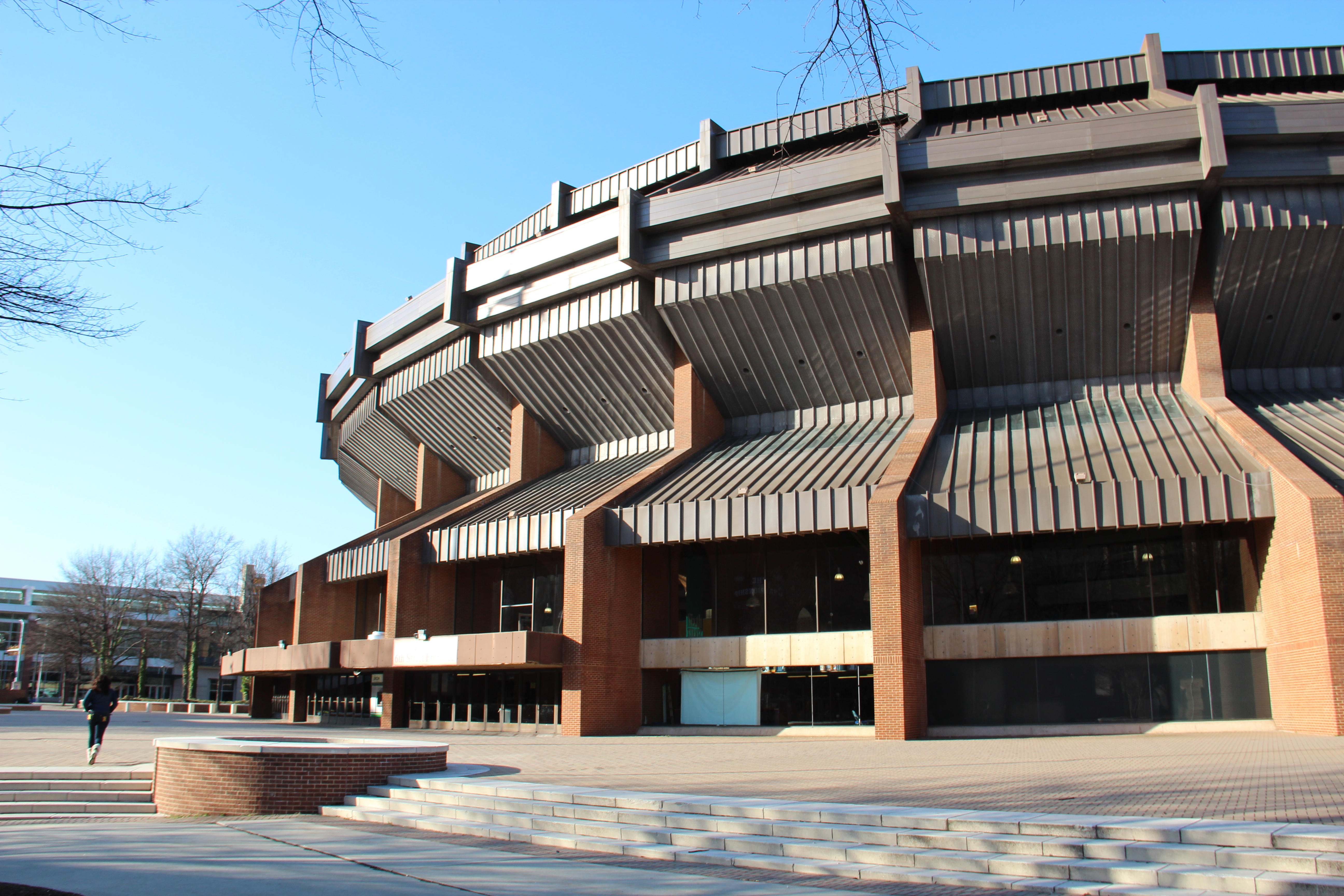
The success of the VCU basketball program seems to have enlivened an old debate in Richmond: what should be done about the Coliseum? Should it be renovated to included more amenities? Should it be replaced entirely?

A recent Richmond Times-Dispatch article mentioned a number of visitors who think the Coliseum needs to be torn down and replaced. Reasons given included lack of electrical outlets in the rest rooms, too few score boards, and small display screens. These problems can all be corrected by renovations and relatively minor ones at that. More serious problems that were mentioned included wider seats and escalators (though the arena already has ample elevators) but even these could be worked into the existing structure. Some have said that it would be easier to simply replace the coliseum than to improve it. My reasons for disputing this claim are three fold.

First, the Coliseum is a valuable piece of architecture. Some may find it bizarre but it is nothing short of distinctive. The interior curving hallway with its textured brick arches are a wonderful caprice. The stadium itself is intimate and brings its spectators uncommonly close to their center of attention. Furthermore, it is representative of an original and interesting period of architecture in Richmond’s history.

Secondly, we must consider not only the benefits of the new coliseum but the fate of the old one. Theoretically, the new coliseum will be constructed on a different site a few blocks to the east (between 8th and 10th and Leigh and Marshall) leaving our current coliseum to be destroyed. What will happen to this site? Infill is certainly possible, but how likely is it that this space will be built on or used effectively in the coming years? It may be over a decade until the neighborhood, which already features many empty lots, is saturated enough to induce a developer to build there. From the time of the new coliseum’s construction until then, there would be a gaping, two-block hole in the urban fabric of an already sensitive neighborhood.

The third and final reason is cost. The estimated cost of the hypothetical new coliseum would be around 150 million dollars so I will use that figure for reference. Let us consider what advantages we would get from this new coliseum. In addition to the improvements mentioned above, the number of seats would move from 13,410 to around 14,000-15,000: still not enough to host the Atlantic Coast conference tournament. 150 million dollars would essentially buy us only a few hundred more seats if used for this purpose as the other changes could be made for a small fraction of this cost.

An important question is, what (if anything) could be done with this money? Baltimore’s light rail system provides a poignant example. It’s cost averaged under 20 million dollars per mile. At that rate, the 150 million used for Richmond’s new coliseum could pay for two light rail lines, one spanning from the border of the west end and the museum district to Church Hill along Broad St. and the other spanning from Carytown to Shockoe Bottom along Cary. We must ask ourselves which option would bring more economic and urban growth in our city. Would we rather have a new, yet similar stadium which may host a few more events or a mass transit system which will encourage urban development on a large scale and make the city more attractive to potential tourists, residents, and businesses of all types? To me the answer seems clear.

D.OK.

Aforementioned Times-Dispatch Article:

http://www2.timesdispatch.com/business/2012/mar/05/tdmet01-even-visitors-say-richmond-coliseum-needs–ar-1740184/

Richmond City Hall

Architect: Ballou and Justice, renovation by SMBW architects
Date: 1971
Address: 900 East Broad Street

While opinions of City Hall cover a vast range, the particularity of its image is difficult to ignore. Built in 1971, it was the tallest building in Virginia for four years. Deteriorating structural conditions of its facade of marble and granite prompted a re-cladding of the exterior by local firm SMBW. This resulted in an award winning project of an aluminum-based facade, keeping the original intent and personality of City Hall while improving on its structural concerns.

The building sits on a four story plinth of black marble, raised above the street level and contained by planters. A large glass canopy is suspended over the entrances, drawing the pedestrian under and into the center of the building. As a form, it is a fairly straightforward skyscraper of uniform sides, divided into quadrants internally. But the structure manages to stand out distinctly on the Richmond skyline through the recognizable recessed windows and emphasized spandrels, an image enabled by the detached perimeter columns from the exterior curtain wall system. The overhanging roof, service box above and antenna give it the vague appearance of a slowly moving massive ship on the horizon.

In total, City Hall contains more than 800 employees; 18 departments and agencies in addition to offices for the city government, mayor, city council and school administration comprise the 21 story building. Some of the best views of the city can be found from its lookout on the top floor, publicly accessible and free of charge.

M.F.A.

Sources:
Hart, S. (n.d.). Born again: A new skin offers a new start. Architectural Record, Retrieved from http://archrecord.construction.com/features/green/archives/0505edit-1.asp

Egyptian Building

Architect: Thomas S. Stewart
Dates: 1845
Address: 1200 E. Marshall Street Richmond VA

Among all the buildings in Richmond, the Egyptian Building is certainly one of the most fascinating. The building was erected in 1845 as the home for Hampden-Sydney College’s Medical school, the first in the south. It is currently part of the campus of the Medical College of Virginia (a branch of Virginia Commonwealth University) and is the emblem of the campus.

The building was designed by Philadelphia architect Thomas S. Stewart in the Egyptian revival style. Egyptian imagery is common in the field of medicine as the first physician in western history is often cited as Imhotep, also the first recorded architect of the west. Egyptian forms had been adapted for funerary and medical buildings previously but MCV’s Egyptian Building took this influence uncommonly far.

The building is filled with glyphs, antiquated symbols, and even quotes from hymns praising the gods Aten and Amun. It’s facade is not merely an Egyptian entry sutured onto a neoclassic building but rather a complete egyptian expression. Its obelisk gate, battered walls, papyrus columns, monumental windowless surfaces, and harsh contrast between shadow and highlight create a convincing Egyptian effect. Rarely do people guess from a photograph that the building is five stories high due to its deceivingly sculptural facade.

The building has remained in continuous use since its completion and it’s unique architectural qualities have landed it on the list of National Historic Landmarks. While both of those accolades are strong indicators, nothing could more meaningfully convey the building’s significance than a remark by Dr. Wyndham Blanton at a Founder’s Day function in 1940. He stated:

“It is a shrine, a sanctuary of tradition, the physical embodiment of our genius. It is a spiritual heritage. In a world often accused of cold materialism, with an ideology of human self-sufficiency, and an adoration of objects that can be handled and seen, there is a need for things of the spirit, if science is to do more than make life safer, longer and more comfortable.”

D.OK.